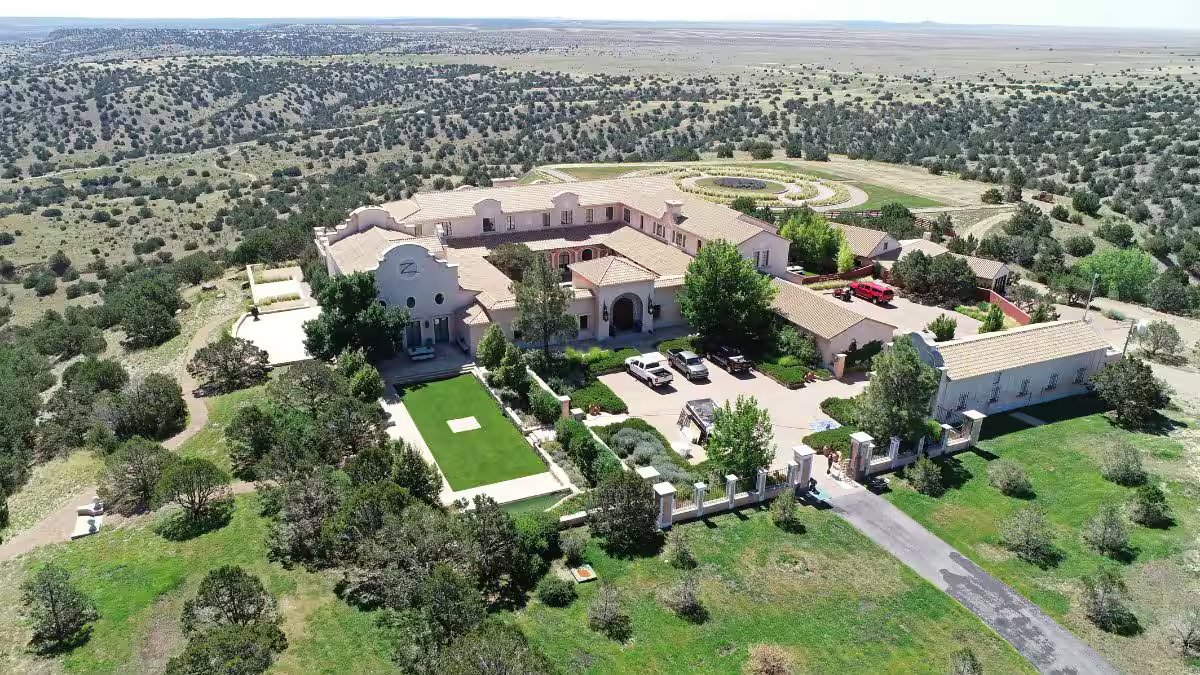
New Mexico has reopened one of the most disturbing chapters of the Jeffrey Epstein scandal by authorising what state lawmakers describe as the first full, independent investigation into alleged criminal activity at his sprawling desert property known as Zorro Ranch.
The move comes following the release of millions of Epstein-related documents by the US Justice Department, which brought fresh attention to his political connections, business relationships and activities in New Mexico.
The bipartisan inquiry is designed to piece together what occurred at the ranch over decades, why law enforcement agencies failed to build a complete public record of alleged abuse at the site, and whether state institutions allowed Epstein to operate with impunity.
While rumours have long circulated about extreme crimes at the property, lawmakers say the mandate of the investigation is strictly evidentiary and focused on survivor testimony, official records, and institutional accountability, rather than unverified claims.
The commission has been granted subpoena authority and a multi-million-dollar budget, and its findings are expected to inform potential prosecutions and legal reforms in New Mexico.
Why has New Mexico ordered a truth commission now?
The decision to establish a four-member “truth commission” followed months of political pressure.
Lawmakers from both parties supported the legislation creating the commission, which passed the New Mexico House of Representatives unanimously.
The panel has been given subpoena powers and a budget of more than $2 million, with some lawmakers citing a figure of $2.5 million allocated to its work. The commission is expected to begin taking testimony immediately, issue interim findings by July, and submit a final report before the end of the year.
The panel is chaired by state Representative Andrea Romero, a Democrat from Santa Fe, and includes Democratic Representative Marianna Anaya of Albuquerque, Republican Representative William Hall, a retired FBI agent from Aztec, and Representative Andrea Reeb, a former district attorney from Clovis.
Together, they are tasked with identifying guests at Zorro Ranch, examining whether public officials were aware of alleged abuse, and assessing whether any state agencies failed in their responsibilities.
Romero has said survivors have already indicated that alleged sex trafficking activity extended to the ranch and that federal investigations in the past did not establish an official record of what happened there.
In her words, “We’ve heard years of allegations and rumors about Epstein’s activities here. But unfortunately, federal investigations have failed to put together an official record. This truth commission will finally fill in the gaps of what we need to know.”
Romero, who co-sponsored the legislation, has also argued that Epstein appeared to face no meaningful oversight in New Mexico for years.
“He was basically doing anything he wanted in this state without any accountability whatsoever,” she said, adding that testimony gathered by the commission could later be used in prosecutions.
According to an email which formed the latest cache of the Epstein files, two girls were sexually assaulted, killed and buried near the ranch under orders from Epstein.
Part of the email read, “The material below was taken from Jeffrey Epstein home as my insurance in case of future litigation against Epstein. SORRY NO QUESTIONS. What is damning about Jeffrey Epstein is yet to be written. Did you know somewhere in the hills outside the Zorro, two foreign girls were buried on orders of Jeffrey and Madam G? Both died by strangulation during rough, fetish sex.”
What is known about Epstein’s activities at Zorro Ranch?
Epstein purchased the remote property in 1993 from former New Mexico governor Bruce King. Over time, he expanded it into a high-end compound that included a 26,700-square-foot hilltop mansion, guest houses, and a private runway that allowed visitors to fly in directly.
The ranch, located roughly 30 to 35 miles south of Santa Fe, became known locally by a nickname that reflected its reputation for secrecy and excess.
Multiple civil lawsuits have accused Epstein of sexually assaulting underage girls at Zorro Ranch over a period stretching back to the 1990s. Despite these allegations, he was never charged in New Mexico for offences linked specifically to the property.
Romero has said there is no public record of federal law enforcement conducting a thorough search of the ranch, even though one allegation refers to abuse of a 16-year-old girl there as early as 1996.
Epstein’s death in 2019 in a New York jail — which authorities ruled a suicide — cut short the possibility of a full federal trial on sex trafficking charges. That outcome left unresolved questions about the scope of his operations in New Mexico and whether local or federal authorities missed opportunities to intervene earlier.
In 2019, then-New Mexico attorney general Hector Balderas initiated a state probe into Epstein’s activities. That inquiry was later paused at the request of federal prosecutors, who cited concerns about parallel investigations. Balderas has said the state stepped back to avoid interfering with federal proceedings.
More recently, New Mexico attorney general Raúl Torrez assigned a special agent to follow up on any allegations that may emerge from testimony before the truth commission. His office has also pursued financial inquiries linked to Epstein’s business dealings in the state.
In 2023, those investigations led to agreements with two banks that committed $17 million toward efforts aimed at preventing human trafficking, according to a spokesperson for Torrez’s office.
Lawmakers backing the commission say one of their priorities is to examine whether Epstein was properly registered as a sex offender in New Mexico after his 2008 guilty plea in Florida for soliciting prostitution from a minor, and whether any failures in that process allowed him to continue moving freely in the state.
What do we know about survivor accounts at the Zorro ranch?
Survivor accounts are expected to form the backbone of the commission’s work. Victim advocates have welcomed the inquiry, arguing that experiences tied to New Mexico were often overshadowed by investigations centred on Epstein’s properties in New York and the Caribbean.
Attorney Sigrid McCawley, whose firm has represented hundreds of Epstein survivors, has
said many of her clients had experiences at Zorro Ranch and that local politicians and other figures were aware of what was happening in the state.
She noted that among those abused at the ranch was
Virginia Giuffre, who later became one of the most prominent public voices accusing Epstein and his associates.
Several women described their experiences at the ranch during the sex-trafficking trial of Ghislaine Maxwell. Jane, the first accuser to testify at that trial, said she met Epstein in 1994 while attending the Interlochen Center for the Arts.
According to her testimony, Epstein and Maxwell obtained her mother’s contact details, invited them for tea after she returned home, and began drawing her into their circle. Jane said Epstein started abusing her when she was 14.
She told the court that she travelled with Epstein and Maxwell to New York City and to New Mexico, and described being summoned to Epstein’s bedroom at the ranch. “I just remember someone, at one point, just came into [my] room and said: ‘Jeffrey wants to see you,’ and then escorted me to see him,” she said.
“I just, as usual, felt, like, my heart sink into my stomach, you know.” She added, “I did not want to go see him.”
Another accuser, Annie Farmer, told the court that Maxwell gave her a nude massage at the ranch when she was 16. She testified that Epstein joined her in bed the following morning, saying he wanted to cuddle.
“He pressed his body into me,” Farmer said, adding that she felt frozen and later told Epstein she needed to use the restroom in order to escape.
A third woman, identified in court filings as Jane Doe, alleged she met Epstein during a school trip to New York City and that his secretary photographed her and told her Epstein wanted to meet her. She later received an email stating that Epstein was interested in her after seeing the photographs.
Jane Doe said she and her sister were invited to a magic show in Las Vegas and then flown on Epstein’s plane to New Mexico, where several young girls were present. At the ranch, she said she was taken to Epstein’s bedroom, where he demanded a massage and later assaulted her with a device.
Giuffre has also stated that she was abused at Zorro Ranch and provided photographs of herself there in court documents filed in 2015. She has alleged that Epstein trafficked her to powerful men at the property, including the late former New Mexico governor Bill Richardson.
In an unsealed 2016 deposition, Giuffre said Maxwell instructed her to give Richardson a “massage” at the ranch, a term she later explained in her memoir was code for sexual activity. Richardson’s representative responded in 2019 that the allegations were “completely false.”
Who visited the Zorro ranch?
Records unsealed in recent years, along with statements from individuals who interacted with Epstein,
provide details about how guests and workers were brought to Zorro Ranch.
The ranch manager told the FBI in 2007 that Epstein arranged for guests and “masseuses” to be flown to the property and that local massage therapists were also hired.
According to the manager, many of the masseuses were sourced locally through the Santa Fe spa Ten Thousand Waves or via referrals. A spokesperson for Ten Thousand Waves has said the spa neither provided nor referred masseuses to the ranch.
In the documentary series Surviving Jeffrey Epstein, former Santa Fe massage therapist Rachel Benavidez accused Epstein of sexually abusing her when she was hired to work at the ranch.
The recently released Epstein files also detail interactions with business figures and academics. Investment consultant Joshua Ramo has said he visited the ranch once in 2014 for a lunch meeting involving professors from Massachusetts Institute of Technology and Harvard University.
Ramo, who was then the chief executive of Kissinger Associates, said he later met Epstein around 14 times in New York between 2013 and 2016 with business figures and scientists present.
Reflecting on those interactions, Ramo said, “I deferred to the due diligence of the institutions involved, assuming that his presence signaled he had been appropriately vetted. I feel a deep sense of grief for the survivors of his crimes.”
Emails in the Epstein files show Epstein contacted Ramo in 2015 to say he was going to Ten Thousand Waves and suggested meeting for lunch in Santa Fe. Ramo replied, “I assumed we were meeting at the pink bottom ranch.” He later said he did not recall that comment or whether the two met that day.
Over time, Epstein also cultivated political relationships in New Mexico. He donated to the campaigns of Democrats including Richardson and Gary King, a former state attorney general and son of Bruce King.
When those contributions were reported in the press, the recipients pledged to return the money or donate it to charity. Emails show that Gary King flew on a plane chartered by Epstein during his 2014 gubernatorial campaign, with Epstein offering to pay roughly half of the $22,000 cost of the flight.
What role did authorities play?
One of the central aims of the truth commission is to examine whether state and federal agencies failed to act on warning signs connected to Epstein’s presence in New Mexico.
Lawmakers have questioned why Epstein was not registered as a sex offender in the state after his 2008 conviction in Florida, and whether any officials knowingly overlooked allegations tied to Zorro Ranch.
US Representative Marianna Anaya has urged people with knowledge of abuse or facilitation at the ranch to come forward, emphasising that responsibility may extend beyond Epstein himself.
“That perpetrator could not act alone. They could not run a sex ring alone, they could not commit these types of financial crimes alone. So we know as a commission that enablers must also be held accountable, including the state itself, if needed,” she said. “If you do want to share, we’ll be here and we will be operating with confidentiality.”
Anaya has also noted that parallel legislation to extend New Mexico’s statute of limitations for childhood sexual abuse — which would have allowed Epstein survivors to bring civil claims — was rejected by a state House committee.
Lawmakers raised concerns about the potential financial impact on public institutions facing abuse lawsuits, particularly increased insurance costs.
The truth commission is expected to scrutinise why earlier inquiries did not result in searches of the ranch or formal charges tied to alleged abuse there.
What is the status of the Zorro Ranch today?
After Epstein’s death, his estate sold Zorro Ranch in 2023, with proceeds directed toward creditors. The buyer was the family of Texas businessman and politician Don Huffines, a Republican candidate for the office of state comptroller.
Huffines has said on social media that the property has been renamed San Rafael Ranch, after a saint associated with healing, and that his family intends to operate a Christian retreat there.
Huffines has also said that any request from law enforcement for access to the property would be met with full cooperation.
Lawmakers have noted that, while ownership has changed, the commission’s mandate includes examining historical activity at the site and whether any physical or documentary evidence remains relevant to alleged crimes.
The commission is not empowered to seize property but can compel testimony and documents, and refer potential criminal matters to prosecutors.
Legislators backing the inquiry have said the goal is not to stigmatise the current owners but to ensure that the historical record surrounding the ranch is properly established.
What outcomes could follow from the inquiry?
The truth commission’s findings could lead to several outcomes, including referrals for criminal investigations, recommendations for changes in state law, and proposals to improve how New Mexico handles allegations of sexual exploitation and trafficking.
Lawmakers have said the inquiry is intended to close legal and institutional gaps that may have allowed Epstein to operate in the state without effective oversight.
Testimony gathered by the panel may be used in future prosecutions if new evidence emerges. The commission is also expected to make recommendations on inter-agency coordination, record-keeping, and the handling of allegations involving powerful individuals.
Victim advocates have argued that the investigation represents a rare opportunity to centre survivor experiences in New Mexico and to confront the state’s role in a global scandal.
They say that, for years, attention focused on Epstein’s Caribbean island and his Manhattan townhouse, while the ranch remained a peripheral footnote despite repeated allegations of abuse there.
Also Watch:
With inputs from agencies
End of Article