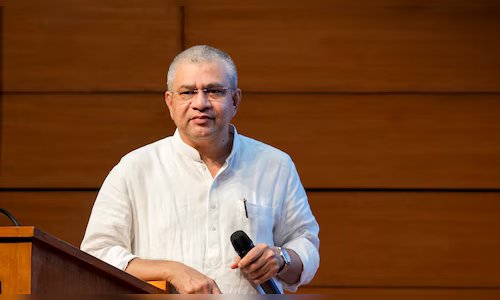
Speaking at the World Economic Forum in Davos, Vaishnaw said India’s position in the global semiconductor space has changed significantly over the past few years. He said the country has moved from scepticism to strong global confidence.
Recalling his first visit to Davos in 2022, the minister said India’s semiconductor plans were then viewed with doubt. “That scepticism has now turned into optimism,” he said, adding that several global leaders indicated that “they do not want to miss the boat as India expands its semiconductor ecosystem.”
Vaishnaw further said India’s IT sector is set to undergo a major shift, stating that “the entire IT industry is going to be the largest AI services provider to the world.”
He also announced that Design Linked Incentive (DLI) 2.0 is currently under development and will be rolled out as part of the broader Semicon 2.0 programme. “In Davos had a semicon roundtable, every industrial leader expressed strong satisfaction at India’s Semicon program,” he said.
Vaishnaw outlined six core domains that will form the foundation of India’s semiconductor design strategy. These include compute systems and microcontrollers, radio frequency (RF), cyber-secure networking, power management, sensors and memory.
He said gaining strength in these areas will allow India to design chips for a wide range of products, including drones, automobiles and space technologies.
Vaishnaw said India is steadily emerging as a global hub for semiconductor design talent, asserting that 50% of the world’s semiconductor design work will eventually be carried out from India.
He added that Semicon 2.0 aims to develop advanced manufacturing capabilities, including the ability to produce 3-nanometre (3nm) chips domestically by 2032.
The minister also announced the launch of Deep Tech Awards to recognise start-ups working in advanced technology areas such as semiconductors and space. The first edition of the awards will be held in November 2026.


