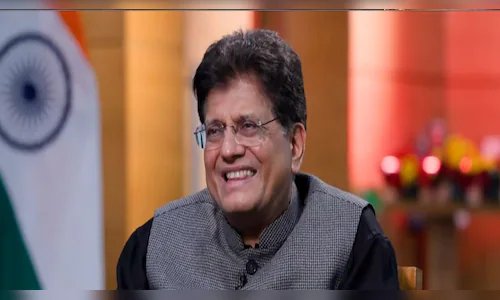
In an exclusive chat with CNBC-TV18, Goyal said companies remain confident about accessing skilled talent when required. He added that changes in global work models after the pandemic, along with the rise of Global Capability Centres (GCCs) in India, have reduced dependence on relocating employees overseas
“H-1B lost its significance significantly post-COVID. We’ve already seen the impact of that with the growing number of GCCs that are now operating in India,” he said.
India currently hosts around 1,800 GCCs. According to Goyal, global companies are increasingly using offshore delivery models instead of moving employees to high-cost locations such as the US, UK, or major global cities.
He added that GCC growth supports domestic income, tax collection, investment flows, and foreign exchange earnings, as employees continue to live and work in India while serving global markets.
He also noted that the visa programme may become more focused over time. “Some people also told me it will become better, because a lot of the fringe applications will go out, and serious players will now be looking for entry of their people into the US to serve high-tech products and high-tech requirements.”
Also Read | How US-India trade deal will affect imports, exports and industries, explains Piyush Goyal
These are edited excerpts of the interview.
Q: The joint statement is done. I think investors and exporters would now want to know when the 18% tariff rate becomes effective.
A: Since we had the weekend, Saturday and Sunday, after the joint statement was issued, I would suspect any day during this week, the executive order to reduce tariffs to 18% should be coming out.
Q: So, does this mean that with that executive order, the rate would immediately come down to 18% for trade?
A: That is right.
Q: Would it require a signing?
A: It would require a signing by the Honourable President of the United States of America. But now, having entered into the framework agreement and all terms being finalised, I see no difficulty in that.
Q: So, are you also expecting a visit from the United States to somehow jointly announce this deal? Or are you going to the US?
A: We will have our teams now put the entire documentation in legal format so that we can sign the interim trade agreement, or the first tranche of the bilateral trade agreement, for which I have invited the United States Trade Representative (USTR), my good friend Ambassador Jamieson Greer, to visit India. He has indicated that he would accept the invitation, and maybe sometime in mid-March, he will be visiting India.
Q: So, for Indian exporters, that would be the date, possibly, when the new tariffs will become effective?
A: No, the 18% would become effective immediately. There are other areas of concessions, some areas where we’ve got a zero-reciprocal tariff. Those will become effective after the execution of the interim agreement.
Also Read | Russian oil purchases is not part of the India-US trade deal: Goyal
Q: Over the last year, there was uncertainty about the trade deal, and that was impacting investor sentiment towards India. The stock market sentiment was also impacted to some extent. What would be your expectation now?
A: The Indian economy powers on. It is the fastest-growing large economy. Companies are reporting huge demand. January performance numbers should come out quite well in terms of volumes. Recently, I was told that steel mills are working at full capacity. I was told auto stocks are all sold out. There’s no inventory at the dealer’s end. Cement stocks were down for just about a week or a few days.
The indications which I have received from the market, public sources, and industry clearly reflect that there is a good amount of enthusiasm in the marketplace. The execution and finalisation of the EU trade deal, coupled with the US trade deal coming in quick succession of each other, I’m sure will give a big fillip to the Indian growth story.
Q: Speaking about the executive order, which was issued almost simultaneously by the White House along with a joint statement, it is said that India has committed to stop, directly or indirectly, importing Russian oil and will purchase products from the United States. Could you give us a sense of what’s the understanding? Our Russian oil purchases have been coming down.
A: This is a subject that doesn’t get included in the trade deal, nor do I handle it. I think it would best be answered by the Foreign Office. We have already made certain clarifications in this regard.
Q: I’ll just persist for one more moment, because the executive order also speaks about monitoring mechanisms, and it makes the elimination of the 25% ad valorem duty contingent on stopping the purchase of Russian oil. So how are we going to handle this? Because the US will be monitoring whether we are buying directly or indirectly.
A: I think this is best answered by the Foreign Office, because I wouldn’t know exactly what they mean by this comment and whether any discussions have been held.
Q: Are we going to be working on trying to get concessions from the US on areas which are under Section 232?
A: This is the first tranche of a potential bilateral trade agreement, and we will continue to work with the US to see areas of mutual benefit, which can be considered in the final bilateral trade agreement. And we will certainly be taking up Section 232 tariffs in the course of those discussions.
Also Read | Zero Russian oil unlikely despite India-US trade deal, indicates former HPCL chief
Q: H-1B was an area of concern. The US has imposed additional restrictions on the H-1B program. Has that been a part of your talks? And would you be taking this up in further negotiations?
A: I have not discussed H-1B visas with my counterparts so far. I had discussed this with our Indian industry, and they don’t seem to be perturbed at all about the restrictions on H-1B. They are very confident that wherever they require it, they will get it. In fact, some people also told me it will become better, because a lot of the fringe applications will go out, and serious players will now be looking for entry of their people into the US to serve high-tech products and high-tech requirements.
Having said that, I personally think H-1B lost its significance significantly post-COVID, when we all saw that working from home, we could do a lot of work. We’ve already seen the impact of that with the growing number of GCCs that are now operating in India. Almost 1,800 GCCs now operate in India. The world and large corporations recognise that you could do the same work from any other offshore location, instead of getting people into very high-cost economies like the US. Getting anybody to the UK, London, or New York, or any such place, is a very expensive proposition.
So, a lot of work is being outsourced to their GCCs, which is great news for India, because the people stay in India with their families. They earn in India. They pay taxes in India. They spend in India, adding to our economy and economic activity. They save in India, invest in India, and we also earn foreign exchange.
For the full interview, watch the accompanying video
Catch all the latest updates from the stock market here