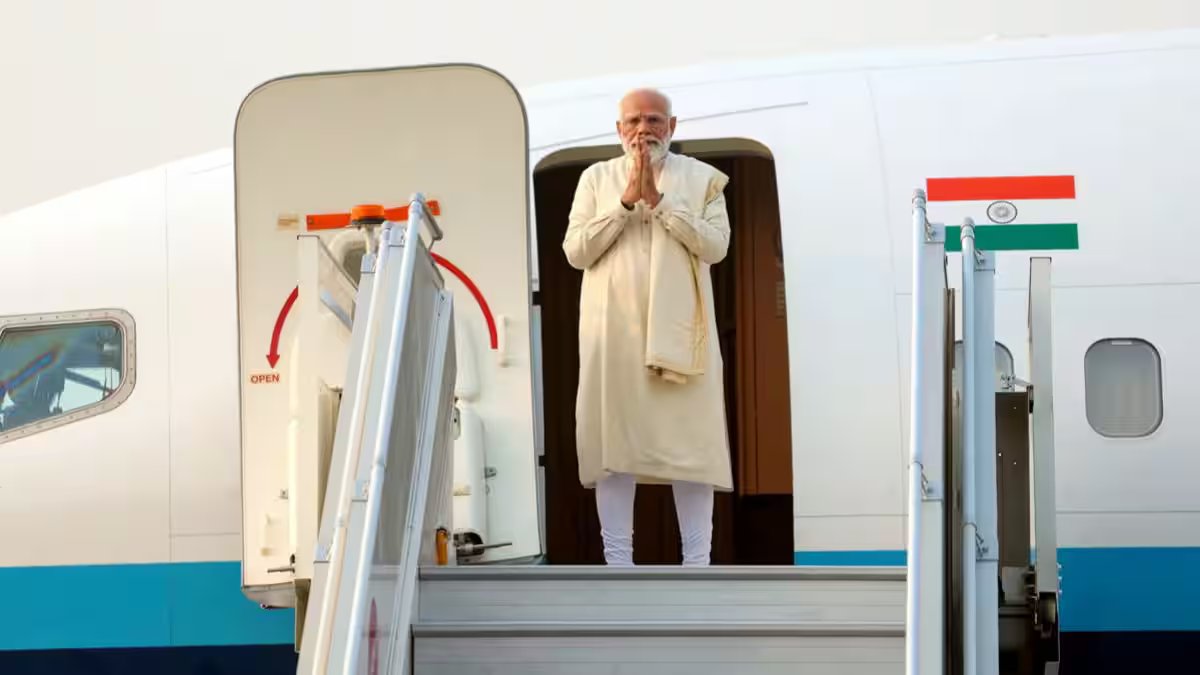
Prime Minister Narendra Modi’s 2025 was defined by high-stakes international visits that yielded long-term results for India’s geopolitical standing and furthered the country’s position as the voice of the global south.
PM Modi’s international itinerary was designed in such a way that he covered every strategic location in the world. His trips were testimony to India’s ability to maintain ties with allies at a time when uncertainties plague the world.
Here’s a rundown of the Indian prime minister’s international tours in 2025:
US and France
US: PM Modi began the year
with a visit to the US, shortly after the inauguration of Donald Trump’s second presidency. In fact, PM Modi was one of the first foreign leaders to step into the White House at the start of a new term in America.
The trip was dubbed as a productive and substantive meeting by both Indian and US officials. Trump held a four-hour-long conversation with PM Modi, signalling the priority both leaders hold for India-US ties.
At their Oval Office meeting, the two leaders agreed to launch a new target dubbed “Mission 500,” aimed at more than doubling bilateral trade to $500bn by 2030. The US is currently India’s largest trading partner, with two-way trade totalling $129.2bn in 2024. They also agreed to negotiate the first phase of a multi-sector Bilateral Trade Agreement by the fall of 2025, committing to appoint senior representatives to push the talks forward.
France: Before heading to the US, PM Modi attended the
AI Action Summit in France, where he met French President Emmanuel Macron. PM Modi co-chaired the summit with Macron, demonstrating India’s advancement towards artificial intelligence and other tech developments.
During his visit, PM Modi inaugurated the Indian Consulate in Marseille alongside Macron. India and France agreed on a wide range of initiatives covering technology, innovation and sustainable development. The two sides issued a declaration on artificial intelligence, committing to promote safe, secure and trustworthy AI systems while supporting the UN’s 2030 Agenda for Sustainable Development.
They also launched the logo for the India–France Year of Innovation 2026, signed a letter of intent between India’s Department of Science and Technology and France’s INRIA to establish an Indo-French Centre for Digital Sciences, and reached an agreement to host 10 Indian startups at the French startup incubator Station F.
Mauritius
A month after his successful trips to the US and France,
PM Modi flew down to Mauritius in March, where he was invited to attend the island country’s National Day celebrations. Mauritius Prime Minister Navin Ramgoolam conferred PM Modi with the country’s highest award, the Grand Commander of the Order of the Star and Key of the Indian Ocean. PM Modi was the first Indian national to receive the honour.
PM Modi attended the Mauritius National Day celebrations as the Chief Guest, underlining the strong diplomatic and cultural ties between the two nations. Notably, Mauritius holds a crucial place in India’s diplomatic and cultural ties, with historical connections dating back nearly two centuries.
PM Modi inaugurated over 20 India-funded projects, ranging from capacity building to community-linked infrastructure, during his
two-day state visit. Modi and Ramgoolam jointly inaugurated the Civil Services College building, which was built at a cost of around $4.75 million. The project was initiated through an MoU signed in 2017.
Thailand and Sri Lanka
In April, PM Modi commenced a two-nation tour, starting in Thailand and ending in Sri Lanka. The visits marked New Delhi’s dedication to being the voice of the Global South.
Thailand: PM Modi went on a
two-day visit to Thailand, where he attended the 6th Bimstec Summit. It was the first bilateral visit by an Indian prime minister to Thailand in over a decade. At the summit, PM Modi met Nepal’s former Prime Minister K P Sharma Oli and Bangladesh Chief Adviser Muhammad Yunus. His meeting with Yunus amid India-Bangladesh tensions was the highlight of the summit.
Apart from the summit, PM Modi’s visit also gave
India and Thailand an opportunity to review their relationship. Thailand is the 3rd largest economy in ASEAN and India’s 4th largest trading partner after Singapore, Indonesia and Malaysia in the ASEAN region.
PM Modi and his Thai counterpart Paetongtarn Shinawatra (former PM of Thailand) underlined the need to enhance connectivity, health, science and technology, start-up, innovation, digital, education, culture and tourism collaborations.
Sri Lanka: During his visit to
Sri Lanka, PM Modi discussed progress in cooperation outlined in the Joint Vision for “Fostering Partnerships for a Shared Future,” which was established during the Sri Lankan president’s visit to India, the Ministry of External Affairs (MEA) said in a statement.
PM Modi, who last visited Sri Lanka in 2019, also engaged with senior dignitaries and political leaders. He travelled to Anuradhapura to inaugurate development projects funded through Indian financial assistance.
Earlier, Sri Lanka’s president had made his first overseas visit to India after assuming office.
Saudi Arabia
PM Modi’s two-day state visit to
Saudi Arabia from April 22-23 marked his third trip to the kingdom as PM and the first to Jeddah in over four decades. He co-chaired the second meeting of the India-Saudi Arabia Strategic Partnership Council (SPC) with Crown Prince Mohammed bin Salman (MBS), reviewing progress in political-security, economic, investment, energy, technology, agriculture, and cultural ties.
The visit expanded bilateral cooperation into defence, space, cybersecurity, and emerging technologies like AI and semiconductors, with new ministerial committees added under the SPC for defence and tourism. Agreements
included four MoUs, a preliminary pact on peaceful space activities, and pledges for joint efforts in maritime security, counter-terrorism, and green energy.
Cyprus, Canada and Croatia
Cyprus: PM Modi’s visit to
Cyprus in June 2025 was historic, marking the first by an Indian PM in over two decades. He held talks with President Nikos Christodoulides, received the Grand Cross of the Order of Makarios III, Cyprus’s highest civilian honour, and addressed business leaders in Limassol on trade, fintech, renewable energy, and digital innovation.
Key outcomes included an
MoU between the Cyprus Stock Exchange and India’s NSE for dual listings in GIFT City, pledges for defence cooperation, counter-terrorism, maritime security, and support for the India-Middle East-Europe Economic Corridor (IMEC)
Canada: The prime minister’s visit to Canada centred on attending the
51st G7 Summit in Kananaskis, Alberta, as a guest leader following his Cyprus. Discussions focused on global issues like terrorism, economic corridors, and India’s role in sustainability, with emphasis on strengthening
India-Canada ties amid recent strains.
Croatia: PM Modi’s visit to
Croatia, part of his European engagements around mid-2025, aimed to deepen bilateral ties in defence, trade, and tourism. He met Croatian leaders to discuss EU-India relations, energy cooperation, and cultural exchanges, building on historical friendships. Outcomes included agreements on mobility, innovation, and potential direct flights to boost people-to-people links.
Ghana, Trinidad and Tobago, Argentina, Brazil and Namibia
In one of his longest foreign visits, PM Modi embarked upon a five-nation tour in July, starting from an African nation and ending in another African country.
Ghana: PM Modi’s visit to
Ghana strengthened India-Africa ties through talks on trade, defence, and digital infrastructure, with multiple MoUs signed on agriculture, health, and capacity building.
Trinidad and Tobago: His trip to the
Caribbean nation highlighted diaspora engagement, cultural exchanges, and economic pacts in energy and pharmaceuticals, marking a milestone in Caribbean relations.
Argentina: PM Modi’s
Argentina trip focused on defence cooperation, lithium mining investments, and trade diversification amid South American outreach.
In Brazil, he attended the
BRICS Summit, pushing for reformed global governance, green energy, and enhanced bilateral trade targets.
The
**Namibia** visit emphasised uranium supply deals, development aid, and strategic minerals partnership for India’s energy security.
UK and Maldives
PM Modi visited the UK on July 23-24, 2025, at the invitation of Prime Minister Keir Starmer. The highlight was signing the landmark
India-UK Comprehensive Economic and Trade Agreement (CETA), reducing tariffs on goods like automobiles, whisky, textiles, and electronics while securing visa concessions and professional qualification recognition for Indians.
PM Modi also met King Charles III, launched the India-UK Vision 2030 for future ties in defence, technology, and climate, and announced £6 billion in investments creating 2,200 UK jobs.
PM Modi proceeded to the Maldives on July 25-26 as the chief guest for the 60th Independence Day, hosted by President Mohamed Muizzu. He inaugurated India-funded projects, held talks strengthening economic and maritime security cooperation, and reaffirmed India’s
‘Neighbourhood First’ policy amid warmer bilateral relations. The visit underscored enhanced people-to-people ties and development partnerships.
Japan and China
Once again circling back to Asia, PM Modi flew down to Japan and China from August to September. His visit to China was perhaps a watershed moment for the country’s ties with India following years of diplomatic tensions.
PM Modi visited Japan for the 15th
India-Japan Annual Summit with Prime Minister Shigeru Ishiba. Key highlights included unveiling a Joint Vision for the Next Decade across eight pillars like economy, technology, and people-to-people ties, a Joint Declaration on Security Cooperation, frameworks for digital innovation, clean energy, critical minerals, and space, plus Japan’s 10 trillion yen private investment pledge over a decade.
The prime minister then attended the Shanghai Cooperation Organisation
(SCO) Summit in Tianjin, China, from August 31 to September 1, 2025, at
President Xi Jinping’s invitation. The trip focused on reviewing bilateral ties, advancing economic and investment collaboration in AI and semiconductors, strengthening SCO commitments for regional peace and cooperation, and bilateral meetings with leaders like Xi and Putin.
Bhutan
During a two-day state
visit to Bhutan, PM Modi assured the country of India’s “unwavering support” to Bhutan’s 13th Five-Year Plan. He emphasised India’s commitment to actively assist Bhutan in achieving its key development priorities and advancing sustainable growth across sectors.
Modi participated as the Guest of Honour in the
birthday celebrations of Jigme Singye Wangchuck, the fourth King of Bhutan (1972-2006) and father of the current monarch. He also took part in the ongoing Global Peace Prayer Festival in Thimphu.
He held meetings with Jigme Khesar and Bhutanese Prime Minister Tshering Tobgay and discussed key areas of bilateral cooperation and regional and global issues of mutual interest.
South Africa
PM Modi went to South Africa in November to attend the
G20 Summit, where he held important bilateral meetings with the UK’s Starmer, Malaysian Prime Minister Anwar Ibrahim, French President Emmanuel Macron, South Korean President Lee Jae-myung, Brazilian President Luiz Inacio Lula da Silva and UN Secretary-General António Guterres.
The Prime Minister’s meeting with South Korean President
Lee Jae-myung was their second this year. PM Modi said it reflected “the strong momentum in our Special Strategic Partnership,” adding that both sides discussed ways to deepen economic and investment linkages.
Following his meeting with Brazilian President Lula da Silva, Modi said India and Brazil would “continue to work closely to boost trade and cultural linkages for the benefit of our people.” He also described his discussion with UN Secretary-General António Guterres as “very productive.” Modi later shared a family photo with fellow
G20 leaders, posting, “Together, we reaffirm our shared commitment to global progress and prosperity.”
End of Article