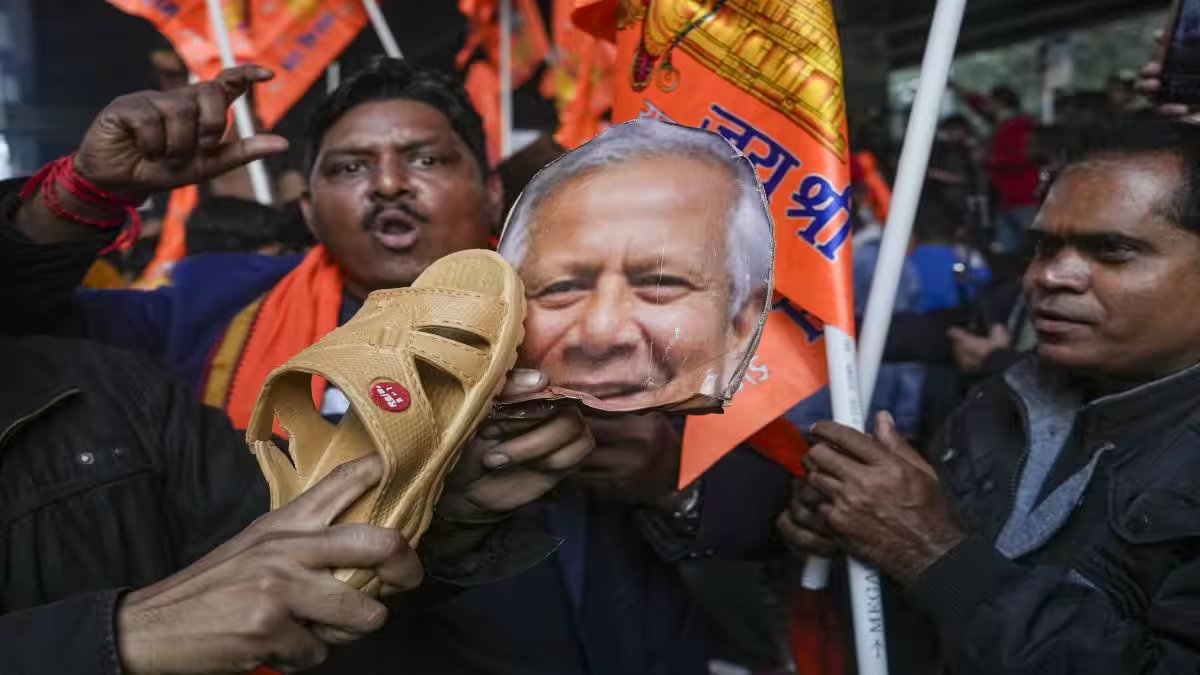
Ties between India and Bangladesh have been tense since the ouster of former Prime Minister Sheikh Hasina in 2024. However, over the past few days, the relations have nosedived even further. On Monday (December 22), Dhaka suspended visa services at its high commission in New Delhi and its mission in Tripura, citing “unavoidable circumstances”.
The move comes in the wake of unrest across India’s neighbouring country following the death of
Sharif Osman Hadi, a leader of the protests that led to the ouster of Sheikh Hasina’s Awami League government in 2024.
For analysts, while the move may be temporary, it also indicates how difficult ties are between the two nations.
Bangladesh suspends visa services for Indians
On Monday, the
Bangladesh High Commission in New Delhi suspended consular and visa services, stating: “Due to unavoidable circumstances, all consular and visa services from the Bangladesh High Commission in New Delhi are temporarily suspended until further notice. Any inconvenience caused is sincerely regretted.”
#WATCH | Delhi: A notice has been put up outside the Bangladesh High Commission.
The notice reads, “Due to unavoidable circumstances, all consular & visa services from the Bangladesh High Commission in New Delhi are temporarily suspended until further notice.” pic.twitter.com/1wW9jEtElw
— ANI (@ANI) December 22, 2025
The assistant high commission of Bangladesh in Tripura also made a similar announcement on the suspension of visa services, while a private operator tasked with processing visa applications in West Bengal’s Siliguri also suspended its services.
The move comes amid the fresh wave of unrest in Bangladesh over the death of student leader Sharif Osman Hadi last week. Hadi was a prominent face in the anti-government protests that forced the collapse of the Sheikh Hasina government last year.
A tit-for-tat move by Bangladesh
While Bangladesh hasn’t put out a proper explanation for its move, many in India see it as a reciprocation of
New Delhi’s decision to suspend visa services from Bangladesh’s port city of Chittagong.
Earlier on Sunday (December 21), the Indian Visa Application Centre, Bangladesh, had cited a “security incident” for suspending services. “Due to a recent security incident at AHCI (Assistant High Commission of India) Chittagong, Indian visa operations at IVAC Chittagong will remain suspended from 21/12/2025 until further notice,” it said. “The announcement for reopening the visa centre will be made after reviewing the situation,” it said.
India’s decision to temporarily suspend visas came after a group of angry Bangladeshi protesters tried to storm India’s assistant high commission in Chittagong. Many of the protesters at the site alleged that
Osman Hadi’s attackers had fled to India after the shooting, even as Bangladesh has not produced any evidence to back this claim.
Protests in Bangladesh as well as in India
The suspension of visas on both sides is only one part of the larger issue though. Following the shooting of Osman Hadi, both countries have seen anger spill out on the streets.
In Bangladesh, the unrest took an ugly turn last week when a young garment factory worker, Dipu Chandra Das, was reportedly lynched and killed by a mob in Bhaluka, in Bangladesh’s Mymensingh district. According to Mymensingh Additional Superintendent of Police Abdullah Al Mamun, factory officials initially claimed Dipu was attacked over alleged “derogatory remarks about the Holy Prophet Hazrat Muhammad (PBUH)” in a Facebook post. However, investigators found no evidence that the victim had posted or written anything on Facebook that could have hurt religious sentiments.
Dipu’s brother, Apu Chandra Das, said the killing has left his family fearful of their lives. “He (Dipu) is left behind by a small child. If we had the facility, we would love to leave Bangladesh now, and if we get help, we would like to go back to India,” Apu told News18.
Separately, several buildings in Dhaka — including those housing the country’s
two leading newspapers, The Daily Star and _Prothom Al_o — were reportedly set ablaze.
And on Monday, the Indian state of Kolkata also witnessed angry protests outside the High Commission of Bangladesh over the lynching. Led by BJP leader and Leader of Opposition in the West Bengal Assembly Suvendu Adhikari, along with other party leaders and supporters, demonstrators staged their protest in front of the High Commission, condemning the killing and demanding accountability from the Bangladeshi authorities.
Speaking during the protest, Adhikari stated that Dipu Das was brutally killed and warned of intensified agitation, noting that the incident had deeply angered the Hindu community.
He further announced a one-hour border blockade on December 24 in protest of the murder, and that another demonstration will take place outside the Bangladesh High Commission on December 26.
“Dipu Das was burnt alive. We will not allow them to sit here (Bangladesh High Commission). They will have to lock this up. The whole Hindu community will not spare them,” Adhikari was quoted as saying by news agency ANI.
Meanwhile, the All India Medical Students Association (AIMSA) made an urgent appeal to Prime Minister Narendra Modi for “immediate and urgent intervention” to ensure the safety and well-being of Indian medical students currently stranded in Bangladesh. In a letter addressed, AIMSA said it had been receiving “serious and distressing communications” from Indian students and their families, warning that the prevailing situation had left many living under unsafe and uncertain conditions.
No sign of improvement in ties between Bangladesh and India
Ever since Hasina sought refuge in India following her ouster from power in Bangladesh last year, ties between the two countries have been strained.
New Delhi has expressed concerns over attacks on minorities after Mohammad Yunus government was sworn in, while Dhaka said these were internal matters and political in nature, and India should not intervene. Dhaka also spoke of exaggeration of certain incidents and the spread of misinformation and disinformation by sections of the Indian media. Bangladesh has also repeatedly called on India to prevent Hasina from making incendiary comments, arguing that such remarks were creating instability in Bangladesh.
It also requested India to extradite
Hasina after the International Crimes Tribunal sentenced her and ex-minister Asaduzzaman Khan to death.
The suspension of visa services on both sides has also got analysts noting that it may be difficult for bilateral ties to return to normal any time soon. As Sreeradha Datta, an international relations professor at OP Jindal Global University in India, told South China Morning Post, “Though things look difficult and unfriendly, it’s a temporary setback and hopefully both sides will resume their engagement. I expect normalcy will only return after elections are held in Bangladesh.”
With inputs from agencies
End of Article