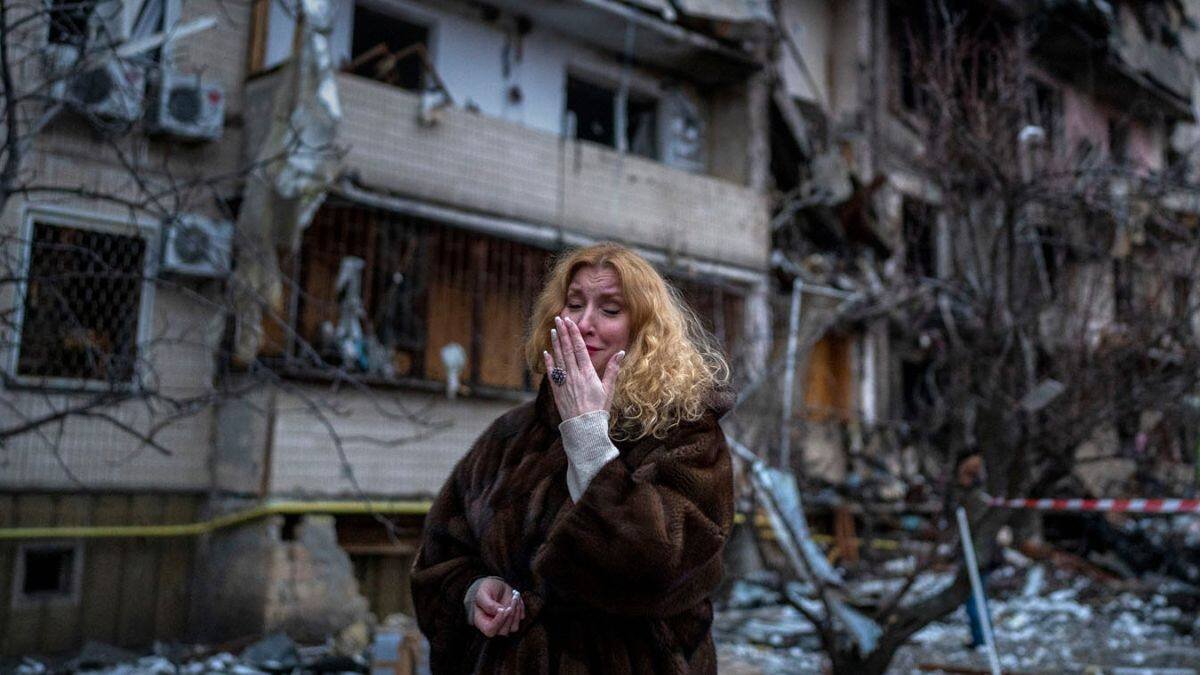
Four years after Russia-Ukraine war, over millions of Ukrainian families remain fractured across Europe. Displaced women and children face the agonising choice between safety abroad and the longing to return home.
Four years into the largest refugee crisis in Europe since World War II, millions of families remain suspended between a homeland under fire and fragile new lives abroad. For many, exile was meant to be brief. Instead, it has become an extended, uncertain chapter defined by separation, adaptation and fading expectations of return.
Living out of suitcases in Poland
Maryna Bondarenko, 51, keeps three suitcases permanently packed in her apartment in Poland. A journalist who fled Kyiv with her son and mother in February 2022, she believed they would be gone for only a few weeks.
Today, she works in a Ukrainian-language newsroom serving a diaspora of more than 1.5 million Ukrainians in Poland. Waves of Russian air strikes and winter blackouts in Kyiv — leaving tens of thousands without heating, power or water — repeatedly forced her to postpone going home.
Her husband, Andrij Dudko, 44, remains in Ukraine, serving as a drone operator on the front line. Under martial law, men of military age are barred from leaving the country, meaning roughly three-quarters of refugees are women and children.
While Polish cities such as Warsaw and Krakow have absorbed large Ukrainian communities, the social integration has not been seamless. Complaints over welfare access and jobs have occasionally stirred tension. Yet for Bondarenko, the greater strain is emotional: a longing for home overshadowed by concern for her son’s safety.
Her 11-year-old, Danylo, now barely remembers life in Ukraine. Though he has faced some hostility at school, Poland increasingly feels familiar, a sign of what prolonged displacement can mean for the next generation.
Caught between worlds
Further south in Istanbul, Iryna Kushnir and Olga Yermolenko — high school friends from Kharkiv — rebuilt their connection after fleeing Ukraine. Turkey hosts far fewer Ukrainians than Central Europe, but for them it has become a place of uneasy stability.
Kushnir, 42, initially expected a swift end to the war. Four years on, she is married to a Turkish citizen and teaches at the Ukrainian department of Istanbul University. Her daughter chose to remain in Ukraine, a decision she respects but which underscores the family’s divided reality.
Yermolenko, 43, works remotely for Ukrainian clients while her 73-year-old mother stays in Kharkiv. She monitors real-time updates of missile attacks and calls immediately when alarms sound. The sense of being “caught between” a previous life and an uncertain future persists.
Ukraine’s leadership has said it hopes a majority of displaced citizens will return once the war ends. But surveys suggest willingness to go back is declining over time, particularly among younger refugees.
As the war grinds on, families from Kyiv to Warsaw and from Kharkiv to Istanbul remain bound by memories, separated by borders and united by an enduring question: when, and to what kind of country, can they finally return?
A generation losing its roots
As the war drags on, the Ukrainian government’s hope that 70% of refugees will return is clashing with a fading sense of belonging among the youth. For children like Bondarenko’s 11-year-old son, Danylo, Ukraine is becoming a hazy memory. Despite facing occasional friction in Polish schools, he identifies more with his current surroundings than his birthplace. “I don’t think that I will return,” he says, a sentiment echoed in declining survey figures of those planning a homecoming.
The ‘between’ life: Adaptation vs. longing
The struggle is not confined to Poland. In Turkey, childhood friends Iryna Kushnir and Olga Yermolenko have built new lives in Istanbul while their hearts remain anchored in Kharkiv. While Kushnir has adapted through marriage and employment at Istanbul University, Yermolenko describes a “strange feeling” of being caught between a past life and an uncertain future.
For these families, the war is a real-time trauma monitored via Telegram channels. They watch missiles fly toward their neighbourhoods on smartphone screens, a digital tether that provides a constant, terrifying connection to a home that grows more unrecognisable every day. As social integration deepens abroad, the “three packed suitcases” represent less of a travel plan and more of a fading hope for a peace that remains elusive.
With inputs from agencies
End of Article