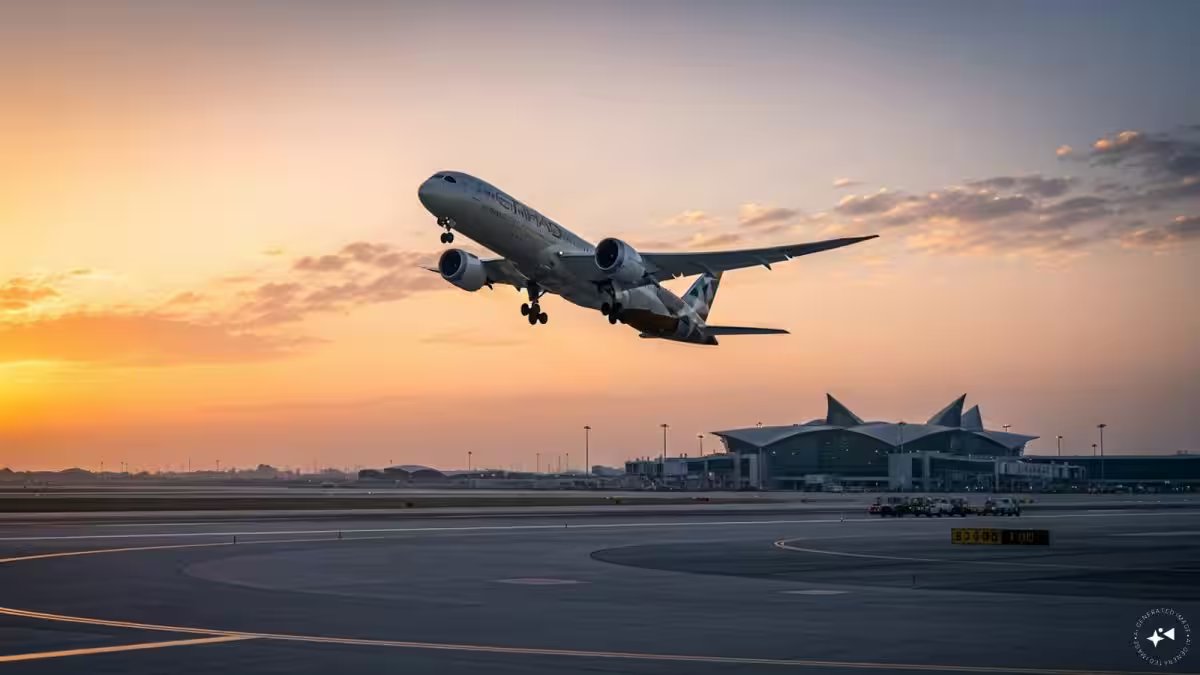
The first passenger flight took off from Abu Dhabi on Monday after Iran distanced itself from recent missile and drone strikes across the Gulf, as Etihad Airways resumed limited operations from Zayed International Airport
The first passenger flight took off from Abu Dhabi on Monday after Iran distanced itself from recent missile and drone strikes across the Gulf, as Etihad Airways resumed limited operations from Zayed International Airport.
The first passenger flight just took off from Abu Dhabi. pic.twitter.com/HMUNd5Pd0z
— Flightradar24 (@flightradar24) March 2, 2026
Flight tracking service Flightradar24 showed departures to London Heathrow, Paris, Amsterdam and Moscow.
The first aircraft, EY67 to London Heathrow, departed at 2:39 pm local time (11:39 am CET) and quickly became the most tracked flight on the platform.
Earlier in the day, at 1:44 pm local time, the airline had posted on social media that all flights to and from Abu Dhabi were suspended until 2 pm local time on Tuesday, 3 March.
However, a source at Zayed International Airport told Euronews that services were being restored to select destinations, including Mumbai, Karachi, Delhi and Cairo.
Etihad is expected to operate up to 15 flights on Monday afternoon. Services had been suspended since Saturday amid escalating regional tensions linked to the conflict involving Iran.
Local authorities have not formally announced the reopening of airspace. Etihad’s decision contrasts with Emirates and Qatar Airways, which have kept aircraft grounded. The airline has said it intends to resume normal operations at 2 pm on Tuesday, with Monday’s limited departures understood to prioritise passengers stranded in transit since the weekend.
Meanwhile, Iran’s Foreign Minister Abbas Araghchi indicated that recent missile and drone strikes across parts of the Gulf were not the result of a new political directive from Tehran, but actions carried out under previously issued military orders.
In remarks to Al Jazeera, Araghchi addressed the reported attack on the port of Duqm in Oman — a country acting as an intermediary in sensitive discussions between Iran, the United States and Israel. He suggested some Iranian military units were operating with a degree of autonomy within broader strategic parameters set by leadership.
Reports of fresh explosions emerged for a second consecutive day in Gulf cities including Dubai, Doha and Manama, in addition to Duqm, raising fears of a wider regional confrontation.
Araghchi said Tehran views the conflict as a consequence of actions by Washington and Tel Aviv, urging Gulf states not to pressure Iran to halt operations but to direct diplomatic efforts toward what he described as the opposing side.
While acknowledging unease among neighbouring governments, he said he has remained in direct contact with regional counterparts since tensions escalated, adding that Iranian armed forces have been advised to exercise caution in selecting targets.
With inputs from agencies
End of Article