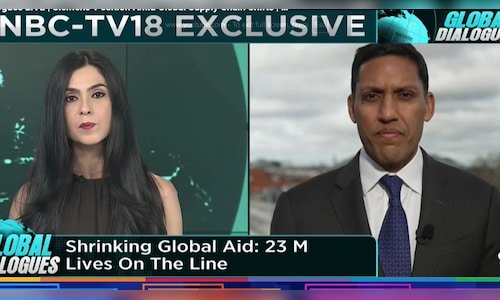
At a time when global funding for humanitarian aid and climate action is shrinking, the world risks weakening its ability to respond to pandemics and food crises, Raj Shah, President of the Rockefeller Foundation, said in an interview with CNBC-TV18. He warned that sustained aid cuts could allow local health shocks to escalate into broader global challenges.
“We are extremely concerned,” Shah said, noting that the pullback from international cooperation is making the world “less safe and less interconnected.” He added that the immediate objective is to bring greater attention to the consequences of shrinking aid budgets and to ensure policymakers understand the long-term risks.
Those risks were outlined in a recent report published in The Lancet Global Health, which estimates that 93 low- and middle-income countries, including India, could see nearly 23 million additional deaths by 2030 if current trends in global aid reductions continue. The analysis was conducted by the Barcelona Institute for Global Health with support from the Rockefeller Foundation, using data from 2002 to 2021.
Read More: Global aid cuts could trigger 22.6 million deaths by 2030: Lancet study
The study modelled two defunding scenarios. An annual reduction of around 10.6% in aid could result in 9.4 million preventable deaths, while sharper cuts of 15% or more — already observed in 2024 and 2025 — could lead to 22.6 million additional deaths, including 5.4 million children under the age of five.
Shah said these findings help clarify what is at stake. “If we were to face a 2008-style food security crisis or a 2014-style Ebola outbreak today, those could become global points of instability,” he said. “We are dismantling the capacity to solve such problems where they occur.”
The issue has gained urgency because 2024 marked the first time in nearly three decades that all major donors — the US, UK and France — reduced foreign aid simultaneously, with further cuts likely in 2026. As a result, humanitarian assistance has become a focus of discussions at the Munich Security Conference, where leaders are increasingly viewing aid through a security lens.
Shah also linked aid reductions with wider economic policy shifts. He said the current tariff environment is adding to pressures faced by poorer countries. “The tariff fight is effectively doubling down on the humanitarian and development pullback,” he said, pointing out that while overall US tariff rates have risen sharply, the poorest countries now face average tariffs of about 27%.
On climate policy, Shah said the decision by US President Donald Trump to roll back a scientific finding that climate change poses a public health risk represents another setback. The move removes emission limits on vehicles, power plants and other major polluters, with the administration arguing it will reduce compliance costs and generate savings of up to $1 trillion. “Ignoring the issue will not make it disappear,” Shah said, adding that global warming has accelerated in recent years.
Private sector seen as a key support
Despite these challenges, Shah said the private sector could play a constructive role, particularly in countries with stronger institutions. In India, he noted, all Rockefeller Foundation initiatives are designed as public-private partnerships.
Its flagship Global Energy Alliance is helping provide reliable electricity to tens of millions of people. In Rajasthan, the foundation is working with an AI company to digitise the state’s power grid using drones, enabling a transition from coal to renewable energy. Farmers are installing solar infrastructure, selling electricity back to the grid and earning feed-in tariffs, which Shah said is improving rural incomes.
However, he cautioned that the situation remains fragile in countries with weaker state capacity. “That’s where the risk of catastrophe lies if another major food crisis or pandemic emerges,” Shah said.