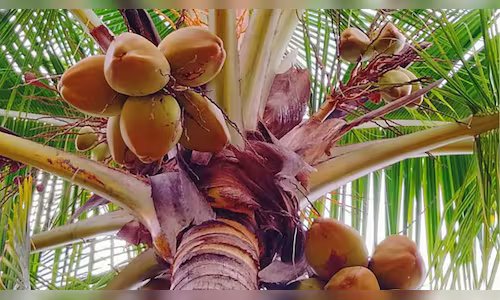
India accounts for over 30% of global coconut production, according to data from the India Brand Equity Foundation (IBEF), making it the largest producer worldwide. The country plays a significant role in the global supply of coconut and coconut-based products, backed by a vast cultivation base, steady growth in exports and an expanding ecosystem of value-added processing.
Top 5 Coconut Producing Countries (2021)
| Rank | Country | Area (‘000 ha) | Production (Million nuts) | Productivity (Nuts/ha) |
| 1 | India | 2,199.00 | 20,736.00 | 9,430 |
| 2 | Philippines | 3,647.00 | 14,717.00 | 4,035 |
| 3 | Indonesia | 3,374.00 | 14,200.00 | 4,209 |
| 4 | Sri Lanka | 444.00 | 3,120.00 | 7,027 |
| 5 | Papua New Guinea | 222.00 | 1,483.00 | 6,680 |
(Source: Coconut Development Board)
The proposed scheme comes amid rising demand for coconut and its derivatives, both domestically and internationally, and is seen as part of the government’s broader push to modernise plantations, improve productivity and support farmers engaged in high-value horticultural crops.
Planting season
The planting season for coconut depends largely on local climatic conditions and therefore varies from state to state. In general, the ideal time for planting is at the advent of the monsoon, which ensures adequate soil moisture for early establishment of seedlings. In areas with assured irrigation facilities, coconut planting can be carried out at any time of the year. However, in low-lying areas, planting is usually recommended either after the monsoon or well before its onset, to avoid water-logging and ensure better survival and growth of young palms.
Coconut cultivation
On the domestic front, coconut cultivation spans a large geographical area. As per the third advance estimate for 2023–24, presented in Parliament by Union Agriculture Minister Shivraj Singh Chouhan on February 4, 2025, the total area under coconut cultivation in the country stood at 23.33 lakh hectares, with total production estimated at 153.29 lakh tonnes.
Also Read: Budget 2026: India bets on cashew, coconut and AI to lift farm incomes
State-wise data from the 2024–25 third advance estimate, released by the Horticulture Statistics Unit of the Department of Agriculture & Farmers Welfare (DA&FW), show Tamil Nadu as the largest producer among the listed states, with production of around 43 lakh tonnes and the highest yield of 8.51 tonnes per hectare, followed by Kerala and Karnataka. Together, these three states account for over 11.7 million tonnes of coconut production.
Coconut production 2024-25 (Third advance estimate)
| State | Area (A) [‘000 Ha] | Production (P) [‘000 MT] |
| Kerala | 765.62 | 3861.72 |
| Tamil Nadu | 505.53 | 4302.07 |
| Karnataka | 600.00 | 3558.46 |
Institutionally, reports suggest that the sector is supported by 203 operational coconut producer societies (CPS) across the country. Over the last five years, 29 new such societies were registered, including nine in Andhra Pradesh, located in East Godavari and Visakhapatnam districts.
The gross value of output (GVO) of coconut at current prices was estimated at ₹27,199.5 crore in 2022–23, as per data from the Ministry of Statistics and Programme Implementation. Andhra Pradesh accounts for about 5% of the total cultivated area and 8% of national coconut production, contributing nearly 10.2% of the total GVO during 2022–23.
Coconut exports
Over the years, India’s coconut exports have shown steady growth. IBEF noted that between FY16 and FY22, total coconut exports grew at a compound annual growth rate (CAGR) of 13%. The upward trend continued in subsequent years, with coconut exports crossing $452.19 million in FY23, marking a 9.8% increase over the previous year.
The momentum has remained strong in the current fiscal. During the first eight months of FY25, exports of desiccated coconut surged 300% to $9.6 million, while fresh coconut exports rose 12.7% to $16.4 million. Exports of copra also increased by 10% to $16.6 million, highlighting growing overseas demand across multiple coconut product categories.
India’s expanding export footprint is also linked to the rising demand for a wide range of coconut-based value-added products. These include coconut chips, coconut milk, coconut sugar, coconut water, tender coconut water, coconut honey, coconut jaggery, coconut milkshakes, coconut snacks, virgin coconut oil and coconut natural cream. According to IBEF, the export growth in these segments has contributed to higher employment generation in processing, packaging and allied activities.
India currently exports coconuts and related products to more than 140 countries. The major importers include Vietnam, the United Arab Emirates, Bangladesh, Malaysia and the United States. In FY21, exports to these five countries together accounted for 66% of India’s coconut exports. Vietnam emerged as the largest importer, with shipments valued at $29.6 million, followed by the UAE at $16.61 million, Bangladesh at $14.63 million, Malaysia at $11.27 million and the US at $5.84 million. Vietnam alone accounted for 25% of India’s coconut exports, while the UAE and Bangladesh contributed 14% and 12%, respectively.
India’s export diversification has also evolved over time. In 2016, the country began exporting coconut oil to markets such as Malaysia, Indonesia and Sri Lanka, countries from which it had earlier imported the product.
In the same year, India also commenced large-scale exports of desiccated coconut to the United States and Europe, following initiatives undertaken by the government in coordination with the Coconut Development Board (CDB) to support farmers in production, processing, marketing and exports of value-added coconut products.
The main destinations for coconut oil exports from India include the UAE, Saudi Arabia, the US and Vietnam, with the fastest growth during FY20 seen in Saudi Arabia, the US and Vietnam.
Also Read | Union Budget 2026 boosts farmers with ₹1.63 Lakh crore allocation to Agriculture



Casinosugarrush, my sweet tooth is tingling! Hoping to score some sweet wins here. Gonna try my luck and see if I can hit the jackpot. Wish me luck everyone!casinosugarrush
37×333, That’s a catchy name! I hope to have some fun in this game. Come and join me:37×333
777gamescom… not bad! I like the selection of games. Everything loaded quickly, and I had a good overall experience. I’ll be back for more! Give 777gamescom a look, gamers!