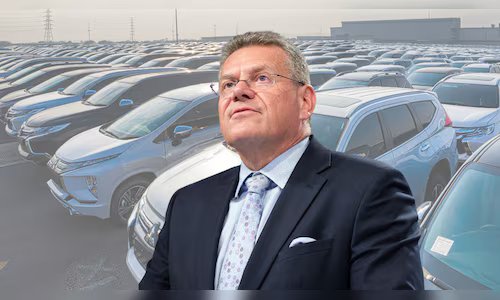
The newly concluded India-European Union Free Trade Agreement is set to significantly reshape the automobile sector, with sharp tariff reductions and quota-based market access for carmakers on both sides, according to EU Trade Commissioner Maroš Šefčovič.
Speaking exclusively to CNBC-TV18, Šefčovič said the auto sector was a central pillar of the agreement, given its importance to European manufacturing powerhouses such as Germany and its growing significance in India’s domestic market.
Under the deal, European carmakers will receive export quotas covering fully built units (CBUs), completely knocked-down (CKD) units and components. At the same time, Indian automakers will benefit from quotas that are expected to be around 2.5 times larger than the general EU quota, offering wider access to European markets.
Šefčovič said the quota system would not be rigid, with the agreement including a review clause to allow adjustments in line with evolving market dynamics.
The trade pact also delivers a sharp reset in tariffs. Duties on European cars imported into India will fall from the current 110% to 35%, and will eventually be reduced further to 10% after a transition period. Tariffs on CKD units will be cut from 16% to 8.25%. The transition timelines will vary for internal combustion engine vehicles and electric vehicles.
He noted that around 90% of India’s car market is priced below €15,000 (about ₹16 lakh), while European carmakers’ quotas will largely apply to vehicles priced above that threshold.
For Indian automakers, the agreement opens a clearer path into Europe. EU tariffs on Indian-made vehicles will be reduced from 10% to zero over a transition period, with tariff cuts for Indian electric vehicles scheduled to begin at a later stage.
‘Mother of all deals’
Europe and India are making history today.
We have concluded the mother of all deals.We have created a free trade zone of two billion people, with both sides set to benefit.
This is only the beginning.
We will grow our strategic relationship to be even stronger. pic.twitter.com/C7L1kQQEtr
— Ursula von der Leyen (@vonderleyen) January 27, 2026
The EU and India formally concluded the Free Trade Agreement on January 27, with European Commission President Ursula von der Leyen describing it as the “mother of all deals”. The pact is expected to become operational after ratification, likely by early 2027.