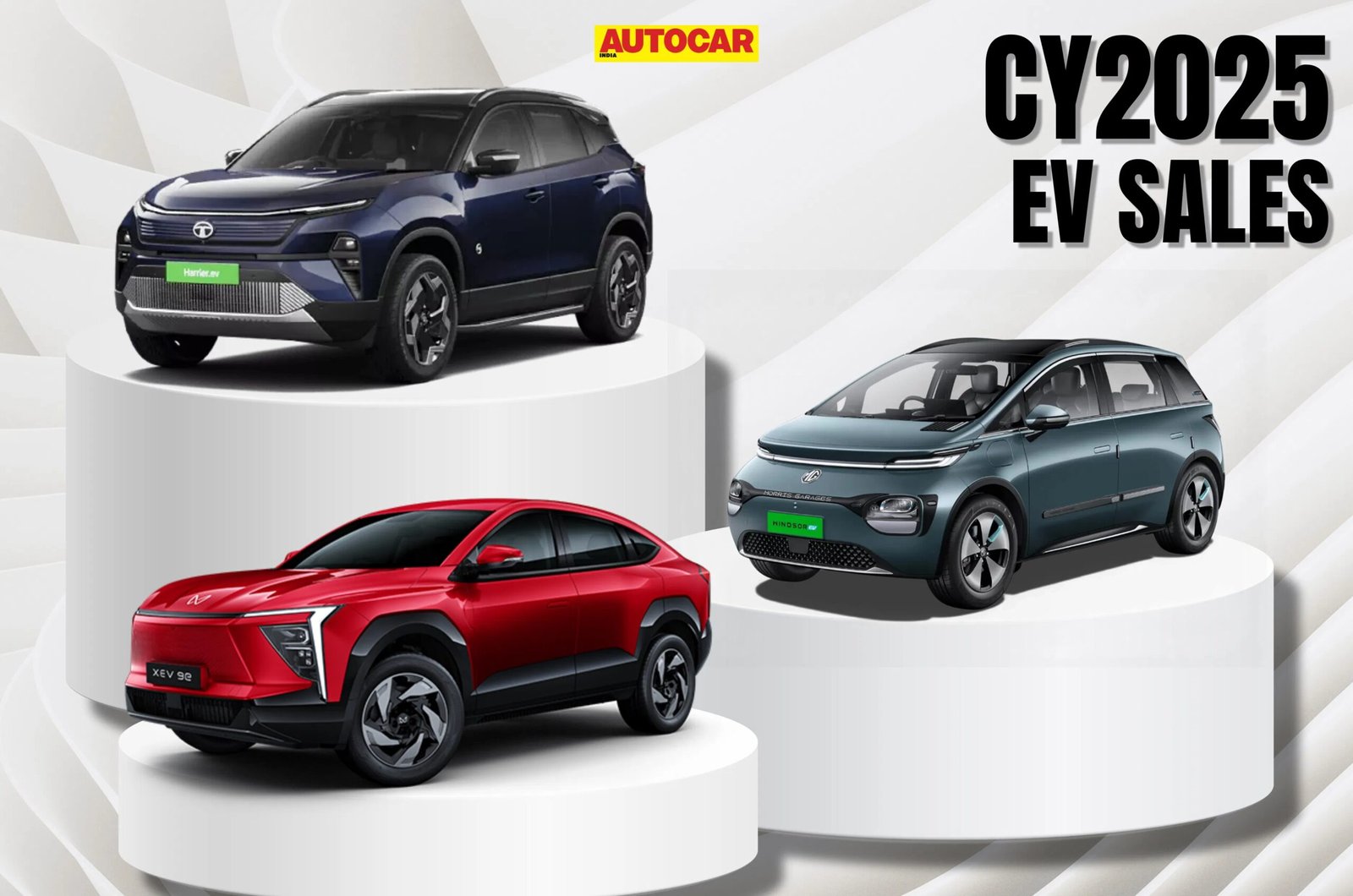
Electric passenger vehicle sales in India touched an all-time high in CY 2025, with total volumes crossing 1.76 lakh units, marking a 77 percent year-on-year rise. Strong demand across mass-market SUVs and MPVs, along with several new launches, drove the growth, even as competition intensified.
- EV volumes rise by 76,845 units compared to 2024
- Tata remains at the top as MG and Mahindra gain ground
- Luxury EV volumes rise, BMW stays segment leader
EV sales growth driven by wider choice, steady demand
| Month | CY 2025 | CY 2024 | YoY change |
| Jan | 11,925 | 8,475 | 41% |
| Feb | 9,495 | 7,517 | 26% |
| Mar | 13,326 | 9,761 | 37% |
| Apr | 13,404 | 7,816 | 71% |
| May | 13,308 | 7,987 | 67% |
| Jun | 14,042 | 7,292 | 93% |
| Jul | 16,321 | 8,011 | 104% |
| Aug | 18,556 | 6,787 | 173% |
| Sep | 16,634 | 6,182 | 169% |
| Oct | 19,161 | 11,444 | 67% |
| Nov | 15,497 | 9,172 | 69% |
| Dec | 14,869 | 9,249 | 61% |
| Total | 1,76,538 | 99,693 | 77% |
Source: Vahan (as of January 2, 2026)
The year saw consistent monthly momentum, with 11 months crossing the 11,000-unit mark and a record 19,161 units sold in October. While demand softened towards the year-end following GST cuts on ICE vehicles, overall EV volumes remained well ahead of 2024 levels.
New EV launches across segments supported sales growth in 2025. EVs accounted for over 40 percent of all new models introduced during the year.
EV sales by carmaker
|
Rank |
Electric PV OEM | CY 2025 | CY 2024 | YoY change | CY 2025 market share | CY 2024 market share |
| 1 | Tata Motors | 69,955 | 61,747 | 13% | 39.62% | 61.93% |
| 2 | JSW MG Motor | 51,376 | 21,801 | 136% | 29.10% | 21.86% |
| 3 | Mahindra | 33,512 | 7,153 | 369% | 18.98% | 7.17% |
| 4 | Hyundai | 6,726 | 913 | 637% | 3.80% | 0.91% |
| 5 | BYD | 5,402 | 2,870 | 88% | 3.05% | 2.87% |
| 6 | BMW | 3,195 | 1,227 | 160% | 1.80% | 1.23% |
| 7 | Kia | 2,731 | 415 | 558% | 1.54% | 0.41% |
| 8 | Mercedes-Benz |
1,168 | 954 | 22% | 0.66% | 0.95% |
| 9 | Stellantis | 871 | 1,925 | -55% | 0.49% | 1.93% |
| 10 | VinFast | 826 | NEW | – | 0.46% | NEW |
| 11 | Volvo | 389 | 450 | -14% | 0.22% | 0.45% |
| 12 | Tesla | 225 | NEW | – | 0.12% | NEW |
| 13 | Porsche | 67 | 73 | -8% | 0.03% | 0.07% |
| 14 | Audi | 49 | 145 | -66% | 0.02% | 0.14% |
| 15 | Maruti Suzuki |
23 | NEW | – | 0.01% | NEW |
| 16 | Rolls-Royce | 19 | 16 | 19% | 0.01% | 0.01% |
| 17 | JLR India | 4 | 4 | 0% | 0.00% | 0.00% |
| Total | 1,76,538 | 99,693 | 77% | 100% | 100% |
Source: Vahan (as of January 2, 2026)
1. Tata Motors: 69,955 units, up 13 percent YoY
Tata Motors retained its position as India’s largest EV carmaker in CY 2025, selling 69,955 units, up 13 percent year-on-year. However, its market share fell sharply to 40 percent, down from 62 percent in 2024 and 73 percent in 2023.
The Nexon EV, Tiago EV and Punch EV continued to anchor volumes, while the newly launched Harrier EV helped support sales. However, rising competition from newer models reduced Tata’s overall market share.
2. JSW MG Motor India: 51,376 units, up 136 percent YoY
JSW MG Motor continued its strong momentum in CY 2025, with sales rising 136 percent to 51,376 units. Its market share increased to 29 percent, up from 22 percent a year earlier.
The Windsor EV was the main volume driver, while newer premium models such as the M9 and Cyberster expanded MG’s presence at the higher end of the market. JSW MG Motor also sells the ZS EV and Comet EV. The brand also crossed the 1 lakh cumulative EV sales milestone during the year.
3. Mahindra: 33,512 units, up 369 percent YoY
Mahindra climbed to third place, delivering 33,512 electric SUVs, a 369 percent jump over 2024. Its market share nearly tripled to 19 percent.
Growth was driven by the BE 6 and XEV 9e, the brand’s two new Born Electric SUVs launched early in the year. In November, Mahindra expanded its EV line-up with the XEV 9S, which is based on the INGLO platform and is the first mass-market 3-row electric SUV. It is offered with 59kWh, 70kWh and 79kWh battery options, bringing features usually seen in higher-priced models.
4. Hyundai: 6,726 units, up 637 percent YoY
Hyundai moved up to fourth place with 6,726 units, aided by the launch of the Creta electric in January, the zero-emission version of India’s best-selling midsize SUV with two battery options and up to 473km range. Despite the strong popularity of the ICE Creta, the electric version did not witness the same level of demand. Even so, Hyundai’s EV market share rose to 4 percent, up from 1 percent in CY2024.
5. BYD: 5,402 units, up 88 percent YoY
BYD India, the local arm of China’s and the world’s largest electric PV manufacturer, sold 5,402 units, growing 88 percent Year-on-Year. Despite a limited dealer network, relatively low brand awareness and all models being imported as CBUs, BYD posted commendable sales, driven by models such as the Atto 3, Seal, eMax7 and Sealion 7.
6. BMW: 3,195 units, up 160 percent YoY
BMW led the luxury EV segment with 3,195 units sold, registering 160 percent growth over CY 2024. Good demand for models such as the iX1 LWB, iX, and i7 helped BMW maintain a clear lead among luxury EV makers.
7. Kia: 2,731 units, up 558 percent YoY
Kia , which was ranked 10th in CY 2024, has risen three positions to become the No. 7 e-PV OEM in CY 2025. Kia delivered a total of 2,731 e-PVs last year, up 558 percent over a low base of 415 units in CY 2024. This sudden jump in volumes can be attributed to growing demand for the Carens Clavis EV MPV. Kia’s EV portfolio also contains the EV6 and EV9, which are imported as CBUs into the country and, as a result, are on the pricier side.
8. Mercedes-Benz: 1,168 units, up 22 percent YoY
Mercedes-Benz sold 1,168 electric vehicles in CY 2025, posting 22 percent growth. Demand remained steady across models such as the EQA, EQB, EQE SUV and EQS, keeping the brand second in the luxury EV space.
9. Stellantis: 871 units, down 55 percent YoY
Stellantis India recorded 871 EV sales in CY 2025, a 55 percent year-on-year decline, resulting in its market share falling to 0.49 percent from 1.93 percent in CY 2024. Monthly sales remained in double digits for most of the year, highlighting the lack of traction for the brand’s electric offerings.
The group’s EV presence remains limited, with Citroen eC3 hatchback as its sole electric offering. The model offers a 29.2kWh battery and a 320km ARAI-claimed range, but the overall package has struggled to generate sustained retail demand, with volumes skewed towards fleet buyers. Jeep does not currently offer an EV in India, further limiting Stellantis’ presence in the segment.
10. Vinfast: 826 units
VinFast recorded 826 units in around three months of sales after entering the Indian market with the locally assembled VF6 and VF7 electric SUVs.
The Vietnamese EV maker has opened 24 dealerships across major Indian cities, with plans to add another 11 outlets by the end of 2025. VinFast has also confirmed a seven-seat electric MPV, the Limo Green, due for launch in February 2026.
Luxury EV sales also hit a new high
Luxury EV sales rose 78 percent in CY 2025 to 5,116 units, marking the segment’s best year to date. BMW and Mercedes-Benz led volumes, while other brands saw mixed results.
Volvo sold 389 units, down 14 percent, while Tesla, the newest entry in the Indian luxury market, sold 255 units of the Model Y.
Porsche and Audi recorded lower EV volumes, while Rolls-Royce saw demand rise for its first electric model, the Spectre. JLR’s EV sales remained flat at four units, unchanged from CY 2024.
With inputs from Dhruv Dhaka