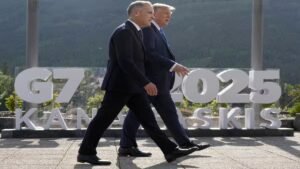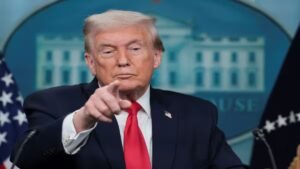
At a time when US President Donald Trump has ruptured the trans‑Atlantic alliance, European unity appears increasingly fractured as multiple axes of power have emerged in Germany, France, and Italy that appear to compete with one another.
While critics say this reflects inherent contradictions within Europe, others argue it merely represents a diversity of approaches to address the crises facing the continent — and may, in fact, be an opportunity for these powers to complement each other’s strengths.
Whether these centres of power ultimately reinforce one another or devolve into bickering blocs remains to be seen.
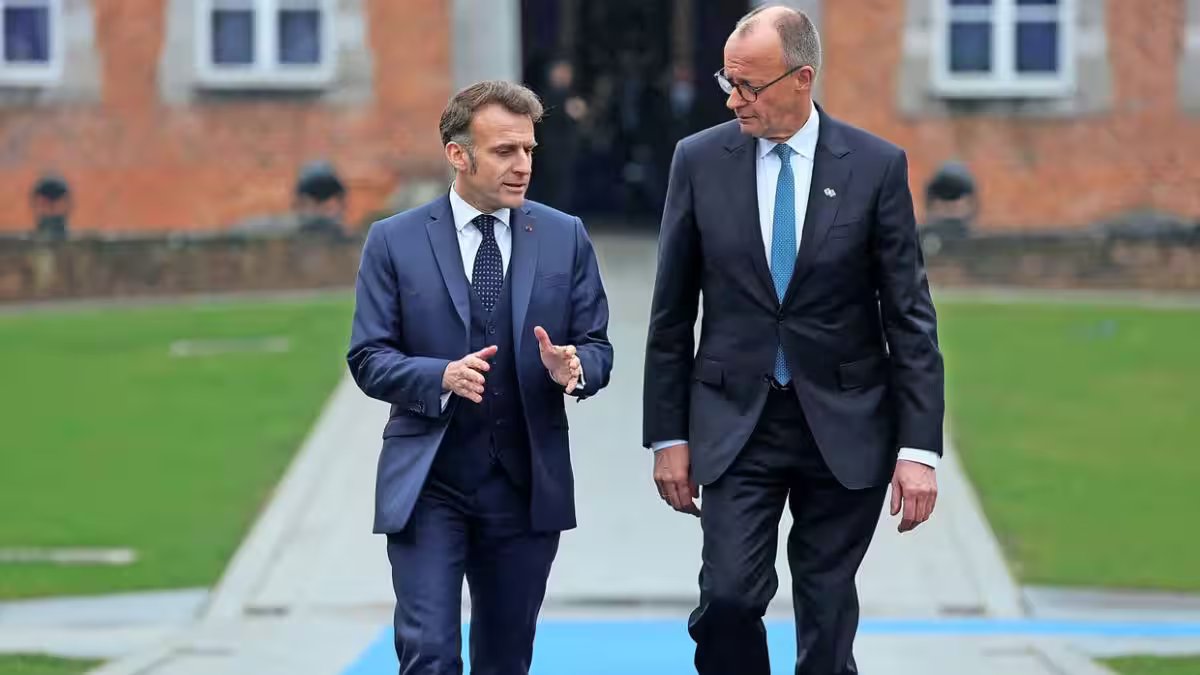
For example, while German Chancellor Friedrich Merz has called for repairing the US–Europe relationship, French President Emmanuel Macron has doubled down on a European rearmament programme and pushed for a far more hawkish and self‑reliant posture.
And Italian Prime Minister Giorgia Meloni appears to get along well with Merz but she has had repeated run‑ins with Macron.
Meanwhile, Poland has criticised both Germany and France as being “too small to govern Europe” on their own and has argued that Eastern European nations should have a much larger say in how the continent’s challenges are addressed.
Polish Foreign Minister Radoslaw Sikorski told Der Spiegel that Europe must “breathe with two lungs — western and eastern” and said France and Germany “don’t even have a blocking minority” within the European Union (EU).
Are France and Germany fundamentally divided on Europe’s path forward?
The differences between Germany and France are not limited to debates on rearmament or relations with the United States. They appear to run deeper.
For one, France and Germany cannot agree on a joint fighter‑jet project dubbed the Future Combat Air System (FCAS).
Merz has said that German requirements differ from those of France, which insists it needs an aircraft capable of operating from an aircraft carrier and delivering nuclear weapons. Merz has warned that the project may need to be abandoned if these differing requirements cannot be reconciled.
Europe has taken notice. Belgian Defence Minister Theo Francken concluded that “the FCAS is dead according to the German Chancellor”, and said his government would reassess its observer status in the programme.
Even though Europe is home to aviation giants such as Airbus, Dassault, and Gripen, European countries are struggling to produce a next‑generation fighter jet. In the absence of common ground, European nations’ dependence on the US‑made F‑35 is only likely to increase.
As for relations with the United States, Merz has rebuked extremists there but has also extended an olive branch. He warned that the United States would not be nearly as powerful without an alliance with Europe. He urged Washington to work toward a “new trans‑Atlantic partnership” to repair “a divide, a deep rift” that has taken root.
Macron, however, took a much sharper stance. He said that “Europe has to become a geopolitical power” and added “it’s ongoing, but we have to accelerate” in defence, technology and “derisking vis‑à‑vis all the big powers in order to be much more independent”.
Macron added that Europe should not only produce more weapons but also demonstrate the determination to use them, if necessary, for its defence.
“If we want to be taken seriously on the European continent and beyond, we must show the world our unwavering commitment to defend our own interests. It starts, of course, with continuing to extend our support to Ukraine, but it could nicely follow with fanning off unjustified tariffs and politely declining unjustified claims on European territory. This is what we did and this is what we will do,” Macron said.
Italy–Germany axis complicates the picture
In recent months, Merz and Meloni have emerged as pragmatic partners as Europe attempts to reinvent itself.
Since both of their governments have had public disagreements with France, a natural question arises: Is the Italy–Germany axis countering France’s role in Europe?
Despite various challenges, Germany remains Europe’s largest economy, but it needs partners to push the continent toward higher defence spending, economic resilience, and competitiveness. Italy under Meloni has emerged from political instability and is seeking greater influence in Europe.
With such converging interests, their alignment appears natural.
“For leaders like Merz and Meloni, this creates political space for policies that would have seemed unthinkable, or certainly more difficult, a decade ago, such as military buildups, defence integration, industrial protection, and tougher migration policies,” noted Julia Khrebtan‑Hörhager, Associate Professor of Critical Cultural & International Studies at Colorado State University, writing in The Conversation.
It remains to be seen whether this bloc complements France and other European powers like the United Kingdom or becomes one more bickering player preventing unity. Some analysts warn that observers may be reading too much into emerging alignments.
For one, nearly all these leaders — Macron, Merz, and Meloni — agree on the basics: Europe needs rearmament, higher defence spending, a more aggressive posture, and stronger political will. They are simply approaching these goals differently.
Moreover, France and Germany are in talks about extending the French nuclear umbrella to Europe as part of a collective security framework. And France and the UK have led a “coalition of the willing” spearheading efforts to create a multinational force to enforce any ceasefire between Russia and Ukraine.
End of Article