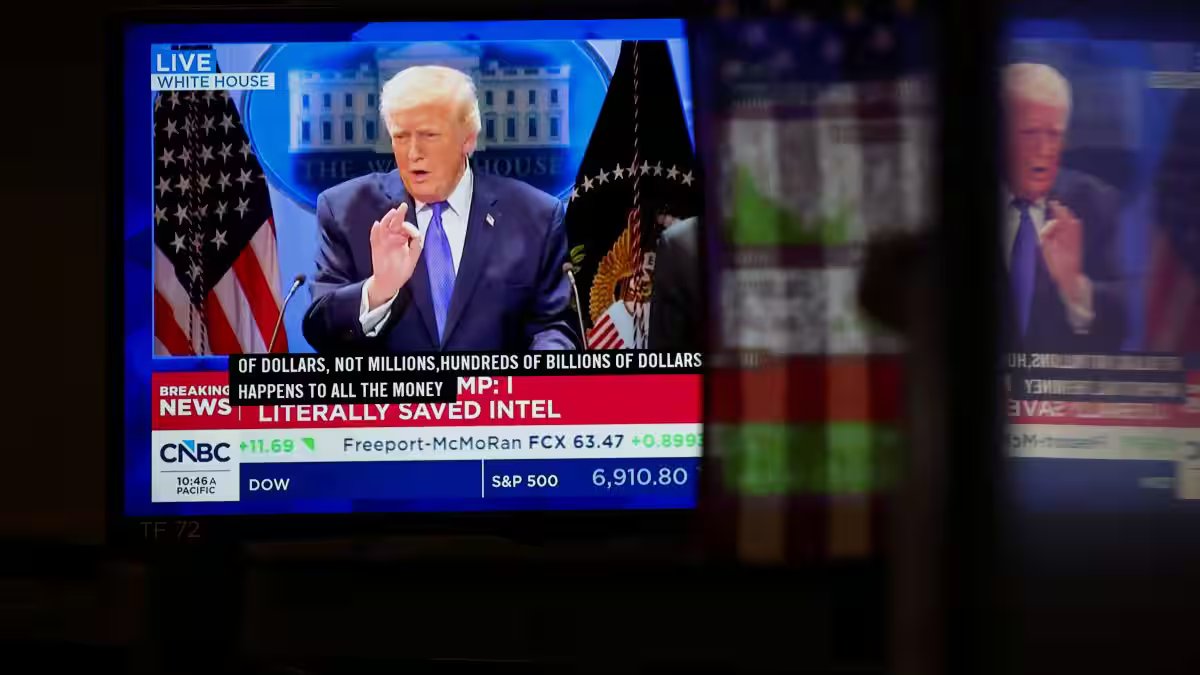
While the US Supreme Court declared Trump tariffs “unlawful”, it does not mean that we would go back to the pre-Trump 2.0 era. Here’s why.
Shockwaves were sent across the White House after the US Supreme Court struck down sweeping reciprocal tariffs imposed by US President Donald Trump. The ruling stung the Trump administration since it was given by a Supreme Court that leaned conservative.
The 6-3 decision, authored by conservative Chief Justice John Roberts, provoked a furious reaction from Trump, who denounced the justices who ruled against him. Soon after the ruling, Trump announced a 10 per cent global tariff under a legal authority different from the one at issue in the case, “over and above our normal tariffs already being charged.”
But the ruling made many wonder if the US Supreme Court ruling would restore pre-Trump 2.0 levies. The short answer to this question is “No”. The Supreme Court did not cancel all tariffs. It only blocked the tariffs that were imposed by Trump under the International Emergency Economic Powers Act, or IEEPA.
So what is still in play?
With the Supreme Court’s ruling, not all tariffs the US imposes on other nations have been scrapped; there are many that are still in force. This includes:
-
Normal tariffs the US imposes are bound to the World Trade Organisation’s (WTO) obligations.
-
Duties that have been approved by the US Congress
-
Those targeted by anti-dumping duties
-
Tariffs imposed under Section 301 – That targeted China
-
National security tariffs have been imposed procedurally in the past.
So what’s gone?
The court on Friday ruled that Trump exceeded his authority and should have got congressional approval for the tariffs. The Supreme Court, with the conservative-majority ruled six to three in the judgment, saying the International Emergency Economic Powers Act (IEEPA) – the 1977 law designed to address national emergencies Trump had used to implement them – “does not authorise the president to impose tariffs”.
The decision was in line with the one delivered by the lower courts that the tariffs Trump imposed under the IEEPA were illegal. Hence, the court put an end to across-the-board tariffs on multiple countries, deficit-based tariffs and the blanket 10 per cent tariffs.
However, Trump signed another executive order, imposing 10 per cent tariffs on all nations for 150 days. It remains unclear how this will come into play with the Supreme Court ruling in place.
The geopolitical implications have not changed
The Supreme Court’s decision is significant because it redefines US trade governance. Before the ruling, the US trade policy could swing dramatically with presidential action. Meanwhile, after the ruling, such actions would require Congressional approval.
However, not a lot has changed. The ruling does not rewind history to 2024 (Biden-era tariffs). However, it stops Trump from suddenly imposing a universal tariff wall against partners such as India, Vietnam, Mexico, the EU or Japan without Congressional approval.
For India, the ruling is also critical. India’s biggest economic risk from the US has never been tariffs or sanctions — it has been policy volatility. The court ruling effectively says that the US cannot weaponise tariffs overnight against friendly countries.
The ruling significantly lowers the probability of an India-US trade conflict during ongoing supply-chain realignment away from China, and gives India more leverage as the two countries work on the fine print.
This also shows India’s waiting game has worked in its favour as the court ruling has not cancelled trade deals the Trump administration has struck with several countries, such as South Korea, Pakistan or Bangladesh, at higher tariffs than they were during Biden’s time.
Bottom line
The ruling does not end the Trump administration’s strategy of protectionism. It does not end US tariffs on foreign nations, and it does not stop the trade negotiation process.
What it does is that the ruling removes the immediate threat of sweeping tariffs on Indian exports and even on other nations. For New Delhi, the outcome is almost as important as a trade deal — because India’s export growth strategy depends heavily on stable access to the American market. In trade diplomacy terms, this is less a courtroom story and more a supply-chain stability decision.
While Trump has said that ’nothing changes’, a White House official hinted that now the tariffs would reset to 10 per cent temporarily. Hence, it remains uncertain how the tussle between Trump and the US Supreme Court would affect global trade.
End of Article