The dramatic US military operation that led to the capture of Venezuelan President Nicolás Maduro in early January did not unfold in diplomatic isolation.
Behind the scenes, months of discreet conversations and quiet reassurances had already reshaped Washington’s understanding of who might steer Venezuela once Maduro was gone.
At the centre of that recalibration was
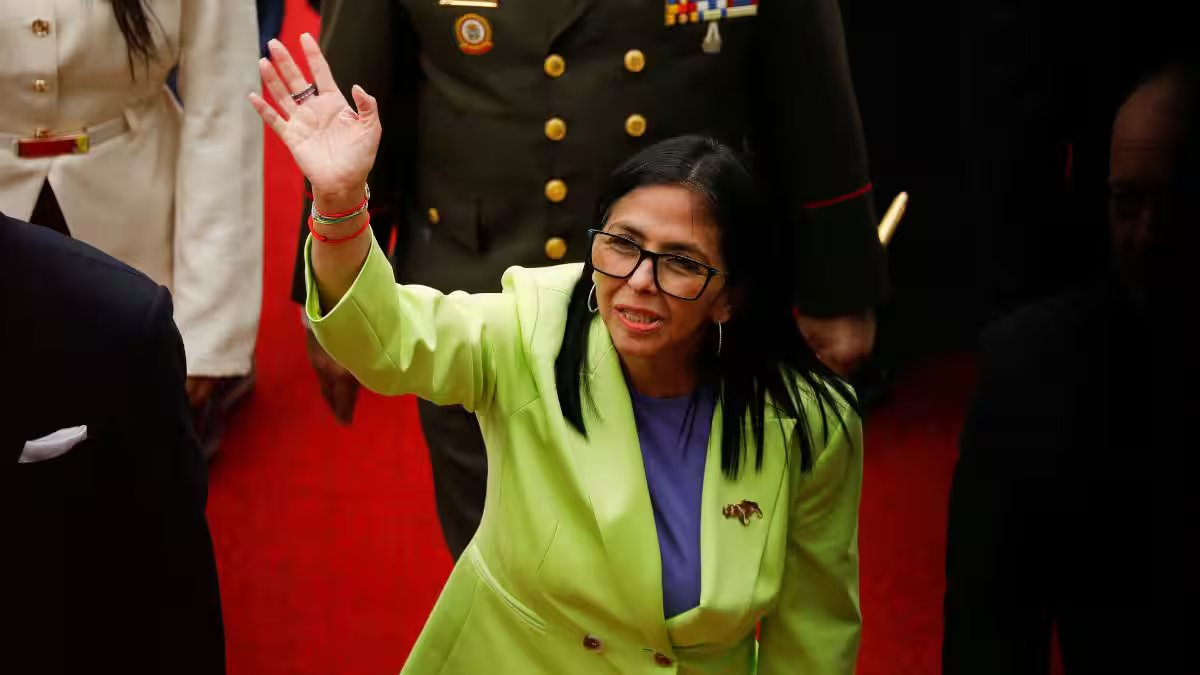
Delcy Rodríguez — Maduro’s long-serving vice-president — and her brother Jorge Rodríguez, one of the most powerful political figures in the country.
Multiple accounts from US and diplomatic sources to The Guardian now indicate that channels of communication between Rodríguez and the Trump administration were active well before helicopters descended on Caracas.
These interactions, which involved intermediaries and foreign governments, appear to have influenced Washington’s confidence that Venezuela could avoid total institutional collapse after Maduro’s removal.
According to several sources involved in high-level discussions, Delcy Rodríguez and her brother began quietly signalling their willingness to cooperate with the United States months before Maduro’s seizure, reported The Guardian.
These communications reportedly took place through intermediaries and included both US and Qatari officials. At the time, Rodríguez was still serving as vice-president under Maduro.
The outreach reportedly intensified in the fall of 2025 and continued even after a consequential phone call between Donald Trump and Maduro in late November. During that call, Trump pressed Maduro to leave Venezuela — a demand Maduro rejected.
However, that rejection appears to have sharpened Washington’s focus on alternative interlocutors within Venezuela’s power structure.
By December, US officials were receiving messages indicating Rodríguez was preparing for a political transition if Maduro exited the scene.
One American involved in the discussions described the message, “Delcy was communicating ‘Maduro needs to go.’”
Another person familiar with the exchanges said Rodríguez made clear her intent to engage after Maduro’s departure, saying, “She said, ‘I’ll work with whatever is the aftermath.’”
Sources pointed out that while Rodríguez and her brother pledged cooperation in a post-Maduro scenario, they did not agree to assist in removing him.
According to those familiar with the talks, this was not an internally coordinated effort to overthrow the president, but rather a promise to help stabilise the country once he was gone.
“She feared him,” one official told The Guardian, describing Rodríguez’s position inside the Maduro government.
How Washington acted accordingly
Inside the Trump administration, the idea of engaging figures from within Maduro’s inner circle was initially contentious.
US Secretary of State and National Security Adviser Marco Rubio was reportedly sceptical at first, particularly given his long-standing opposition to the Maduro regime.
However, as intelligence assessments increasingly warned of the risk of civil conflict or institutional breakdown following Maduro’s removal, Rodríguez’s assurances began to carry weight.
According to sources, Rubio eventually concluded that working with regime insiders who retained bureaucratic and political control could be the most effective way to prevent Venezuela from fracturing.
One source described the overriding concern in Washington as preventing a descent into lawlessness. “The biggest thing was trying to avoid a failed state,” the source told The Guardian.
These concerns were reinforced by intelligence reporting indicating that other powerful Venezuelan figures were also quietly engaging Washington.
Reuters later reported that Interior Minister Diosdado Cabello, who oversees Venezuela’s police and security forces, had held discussions with US officials months before the operation against Maduro.
At the same time, official channels between Washington and Caracas never fully closed. Shortly after Trump’s inauguration, Maduro himself met with Ric Grenell, a senior Trump aide, to discuss US detainees. The prisoners were released soon after.
Separate sources said US officials continued regular contact with Delcy and Jorge Rodríguez on operational issues, including deportation flights for Venezuelans removed from the United States, the destination of those flights, the status of Venezuelans detained in El Salvador, and the possible release of political prisoners.
How Qatar facilitated a backchannel
Rodríguez maintained close personal ties with senior figures in Doha, where members of the ruling family reportedly considered her a trusted interlocutor.
Qatar’s relationship with the Trump administration — bolstered by its donation of a $400 million luxury jet for Trump’s use — helped open doors for Rodríguez during the sensitive negotiations, according to sources.
In October, the Miami Herald reported that Rodríguez had proposed a transitional arrangement in which she would lead an interim government if Maduro agreed to retire to a prearranged safe haven.
The proposal did not materialise, and Rodríguez publicly denounced the report. However, US officials began reassessing her political approach, concluding that she was more flexible than previously assumed.
Those who have interacted with Rodríguez described her as pragmatic and personally engaging, traits that reportedly helped her navigate diplomatic circles.
Her familiarity with the oil sector, and her connections with American energy executives, further distinguished her from other figures within the Maduro government. An ally described her orientation, saying, “Delcy is the most committed to working with US oil.”
By late fall, sources said even officials within the US administration who had favoured maximal pressure against Maduro were increasingly open to working with Rodríguez, viewing her as a stabilising figure capable of maintaining state continuity.
Where Rodríguez was when Maduro was captured
When
US attack helicopters entered Caracas in early January, Rodríguez was not present in the capital. Rumours circulated that she had fled to Moscow, but two sources said she was on Margarita Island, a Venezuelan resort destination.
Within days, US forces seized Maduro and his wife, Cilia Flores, during an operation in the capital. The couple were transferred to New York, where they pleaded not guilty to charges including drug trafficking.
On January 5,
Rodríguez was sworn in as interim president.
Trump appeared to publicly acknowledge prior contacts shortly after the raid, telling the New York Post, “We’ve spoken to her numerous times, and she understands, she understands.”
How formal engagement began
Less than two weeks after Maduro’s capture, CIA Director John Ratcliffe travelled to Caracas at Trump’s direction, marking the first visit by a US cabinet-level official to Venezuela in years.
The two-hour meeting between Ratcliffe and Rodríguez was described by a US official as “historic” and aimed at rebuilding trust and establishing direct lines of communication, reported BBC.
According to the official, discussions focused on potential economic cooperation and security assurances, including the expectation that “Venezuela can no longer be a safe haven for America’s adversaries.”
The meeting took place on the same day Rodríguez delivered her first state of the union address as interim president.
That address revealed the policy direction she intended to pursue. Rodríguez announced
reforms to Venezuela’s oil sector designed to attract foreign investment, signalling a break from Maduro-era economic controls.
She proposed changes to the country’s hydrocarbon law, which had previously required foreign partners to operate through the state-owned oil company PDVSA with majority ownership.
Under the proposed reforms, investment would be permitted in new fields without the existing ownership restrictions. Rodríguez also said she had instructed lawmakers to approve the changes.
As part of a broader transition strategy, the United States has appointed Laura Dogu, a two-time ambassador, as its top envoy for Venezuela. According to the US embassy website, Dogu will serve as chargé d’affaires for the Venezuela Affairs Unit based at the US embassy in Bogotá.
A senior State Department official said, “The Trump Administration continues to work with the interim authorities to stabilize Venezuela as part of the three-phase plan Secretary Rubio laid out for Congress and the American people.”
The US has also begun preparations for a potential reopening of its embassy in Caracas. Diplomatic and security personnel travelled to the Venezuelan capital on January 9 to assess the feasibility of a phased resumption of operations.
The embassy was closed in 2019 amid political unrest.
With inputs from agencies
End of Article