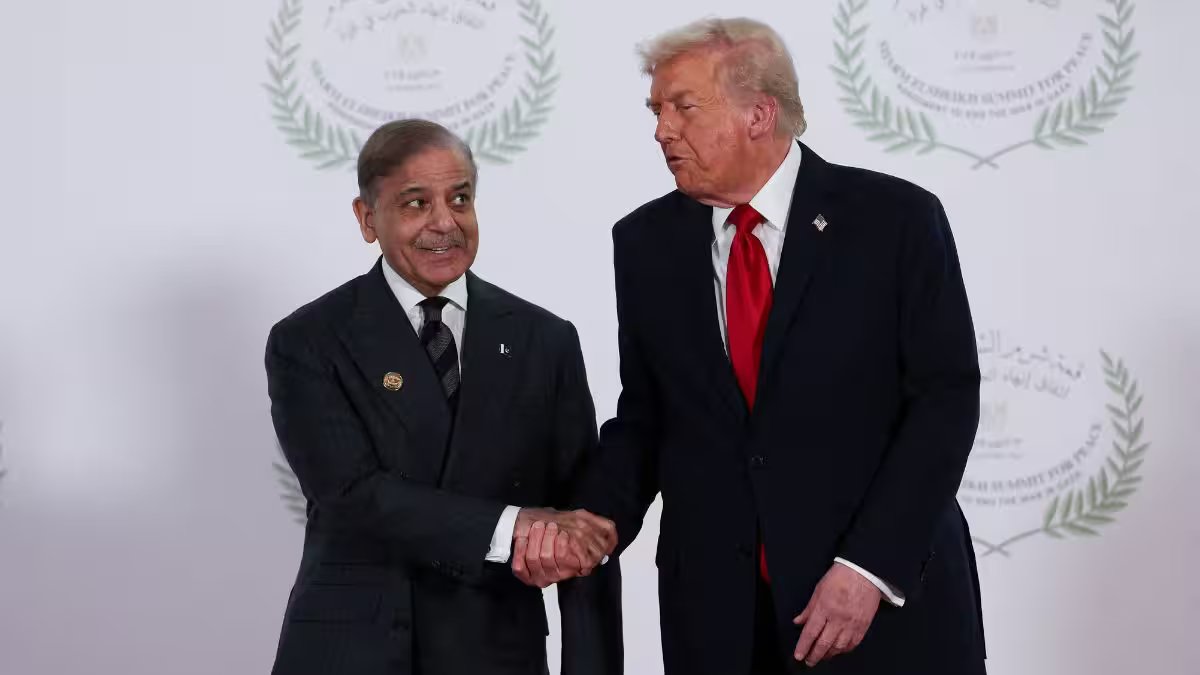
Pakistan Prime Minister Shehbaz Sharif is facing a wave of criticism and online ridicule after his appearance at the inaugural meeting of the Board of Peace convened by United States President Donald Trump in Washington, DC on Thursday.
The backlash was triggered by the circulation of an unverified video on social media in which Sharif appears to perform what users described as a “guard-style salute” towards Trump.
The clip rapidly spread across platforms and became a focal point for debates about optics, diplomacy and Pakistan’s standing on major global platforms.
How Pakistan was represented at the Board of Peace meeting
Opening the session, Trump announced that nine members of the Board of Peace had agreed to collectively pledge $7 billion for a Gaza relief package.
In addition, five countries committed to deploying troops as part of an international stabilisation force intended to help maintain security in the conflict-affected Palestinian territory.
Several officials at the gathering used their speaking slots to praise Trump’s role in conflict mediation, with some contrasting his approach with the diplomatic record of his predecessor.
In this context, Sharif publicly lauded Trump’s outreach and described the Board of Peace as a meaningful step toward achieving a just and lasting settlement in the region.
During his remarks, the Pakistani prime minister also referred to Trump as a “man of peace” and the “saviour of South Asia,” a phrase that immediately drew attention both internationally and within Pakistan.
Sharif also chose to highlight Trump’s diplomatic initiatives and his claimed role in de-escalating tensions between India and Pakistan. The assertion that Trump had mediated a ceasefire between India and Pakistan has been firmly rejected by Indian officials.
How optics fulled backlash for Sharif
The controversy surrounding Sharif began when a video clip surfaced online showing him appearing to salute Trump in a manner that users characterised as resembling a ceremonial guard salute.
The footage started circulating a day after the Board of Peace meeting and quickly drew sharp reactions.
More embarrassment for Pakistan after PM Shahbaz Sharif caught doing ‘gaurd salute’ to President Trump
This is how society gaurds salute 🤣🤣pic.twitter.com/0vPrEfkWrn
— Frontalforce 🇮🇳 (@FrontalForce) February 20, 2026
The authenticity of the video has not been independently verified, but its rapid spread on social media platforms turned it into a symbol of what critics described as awkward or overly deferential conduct.
The video was not the only visual from the summit that attracted attention. During the official group photograph of world leaders, Sharif was positioned at the edge of the lineup, while Trump stood at the centre flanked by key allies.
Despite all praises and hugs, PM Shehbaz Sharif was pushed in the back row while President Trump was giving briefing. pic.twitter.com/TIvuiDpl2N
— ѕнαfιq кнαи off 🇨🇦 (@saknscan) February 20, 2026
The contrast in positioning was widely shared online, with commentators interpreting it as a visual representation of Pakistan’s marginal role at the gathering.
Another moment that circulated widely involved Trump gesturing toward Sharif mid-speech and asking him to stand.
Trump asks Pak PM Sharif to stand up, then starts talking about PM Modi
At the Board of Peace Event, US President Donald Trump asked Pakistan PM Shehbaz Sharif to stand up as he repeated his false claims about ending India and Pakistan war. As soon as Sharif stood up, Trump… pic.twitter.com/YSV51fws5K
— Global intel (@SarkarSar11) February 20, 2026
The clip also prompted online mockery, with some social media users using the moment to question the power dynamics between Washington and Islamabad.
What the Board of Peace appearance meant for Pakistan
The optics of Sharif’s appearance in Washington
quickly reverberated back in Pakistan.
In Islamabad, political opposition questioned his decision to join the Board of Peace without broader consultation and criticised what they described as an erosion of Pakistan’s established foreign policy principles.
Critics argued that Pakistan’s participation in the initiative, coupled with Sharif’s public praise of Trump, risked undermining Islamabad’s long-standing positions on Palestinian representation and opposition to Israel.
The fact that Pakistan was not named among the countries expected to contribute troops to the international stabilisation force in Gaza also fuelled criticism.
For many observers, this omission highlighted a gap between Islamabad’s desire for global relevance and its actual influence in shaping the outcomes of high-level diplomatic initiatives.
Despite being formally invited to join the Board of Peace, Pakistan did not emerge as a central player in the financial or security commitments announced at the summit.
While participation in multilateral forums provides visibility, it does not automatically translate into decision-making power or influence over the allocation of resources.
In this context, Sharif’s presence at the meeting — and the viral moments that followed — became emblematic of the broader challenge facing Islamabad as it seeks to assert itself on international platforms dominated by major powers and key regional actors.
Despite the controversy, Trump offered brief personal reassurance regarding Sharif’s participation, saying, “I like this guy.”
What next for Trump’s Board of Peace
The inaugural meeting drew a broad range of participants, with most countries sending senior officials.
A
handful of leaders travelled in person to Washington, including Indonesian President Prabowo Subianto, Argentine President Javier Milei and Hungarian Prime Minister Viktor Orbán.
Members of the Board of Peace included Albania, Argentina, Armenia, Azerbaijan, Bahrain, Bulgaria, Cambodia, Egypt, El Salvador, Hungary, Indonesia, Israel, Jordan, Kazakhstan, Kosovo, Kuwait, Mongolia, Morocco, Pakistan, Paraguay, Qatar, Saudi Arabia, Turkey, United Arab Emirates, Uzbekistan and Vietnam.
Countries and entities that attended as observers included Austria, Croatia, Cyprus, Czech Republic, the European Union, Finland, Germany, Greece,
India, Italy, Japan, Mexico, Netherlands, Norway, Oman, Poland, South Korea, Romania, Slovakia, Switzerland, Thailand and the United Kingdom.
The United States also extended invitations to China and Russia. Trump stated, “I would love to have China and Russia. They’ve been invited. You need both.”
Trump later told reporters that additional countries were still in the process of joining the board, with some requiring approval from their national legislatures before formally signing on.
Beyond the immediate pledges, Trump also announced that
the United States would contribute $10 billion to the initiative. However, no timeline or detailed breakdown of how the funds would be used was provided.
It also remains unclear how the US government would secure such a large allocation, as any substantial financial commitment would require authorisation from Congress.
Addressing the broader significance of the initiative, Trump said, “Every dollar spent is an investment in stability and the hope of a new and harmonious region,” adding that the Board of Peace illustrates how coordinated global action can help lay the foundation for long-term recovery.
The $7 billion pledged by board members is far below the estimated $70 billion needed to rebuild Gaza after the devastation of nearly two years of conflict.
With inputs from agencies