Iran’s Islamic Revolutionary Guard Corps (IRGC) said on Monday, that it carried out a coordinated missile strike targeting the office of Israeli Prime Minister Benjamin Netanyahu and the headquarters of Israel’s air force commander.
“The office of the criminal Israeli PM, Netanyahu and the location of the regime’s Air Force commander were struck in targeted and surprise attacks by Kheybar Shekan ballistic missiles during the 10th wave,” the IRGC said in a statement on Telegram.
“The office of the criminal prime minister of the Zionist regime and the headquarters of the regime’s air force commander were targeted,” a statement carried by IRGC-affiliate Fars news agency stated.
Iranian media outlets
said the outcome of the strike for Netanyahu was “unclear” in the immediate aftermath.
Parallel claims circulating on social media that the Israeli leader had fled the country were rejected by Israel’s Prime Minister’s Office, which said Netanyahu had held meetings in Tel Aviv on March 1 with the defence minister, the chief of staff and the director of the Mossad.
The claim surfaced amid increasing hostilities that followed a joint US-Israeli operation that killed Iran’s Supreme Leader Ali Khamenei.
In the days after that operation, Tehran and
allied militias launched missiles and drones at Israeli cities and US facilities across the Gulf.
While Israel expanded strikes in Lebanon in response to Hezbollah attacks and
Iran fired projectiles toward targets that included Gulf states and a British military installation in Cyprus.
What is the Kheibar Shekan?
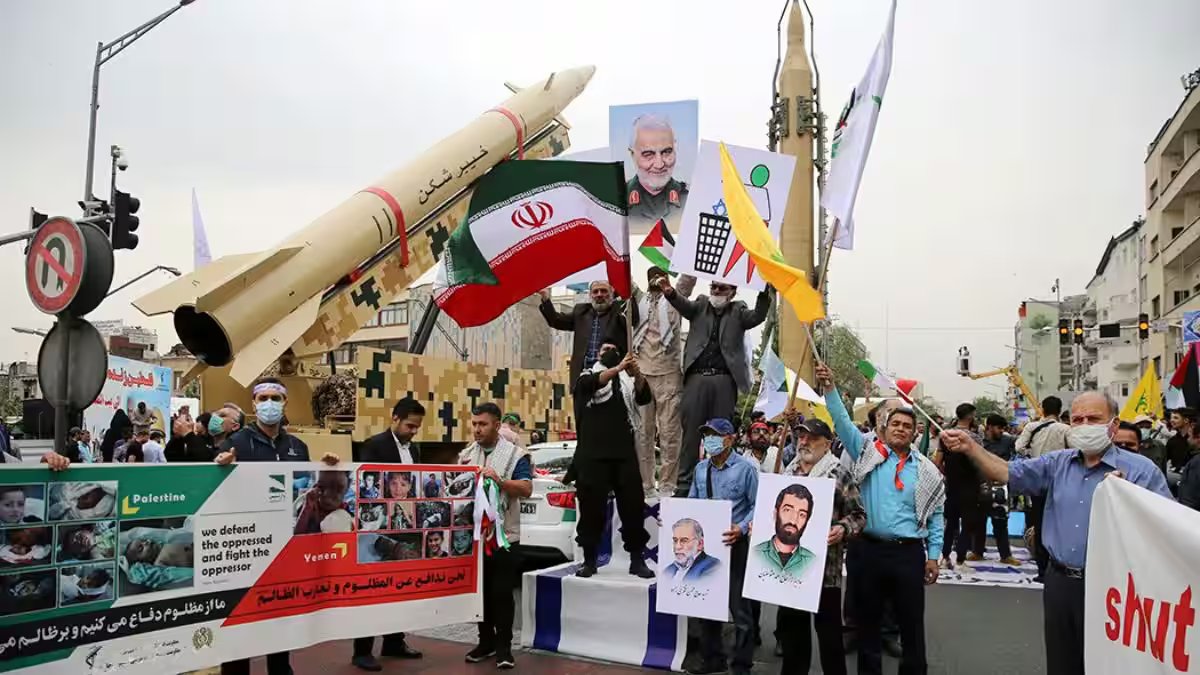
The Kheibar Shekan, translated as “Castle Buster” or “Fortress Buster,” is a solid-fuel, medium-range ballistic missile operated by the IRGC Aerospace Force.
The system was unveiled in February 2022 as part of Iran’s effort to modernise its long-range strike capabilities.
It is described as a third-generation missile within the IRGC’s long-range portfolio, reflecting a design shift away from heavier liquid-fuelled platforms toward lighter, more mobile weapons intended to be deployed quickly and to complicate interception by layered air defence networks.
According to Iranian state-linked reporting, the missile was developed by “scientists of the IRGC Air Force.” The public unveiling in 2022 was carried out by General Mohammad Bagheri, who was then the Chief of Staff of Iran’s Armed Forces and who was later killed in Israeli strikes during
the 12-day war last year.
Iranian officials at the time of the missile’s introduction presented it as a milestone in the country’s missile programme.
The Kheibar Shekan is positioned as a medium-range system capable of striking targets across Israel and US military facilities in West Asia from within Iranian territory.
Reports also state that the missile can be fired from a range of launch platforms, including modified commercial vehicles.
Technical profile of the Kheibar Shekan:
-
The Kheibar Shekan is reported to have a range of approximately 1,450 kilometres, placing it in the medium-range ballistic missile (MRBM) category.
-
This reach allows coverage of targets throughout Israel as well as US bases across parts of West Asia when launched from locations inside Iran.
-
Propulsion is provided by a single-stage solid-fuel motor known as the “Arond” engine. The use of solid fuel is significant because it removes the need for volatile liquid propellants and lengthy pre-launch fuelling procedures.
-
This allows the missile to be stored in a launch-ready state and fired on short notice, reportedly under 15 minutes from a mobile platform.
-
The missile typically carries a high-explosive warhead weighing between 550 and 600 kilogrammes.
-
Reports from 2025 indicate that newer variants have incorporated submunitions and multi-warhead configurations, expanding the missile’s payload options.
-
In terms of physical dimensions, the Kheibar Shekan is about 11.4 metres long with a diameter of roughly 76 centimetres. The total launch weight is estimated at around 6.3 tonnes.
-
This represents a substantial reduction compared with older Iranian ballistic missiles such as the Ghadr, which are significantly heavier.
-
The weight reduction contributes to greater mobility, allowing the missile to be transported and launched from mobile platforms more easily.
-
Speed characteristics vary across different phases of flight. Reports indicate that during the mid-course phase, when the missile travels outside the atmosphere, velocities exceed Mach 15, equivalent to around 19,500 kilometres per hour.
-
During the terminal phase of descent, speeds are cited as being between Mach 8 and Mach 10, with impact velocities reported in the Mach 2 to Mach 3 range.
Can the Kheibar Shekan get past Israel’s defences?
A defining characteristic of the Kheibar Shekan is its guidance and manoeuvrability architecture. The missile employs a manoeuvrable re-entry vehicle (MaRV) fitted with aerodynamic fins on the warhead section, enabling steering adjustments after re-entering the atmosphere.
Guidance is aided by satellite navigation, contributing to the system’s reported accuracy.
Unlike traditional ballistic missiles that follow a largely predictable parabolic trajectory, the Kheibar Shekan is designed to execute manoeuvres during the terminal phase.
This capability is specifically intended to challenge interceptor systems that rely on predicting a missile’s path.
Iranian reporting has highlighted this feature as a means of bypassing air defence layers such as Arrow-3, David’s Sling and Patriot (PAC-3), all of which are designed to intercept ballistic and cruise missile threats.
The missile’s structure incorporates advanced carbon-fibre composite materials. The use of composites reduces overall weight while increasing structural strength, improving the ratio between payload and range.
The streamlined design of the warhead and the removal of certain external stabilising surfaces are described as measures to reduce radar cross-section.
In place of large external control surfaces, the missile reportedly relies on internal thrust vectoring and smaller warhead-mounted fins for course correction, which also contribute to a lower radar signature.
Has the Kheibar Shekan been used before?
The Kheibar Shekan has transitioned from a newly unveiled system to one that Iranian sources describe as combat-tested.
Its first reported operational use occurred in January 2024, when it was fired at targets in Idlib, Syria.
The launch, carried out from Khuzestan province, covered a distance exceeding 1,200 kilometres, marking one of the longest-range operational strikes attributed to Iran at that time.
The missile was also employed in April and October 2024 during large-scale barrages against Israeli airbases, including Nevatim and Tel Nof. These strikes were part of operations referred to as “True Promise 1” and “True Promise 2.”
Post-strike assessments cited in the reports suggested that the Kheibar Shekan achieved a higher rate of penetration through air defences than older liquid-fuelled Iranian ballistic missiles.
In June 2025, following US and Israeli strikes on Iranian nuclear facilities at Natanz and Fordow, Iran introduced an updated version of the missile known as Kheibar Shekan 2. This variant reportedly incorporated enhanced thermal shielding and multi-warhead configurations.
The stated purpose of these upgrades was to increase survivability during re-entry and to overwhelm layered air defence systems, including emerging laser-based defences like Israel’s “Iron Beam,” alongside conventional interceptor batteries.
By this month, Israeli strikes had reportedly destroyed several mobile launchers in western Iran.
Are Kheibar Shekan and the Khorramshahr/Kheibar missiles same?
The similarity in names between the Kheibar Shekan and the Kheibar missile can be confusing. Despite the shared terminology, they are distinct systems with different design lineages and operational roles.
The Kheibar missile belongs to the Khorramshahr family. The first iteration, Khorramshahr-1, was unveiled in 2017 during a military parade marking Holy Defence Week. It measured around 13 metres in length with a diameter of approximately 1.5 metres.
The second generation, Khorramshahr-2, appeared in 2019 and featured guided warheads with a total launch weight of about 20 tonnes.
A fourth generation, Khorramshahr-4, was unveiled in May 2023 and was officially named “Kheibar,” contributing to public confusion between the two missile classes.
Military sources cited in the reporting have said that a Khorramshahr-3 variant exists with undisclosed advanced capabilities, although details have not been made public for security reasons.
The Khorramshahr/Kheibar missiles are characterised by design elements intended to reduce detectability and interception, including the absence of ailerons, which reduces aerodynamic drag and improves speed and accuracy.
By contrast, the Kheibar Shekan is a lighter, solid-fuel MRBM emphasising manoeuvrability, rapid deployment and mobile launch concepts. It is not part of the Khorramshahr lineage, and the two systems represent different classes of weaponry within Iran’s missile arsenal.
Where does the name ‘Kheibar Shekan’ come from?
The name “Kheibar Shekan,” meaning “Breaker of Khaybar,” draws on historical and religious references. It alludes to the Battle of Khaybar in 628 CE, a conflict between early Muslim forces and the Jewish community in what is now Saudi Arabia.
In Shia-majority Iran, the episode carries particular religious resonance because of the role attributed to Imam Ali ibn Abi Talib, who is regarded as the first successor to the Prophet Muhammad.
Iranian narratives invoke this history to frame contemporary confrontation with Israel in ideological and historical terms, even though the original battle took place more than fourteen centuries ago.
The reference to the expulsion of the Jewish community from the Arabian Peninsula following the Battle of Khaybar is also cited as a symbolic signal of Tehran’s stated objective of eliminating the modern State of Israel.
The Khorramshahr family of missiles, from which the Kheibar missile takes its alternative name, draws on a different symbolic source.
“Khorramshahr” refers to the Iranian city that was the site of intense fighting during the Iran-Iraq War in 1982.
Also Watch:
With inputs from agencies
End of Article