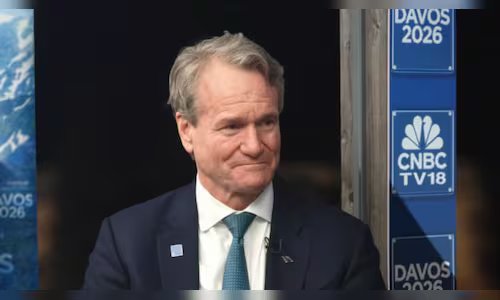
Speaking to CNBC-TV18 on the sidelines of the World Economic Forum in Davos, he said transaction data shows no meaningful slowdown in household or small business activity, supporting a positive outlook for the US and global growth.
Moynihan expects continued investment in artificial intelligence (AI) infrastructure and enterprise adoption to remain a major driver of US economic activity over the next few years. Strong corporate cash flows and open capital markets are supporting large-scale spending on data centres and AI systems, adding momentum to the broader growth outlook for 2026.
These are edited excerpts of the interview.
Q: Let me start by asking you what you’ve made of the Davos mood. This has perhaps been one of the most significant WEF meetings in recent years because of what happened between Trump and the EU, the many meetings, and the global reset that’s underway. What do you take away from Davos?
A: When you have the President of the United States here, President Trump has now come three times, and there is an urgency for the administration and the President to get things done; he has a convenient place.
So, he could work with the people on the Greenland question. He could work with Volodymyr Zelenskyy on the Russia-Ukraine issue, and then a whole bunch of other things I’m sure that I don’t know about, but it’s set the tone of us a lot more around sort of those types of discussions and meetings.
And then there was the usual, all the other stuff about AI and how to make capitalism continue to do good things for the world, but that added another element to it.
Q: Let us talk about growth. And do you walk away feeling that 2026 is going to be better than the previous year?
A: If you look at our team across the world, we’re at about 3.6% for world growth. We think that India grows 6.5% for 2026. We think that the US grows at 2.8%, which is a bit ahead of consensus. We think Europe’s at plus or minus 1%, but the US is growing faster, given the size of the economy, which creates a lot of activity around the world because the US doesn’t make everything it consumes and things like that.
So, our economists are pretty comfortable, and they’ve raised that basically from mid-summer of 2025 at about one and a half after tariffs and what’s going to happen and all that, to come back up to 2.8 now. And so, they’ve been raising it literally each time they touch it.
We think the Fed will cut rates a couple of times later this year. We think inflation will work its way down, probably towards the end of 2027, to levels closer to the target. Unemployment stays reasonable.
Also Read | Davos 2026: McKinsey flags radical uncertainty, urges CEOs to make bold moves amid geopolitical shifts
So, if the US is set up pretty well, that helps the rest of the world. But also, other countries like India are set up well, and in the deregulatory impact on the US, interest rates will be lower next year versus this year, even if nothing happens or is lower. It’s all very positive. We’re bullish on the US, but we’re also bullish on a lot of other places.
Q: But what’s the consumer data telling you, at this point in time? Because the expectation is that the tariffs, while they haven’t yet impacted sentiment, will start to hurt. What is the data telling you today?
A: If we were sitting here last May, you would have said the same thing; they haven’t yet impacted, but they will. And the answer is, they’re well understood now, and that was one of the things.
What you see in our consumer data is that for the fourth quarter, the Bank of America consumers put 5% more money into the US economy than they did in the fourth quarter of 2024. So, from 2024 to 2025, 5% growth. That’s about a trillion and a half dollars. So, it’s not a small sample. So, it’s a lot of money — credit, debit cards, growing, all kinds of other payments that they make.
If you look so far in January, it’s running a little faster now. We have to be careful. It’s only a couple of weeks in, and how the weekends fall, and stuff affects it, but it’s clearly not slowing down. So, that bodes well, because in a US consumer-spending and consumer-led economy, it works.
Then, if you look at our small business customers, you can look in and see that their sales are rising a little bit. You can see their payrolls are going up for their employees, because you see how they pay them.
And, their credit is strong, and their interest rate carry went down. Because as rates came down, the biggest beneficiary is a floating-rate credit line borrower, and that’s generally small- and medium-sized businesses on lines of credit. So, we feel good about that. Mid-size credit is good in the prime space that we’re in, the consumer side and the commercial space. So, it’s, they’re all pretty good.
But they had to figure a lot out last year. Once we got out of here, a lot of people were very bullish about the world, and then Liberation Day and trying to understand all the policies. Right now, you’re seeing a pretty clear thing. If you can agree to invest in America and help America be great, which will then help your country be great, that’s a tariff that goes from 10 to 15. If you don’t, it’s going to be a higher tariff, or it’s national security or other interests. But the pattern’s worked out. Businesses adjusted to it, and I think they feel that they can make business work around it.
Q: And they are spending money and are driven largely by, of course, the large AI infrastructure build-out. How much of a tailwind is that, and do you believe that that’s sustainable and likely to continue?
A: I think it’s going to happen for a couple of reasons. They’re basically the people building on our own account, or people building for these major companies that have strong cash flow and a lot of money to spend. The markets are open. They can get the money from the capital markets.
So, it’s going to happen, whether it happens at exactly the pace people think, there are power issues, there are issues with getting permitted, and there are issues with chip availability. All that stuff is talked about. But the reality is, if you look at the monthly deployed money in the data centres, it’s been going up every month. And so there’s just a lot more left.
If all this work, all these declarations by people are nearly factual over the next several years, it’s definitely a tailwind. But also, the big, beautiful bill, the tax bill, the United States is a tailwind. Tax refunds will be higher for a broad part of the American population because of the SALT limitations, which are technical deductions of state and local taxes, taxes on tips, and Social Security taxes. So that’ll be a benefit.
Then, the corporates didn’t get a rate change. So that’s not stimulation. The stimulus that came for corporates, commercial payers, is the lock-in of the bonus depreciation. Other things that are good because they expanded the coverage, but I also made it certain, so now I know the tax rate is not going to change.
Also Read | Davos 2026: AI beats humans at keeping customers happy, says Freshworks CEO
Q: You talked about the stimulus and what it’s been able to do as far as the economy is concerned. But the other thing that everyone’s talking about is AI-related valuations. What do you make of those?
A: I’ve got a research team that’s the best in the world, and they have opinions about it every day, and the market values those opinions every day. You have to leave aside valuations, because you can get — we get our market experts to talk about the question of what’s driving this?
And what’s driving this is demand by companies like ours to use it. We’re paying licence fees to get access to it. There’s a consumer-led demand for people to pay subscription fees. And then the big thing that’s driving a lot of it is the next generation of how commerce is conducted, with agents versus search and all that. And that’s a battle that’s going on with some titans to figure out how that works.
Then the fourth way, which is all the providers of software are spending money on models for them to embed in their software, which they provide us. So, the major enterprise software will have to have AI capabilities for our teammates to work better.
So, that’s all going on. And so, we’ll spend several hundred million dollars on AI stuff this year. We’ve had AI embedded — our Erica has been running since 2018, with 20 million customers using it. We’ve moved it over to the commercial side. We’ve moved it over to this employee self-help side. We use the same model, and now we have access to other models, Office 365 with copilots, rolled out to the 150,000 teammates. They’re all taking advantage of it. So, you’re seeing all this activity take place. That’s what’s driving the valuations. And the market will fix it if they think it’s too high or not. But what’s under it is a fundamental amount of activity.
Q: You talked about what you’re doing on the tech side and the hundreds of millions of dollars that you’re spending on tech, but agentic commerce and agentic AI — how much of that are you already starting to see benefit the bank?
A: That’s still early days. But our AI agent is Erica, and 20 million people use it, 170 million times last quarter. So, it’s not theoretical. It’s being used. And we said, we think, we calculate, whether we’re precisely right, because it built up over five years, 11,000 FTE equivalents are being utilised by that. And so, it’s very interesting stuff and very interesting possible returns. We spend 14 billion on technology, about four and a half billion on initiatives, and we spend a good chunk of that this year towards AI implementation.
But there has to be a return on it. It’s just not, let’s send this out there and see if it’s fun. Because you can write a song on Copilot, you can — I can do a poem or a haiku or whatever. That’s not going to help people do their job. So, the question is, how do you apply it to the thousands of processes in our company where there’s a process map and what steps, and how do you drive it, and have the data right? So, it’s really nuts and bolts.
Q: So, are you starting to derive a return on investment?
A: Every project is — we won’t do a project for fun.
Also Read | Bank of America CEO says AI spending will drive returns in 2026, bullish on India growth
Q: It’s also fun. But let me talk about rates. And you said that you expect rates to come off. But the other big question is, who’s going to replace Jerome Powell, and what will that mean as far as the central bank’s independence is concerned? The markets have been fluctuating on the back of that story. Do you think it’s going to make a difference who is going to be in Powell’s position?
A: There’s been a list of candidates that President Trump talked about yesterday. He talked about when they get in there, they have to make their decisions, and sometimes you have buyer’s remorse when somebody gets in there. So, he told the whole story yesterday from the stage, answering questions, which was, we know it’s an independent Fed, and the world knows that the US Fed is independent, and that’s a major piece.
We’re trying to be careful who we pick, but once they’re in there, they have to do what they think is right based on the position they’re in and the dual mandate. And so, the understanding of this is much better. But he’s got a good list of candidates. He’ll pick one.
For the full interview, watch the accompanying video
Catch all the latest updates from the stock market here
Catch the latest Budget 2026 expectations updates here
Catch all the latest updates from the Q3 earnings here