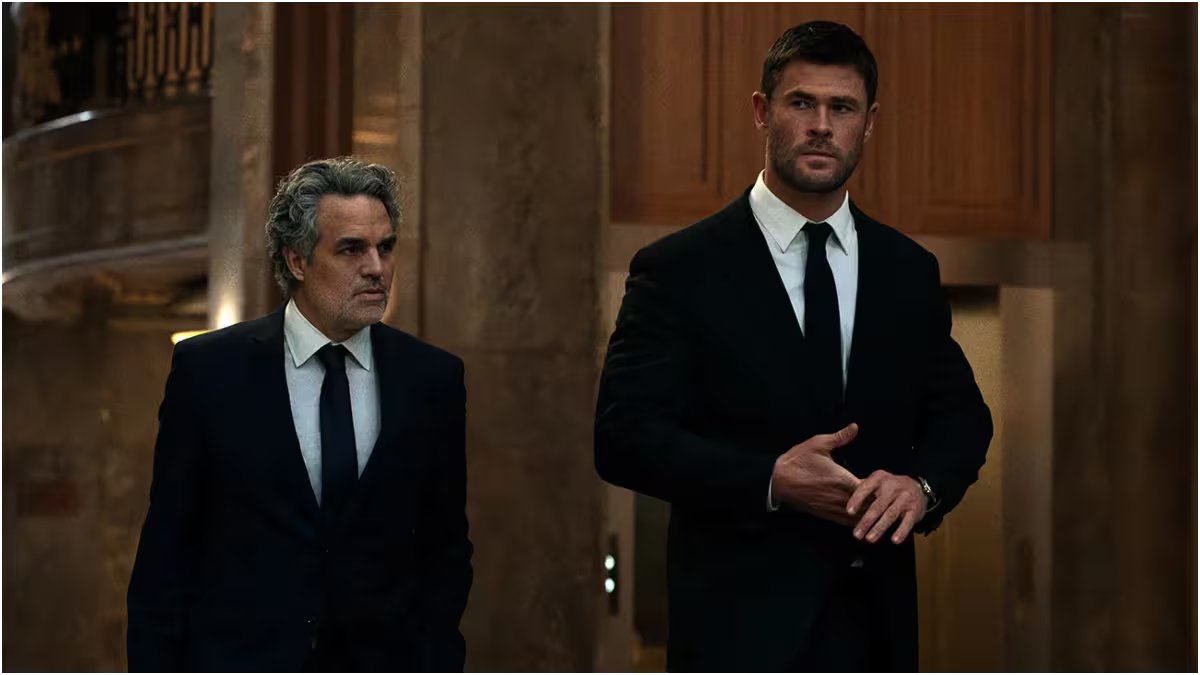
Director: Bart Layton
Cast: Chris Hemsworth, Halle Berry, Mark Ruffalo, Monica Barbaro, Barry Keoghan
Language: English
When you go to watch a crime thriller, you generally expect edge-of-the-seat tension, fast pacing, and thumping set pieces. However, director Bart Layton’s Crime 101 subverts that expectation and leans more into character arcs than the heist itself. Adapted from Don Winslow’s novella of the same name, the film settles into a slow, methodical rhythm, allowing tension to simmer beneath quiet conversations, watchful glances, and carefully constructed silences. It’s the kind of thriller that prioritises atmosphere over action, a rarity in the crime and heist genre.
Right from the first sequence, you know you are in for a technically brilliant film. The way the narrative unfolds, with a calming yoga voiceover asking you to breathe in and breathe out, while high-octane music plays in contrast, instantly sets the tone. The sound design, paired with striking cinematography, heightens the drama and prepares the audience for the psychological journey ahead.
Set against the shadowy underbelly of Los Angeles, Crime 101 revolves around a string of high-value jewel heists that appear almost too perfect. The robberies follow a strict code with no unnecessary violence, no loose ends, no spectacle; and it is this very precision that draws the attention of veteran detective Lou Lubesnick (Mark Ruffalo). As he digs deeper, patterns emerge, pointing towards a meticulous criminal who operates under a rigid moral framework, for whom rules are as important, if not more, than results.
Chris Hemsworth steps away from his larger-than-life screen persona to deliver one of his most restrained performances in recent years. Playing calculating high-profile thief Mark Davis, Hemsworth trades physical bravado for psychological intensity. Despite being a criminal, there is no overt menace in his body language. He is portrayed as a man shaped by poverty, driven by a desire to escape a life of deprivation. He wants money so that he never has to return to that sense of lack, yet he is principled enough to avoid harming innocents in the process. In his own way, he simply wants to swindle the rich without blood on his hands.
Hemsworth also nails the vulnerability of a man awkward around women, longing for emotional connection alongside financial security. It’s a welcome departure from his usual action-heavy roles, allowing him to explore a more layered, morally ambiguous character.
Halle Berry, as insurance investigator Sharon Colvin, brings emotional depth and complexity to the narrative. Ambitious and driven, she has sacrificed her personal life in pursuit of professional success. Yet, despite her dedication, she finds herself navigating a male-dominated world where her age often becomes more important than her achievements. Berry conveys this fatigue through subtle body language, slipping effortlessly into a character shaped by quiet resilience and suppressed frustration. She is also pushed into moral ambiguity, thanks to the circumstances around her.
Mark Ruffalo plays the weary detective chasing ghosts. In a world where he becomes the yin to Hemsworth’s yang, the audience gradually begins to see how similar the two men are in their moral codes. Ruffalo’s Lubesnick refuses to bow down to lies, even when doing so feels like a costly mistake. There’s a lived-in quality to his performance with the exhaustion, the obsession, and the slow erosion of certainty that makes Lubesnick feel painfully real. Ruffalo resists the temptation to dramatise, opting instead for subtle gestures and controlled restraint, which ultimately make his character’s unraveling far more compelling.
What truly elevates Crime 101 is its refusal to sensationalise crime. The film is less interested in the mechanics of the heists than in the psychology behind them. It explores the idea of criminal ethics that, paradoxically, offers structure in a morally chaotic world. This thematic undercurrent lends the narrative a philosophical weight rarely seen in mainstream thrillers.
Bart Layton’s direction leans into minimalism. The camera often lingers, observing rather than intruding, allowing tension to build organically. Los Angeles is portrayed not as a glamorous sprawl but as a cold, impersonal maze. It serves as a fitting backdrop for a story about control, isolation, and moral ambiguity. The pacing, while deliberate, never feels indulgent, although viewers accustomed to faster, plot-driven thrillers may find its measured tempo demanding.
That said, a little later into the film, the tempo can feel testing. At 140 minutes, the runtime is long, and at times the silences and lingering camera work feel stretched. The plot demands sustained attention, asking viewers to sit with its stillness in order to fully appreciate the morally ambiguous climax, which tests conventional notions of right and wrong. The film’s final act resists easy catharsis, choosing ambiguity over closure, and in doing so, leaves behind a lingering sense of unease rather than tidy resolution.
Crime 101 does not deliver explosive thrills or crowd-pleasing twists. Instead, it roots itself in obsession, morality, and the thin line separating order from chaos, while delving deep into the psyche of its characters. Anchored by three compelling performances and a director unafraid of silence, the film emerges as a refreshingly different addition to the modern crime-heist drama landscape.
Rating: 3 stars (out of 5).
WATCH the trailer of Crime 101 here:
End of Article