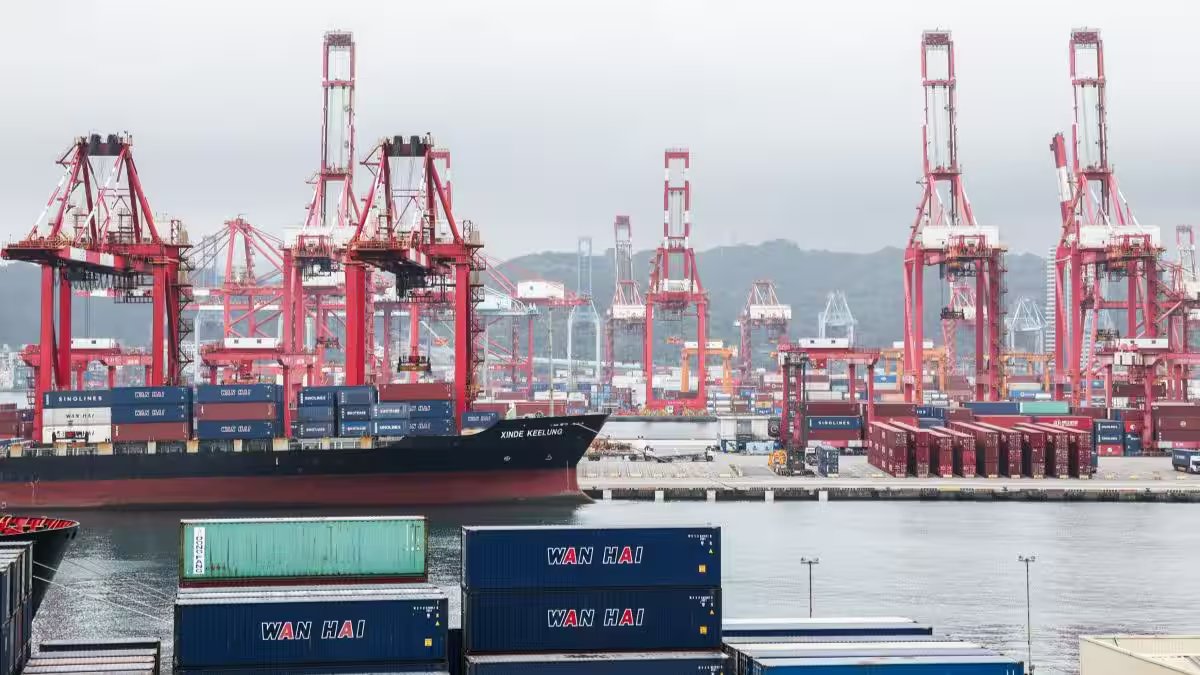
China criticised a new US–Taiwan trade deal lowering tariffs to 15% in exchange for major Taiwanese investments as Taipei welcomed the pact amid Beijing’s objections and rising geopolitical and semiconductor stakes.
China on Friday voiced strong opposition to a newly concluded trade agreement between the United States and Taiwan that aims to reduce tariffs on Taiwanese goods and encourage greater Taiwanese investment in the US. Beijing urged Washington to abide by the one-China principle, reiterating that Taiwan is part of Chinese territory.
Foreign Ministry spokesperson Guo Jiakun said China “consistently and firmly opposes” any agreements with Taiwan signed by countries that maintain diplomatic relations with Beijing. He criticised the accord during a regular press briefing, stressing that such arrangements carry official and sovereign implications that China rejects.
Despite Beijing’s objections, Taiwan’s premier welcomed the agreement, calling it the most favourable tariff deal granted to economies running trade surpluses with the United States.
The deal lowers US tariffs on Taiwanese products to 15 percent in exchange for $250 billion in new investments from Taiwan in the American technology sector. The terms mirror agreements Washington has reached with the European Union and Japan following President Donald Trump’s proposal to impose sweeping tariffs on key trading partners.
“For now, Taiwan has secured the best tariff conditions among countries with trade surpluses with the US,” Premier Cho Jung-tai said, adding that the agreement reflects Washington’s view of Taiwan as a key strategic partner.
Cho said the talks were aimed at reducing reciprocal tariffs and confirmed that Taiwan had negotiated a 15 percent tariff rate without additional charges. He noted that the rate matches those applied to Japan, South Korea and the European Union.
Trump had initially announced a 32 percent tariff on Taiwanese imports, later revising it to 20 percent before settling on the final rate.
In Beijing, Guo reiterated China’s position that it opposes any official agreements with Taiwan involving countries that recognise China diplomatically.
The US Department of Commerce said the agreement would establish an economic partnership focused on developing several advanced industrial parks in the United States to strengthen domestic manufacturing. It described the pact as a landmark deal that would significantly boost the reshoring of America’s semiconductor industry.
Cho said Taiwan had secured tariff reductions without extra fees for the automotive and wood furniture sectors, while some aerospace components would be exempt from tariffs altogether.
The agreement still requires approval from Taiwan’s parliament, where opposition lawmakers have raised concerns about its potential impact on the island’s semiconductor sector.
The deal was announced alongside news from Taiwan Semiconductor Manufacturing Company (TSMC), the world’s largest chipmaker, which said it plans to raise capital spending by nearly 40 percent this year. The company also reported a 35 percent increase in quarterly net profit, driven by strong demand linked to artificial intelligence.
TSMC has pledged around $165 billion of investments in the U.S. and said it’s speeding up construction of new plants in Arizona, looking to create a fabrication plant cluster and meet strong demand from clients.
The Commerce Department said that Taiwanese semiconductor producers that invest in the U.S. also will get favourable tariff treatment, including exemptions.
Ryan Majerus, a trade official in Trump’s first administration and in former President Joe Biden’s, said the agreement’s “timing is interesting.’’
The Supreme Court has yet to rule on the legality of Trump’s most sweeping tariffs, which he has used to strong-arm concessions out of other U.S. trading partners. The justices could strike down the tariffs as early as this month.
But Taiwan, facing ongoing threats from China, was eager to reach a deal and strengthen relations with the United States anyway. “Wanting to solidify things with the U.S. probably played a big role here,’’ said Majerus, now a partner at the King & Spalding law firm.
With inputs from agencies
End of Article