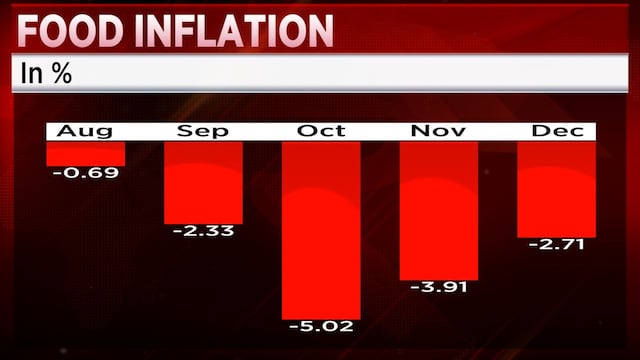
Food inflation slipped into negative territory at -2.7%, driven by lower prices of vegetables, fruits and cereals. This marks the seventh straight month of falling food prices, reinforcing the trend of subdued headline inflation.
Economists, however, cautioned that the unusually low print is unlikely to last.
ICRA Chief Economist Aditi Nayar said the December number was broadly in line with expectations and not a major surprise. According to her, food deflation should gradually ease, pushing headline inflation higher in the coming months.
She expects the next CPI reading to move above 2%, bringing inflation back within the RBI’s Monetary Policy Committee (MPC) 2–6% target band. Nayar also pointed out that inflation analysis will soon become more complex as India shifts to a new CPI series, with limited comparable historical data initially available.
Kotak Institutional Equities Chief Economist Suvodeep Rakshit said the December print gives the RBI comfort ahead of its February 6 MPC policy meeting, as inflation remains well below the lower bound of the target range.
While food prices were lower than expected despite higher-frequency indicators suggesting otherwise, Rakshit noted that even core inflation remains muted. Core inflation excluding gold is hovering around 2.3–2.6%, indicating slack in demand conditions.
According to him, such low inflation levels point to spare capacity in the economy rather than a broad-based slowdown. Some of this slack may narrow as commodity prices rise, but for now, inflation reflects a mixed growth environment.
Bond yields eased today, with the 10-year benchmark slipping below 6.6% for the first time in weeks. However, economists said the CPI print alone is unlikely to dictate bond market trends.
Bandhan AMC Senior Vice President and Economist Sreejith Balasubramanian said the inflation number supports the case for “lower-for-longer” policy rates, but bond markets are now more focused on fiscal dynamics, balance of payments trends, and government borrowing plans.
He added that expectations around India’s possible inclusion in global bond indices could provide incremental support, but supply-demand conditions, Open Market Operations (OMOs), and fiscal signals from the Union Budget will matter more.
Axis AMC Head of Fixed Income Devang Shah said bond investors are increasingly looking beyond near-term inflation. Rising global commodity prices, including base metals, could feed into inflation later, while concerns over higher government borrowing and state development loans (SDLs) are keeping long-term yields elevated.
On the interest rate outlook, opinions were mixed. Rakshit still expects one more rate cut in the cycle if growth weakens. Others believe the RBI is firmly on pause, unless growth disappoints materially later.
For the entire discussion, watch the accompanying video