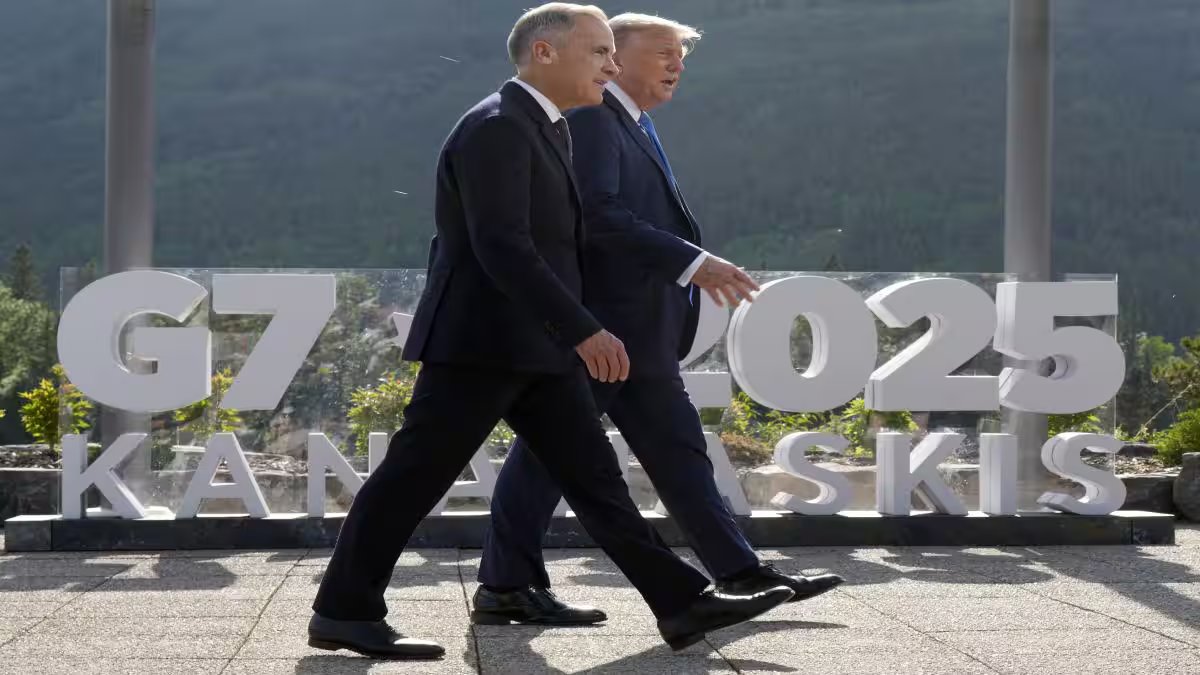
Carney made global headlines at Davos, indirectly rebuking the US president for a “rupture” in the postwar world order. The prime minister on Tuesday denied Bessent’s claim and said that he got a call from Trump
Canadian Prime Minister Mark Carney has said that he will not backtrack from his speech at the World Economic Forum in Davos, where he called out the US over its decisive policies. US Treasury Secretary Scott Bessent has claimed that Carney “aggressively” walked back from his statement during a recent phone call with US President Donald Trump.
“To be absolutely clear, and I said this to the president, I meant what I said in Davos,” Carney said as he confirmed his phone call with Trump after the global event in Davos last week.
Carney made global headlines at Davos, indirectly rebuking the US president for a “rupture” in the postwar world order. The prime minister on Tuesday denied Bessent’s claim and said that he got a call from Trump and that the two had a “very good conversation on a wide range of subjects.”
What did Carney say?
Carney sharply rebutted Trump’s controversial claim at the WEF that “Canada lives because of the United States.” In a national address, Carney said, “Canada and the United States have built a remarkable partnership,” adding, “Canada doesn’t live because of the United States. Canada thrives because we are Canadian.”
The prime minister’s recent trip to China also drew Trump’s attention, who said that Beijing will
“eat them up.”
The Canadian leader hailed a “landmark deal” under a “new strategic partnership” with China, marking a turning point in years of diplomatic spats, tit-for-tat arrests, and tariff disputes.
Carney has sought to reduce his country’s reliance on the United States, its key economic partner and traditional ally, as President Donald Trump has aggressively raised tariffs on Canadian products.
“Canada and China have reached a preliminary but landmark trade agreement to remove trade barriers and reduce tariffs,” Carney told a news conference after meeting with Xi.
Under the deal, China, which was previously Canada’s largest market for canola seed, is expected to reduce tariffs on canola products to around 15 per cent by March 1, down from the current 84 per cent.
End of Article