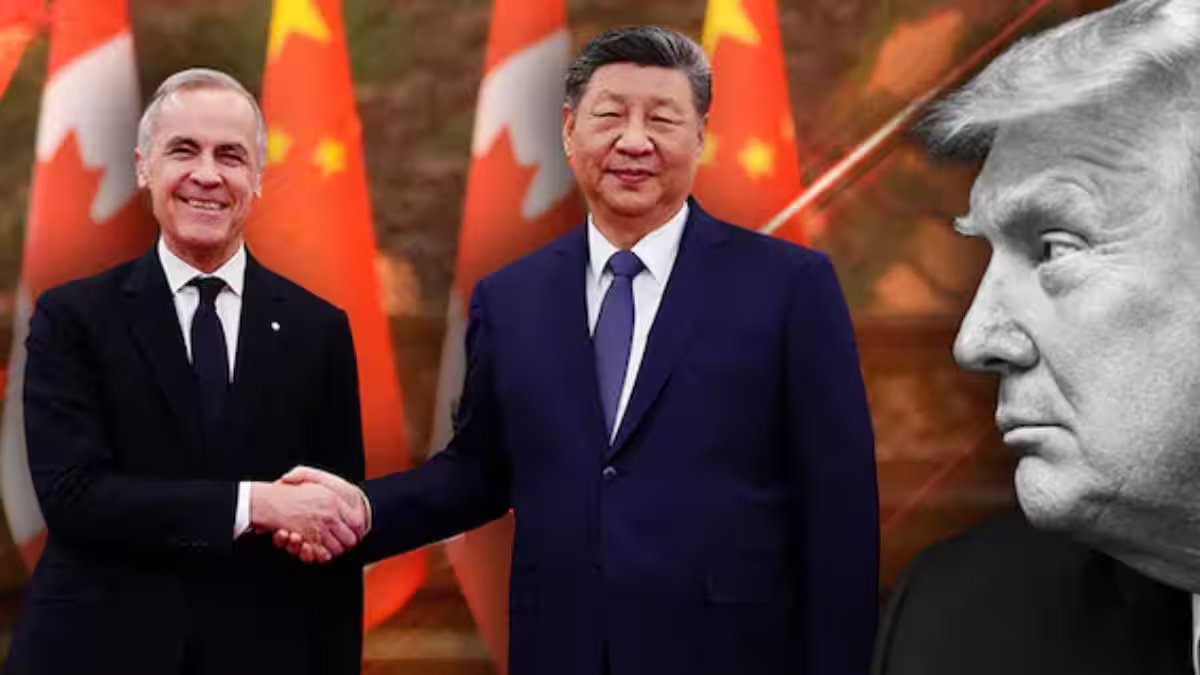
Canadian leader Mark Carney met China’s Xi Jinping this week. The two statesmen talked. Fractured relationships began to heal. And a third man, though he wasn’t in the room, nevertheless made his presence clearly known: Donald Trump.
In the sub-zero temperatures of Beijing this week, a diplomatic “thaw” took place that may redefine North American trade for a generation. Canadian Prime Minister Mark Carney’s meeting with Chinese President Xi Jinping concluded with a landmark—albeit preliminary agreement to de-escalate a bitter tariff war. While the two leaders focused on “strategic autonomy” and “predictability,” the shadow of a third man loomed over the Great Hall of the People: Donald Trump.
The Beijing Bargain: EVs for Canola
The most tangible result of Carney’s visit is a high-stakes trade-off designed to rescue Canada’s struggling agricultural sector while providing a relief valve for Chinese manufacturers. Under the new pact, Canada will slash its 100% punitive tax on Chinese electric vehicles (EVs), allowing up to 49,000 units to enter the country at a preferential rate of 6.1%. This cap is expected to grow to 70,000 vehicles over the next five years.
In exchange, China will reduce its staggering 84% tariff on Canadian canola seeds to approximately 15% by March 1, 2026. This move restores a $4 billion lifeline for Canadian farmers who have been caught in the crossfire of the U.S.-China trade war. The deal also includes visa-free travel for Canadians and the removal of “anti-discrimination” duties on seafood, including lobster and crab, which had seen exports plunge by over 30% in the previous yea
“The security landscape continues to change. You manage those threats through alliances,” Carney said, highlighting the dual objectives of economic engagement and geopolitical stability. Analysts said that China gains a foothold in North America at a time when Ottawa seeks more predictable trade partners amid the unpredictability of US policy under Donald Trump.
Trump’s shadow over diplomacy
Even as Carney celebrated the breakthrough in Beijing, Trump’s influence loomed large. The American president’s aggressive tariff strategies and unpredictable foreign policy have forced Canada to hedge its bets, recalibrating its approach to China while maintaining traditional US ties. Trump’s rhetoric, including suggestions that Canada could become the 51st US state, has strained bilateral relations and accelerated Ottawa’s pursuit of alternative trade avenues.
Experts say Canada’s moves represent both a political and economic balancing act. “China is succeeding in driving a small wedge between Canada and the US,” noted Nelson Wiseman, professor emeritus of political science at the University of Toronto. By engaging China on economic terms while acknowledging cultural and political differences, Canada seeks predictability that has been largely absent from its US relationship in recent months.
Robert Bothwell, professor of Canadian history and international relations, added, “Trump wants a fragmented North America that is easier to bully. China, on the other hand, benefits from a coherent Canada with a functioning economy.” While Trump publicly praised Carney’s deal as positive, his administration’s next moves could reshape Ottawa’s calculations, underscoring the fragile nature of the progress made in Beijing.
Strategic gains and future uncertainty
The longer-term implications of Carney’s visit remain uncertain. Canada now possesses a framework for engaging China economically, gaining potential advantages in trade diversification and investment. China, meanwhile, strengthens its presence in North America and enhances its global image as a reliable counterbalance to US dominance. The deal also reflects the growing role of Chinese soft power in regions with significant Chinese diaspora populations, such as Vancouver.
Yet, analysts warned that Trump’s policy volatility remains a key risk. With Washington still central to Canada’s economic and security landscape, any abrupt shift in US trade or diplomatic priorities could undermine Canada’s recent gains. For now, however, Beijing secures a more predictable partner in Ottawa, even as the unpredictable U.S. looms as both a trading partner and a strategic variable.
Carney’s visit may be seen as a measured step toward balancing North American alliances, but the calculus of global diplomacy, particularly under the shadow of Trump’s policies ensures that caution will remain central to Canada’s strategy.
End of Article