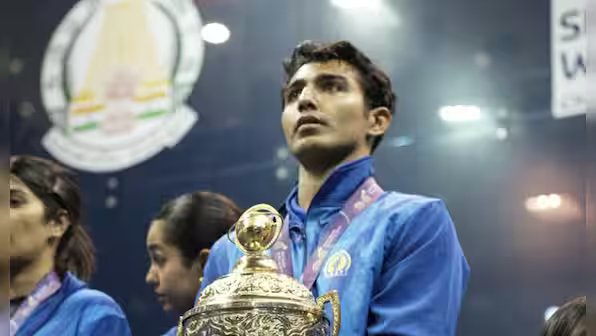
December 2025 will go down in the history books of Indian squash as a watershed month for the sport. Earlier this month the Indian quartet of two-time Asian Games medallist and team captain Abhay Singh, the highly decorated veteran Joshna Chinappa, seven-time Asian Championships medallist Velavan Senthilkumar and 17-year-old prodigy and two-time Asian Games medallist, Anahat Singh managed to do something that had never been done before in the history of Indian squash –
win the squash World Cup – a tournament that had its first edition in 1996 and the last three editions of which have been held in Chennai. With this India became the first Asian country and the fourth overall to win this title.
The Indian team, seeded second, was peerless in the tournament, remaining undefeated enroute to winning the title, beating defending champions Egypt in the semi-finals and another squash powerhouse, Hong Kong, in the summit clash. Needless to say that though the World Cup is held sporadically (there have been only five editions of the tournament since its inception in 1996) this win will be remembered for a very long time and promises to be a huge shot in the arm for the current top crop of Indian squash as well as huge motivation and inspiration for the next generation of players who aspire to represent the country on the highest stages someday.
So, what went into this highly successful campaign? What was the team environment like? What did the players make of the scheduling of the World Cup this time, in December, as opposed to the March and June dates for the last two editions in Chennai (2011 and 2023)? What were the big targets for the captain and how easy or difficult was it to take on a leadership role for this team?
To talk about all that and more, we spoke to team captain Abhay Singh, as part of an exclusive interaction. The 27-year-old Abhay is India’s current number one male squash player and the highest-ranked Indian men’s player currently, ranked 29th in the PSA rankings. The extremely confident and articulate Abhay was also part of the 2023 squash World Cup squad, which won the bronze medal and was part of the Indian team that won the team gold at the 2022 Guangzhou Asian Games, along with the mixed doubles bronze.
Abhay has been coached by legends like six-time World Championship medallist, James Willstrop, former Asian Games medallist, Harinder Pal Singh Sandhu (current Indian men’s coach) and David Campion, who coached the England national team for 23 years, among others.
In a candid chat, Abhay talked about his captaincy mantra for the team at the World Cup this time, what he thought was the big difference between this team and the one that represented the country at the 2023 edition, his take on teammate Anahat Singh, who is widely tipped to have a very successful career, his relationship with his teammates, how leadership comes naturally to him, the state of squash coaching overall in the country, the scheduling of the World Cup vis-à-vis the World Team Championship, looking ahead to LA 2028, where squash will be making its Olympic debut and more.
This is part one of the interview.
First-up, I wanted to take you back to the recent past – to the time when you and your teammates, Joshna, Anahat and Velavan won the squash World Cup title in Chennai. This was of course India’s maiden squash World Cup title. Talk to me a little bit about that experience. The team didn’t lose a single match enroute to the title. Were you expecting this clinical a performance yourselves?
Abhay Singh: Well, certainly speaking for the three of them, they were in very good shape. They had had a good run at the Chennai Open, the week before (the World Cup began). The match vs Egypt was a lineup that we couldn’t fully bet on every player with (India beat defending champions Egypt 3-0 in the semi-finals), but I am really happy that everyone delivered wins through the event.
In the final of the World Cup, you beat the top-seeded team, Hong Kong and didn’t even need the fourth match, which Velavan was scheduled to play. As team captain, what were some of the strategies that you had chalked out with your teammates?
Abhay Singh: Vela (Velavan Senthilkumar) and Joshna didn’t really need a lot from me, because they are very experienced and older as well, but Anahat and my matches were quite crucial, because we played in the middle of the line-up and on the day we played Egypt, I told her that she shouldn’t worry about the matches that are after her’s, all she needs to do is focus on a good result in her match and I will take care of the rest. I knew that when she finished her match, all India needed was three more games and that’s what I had to put on the board and I did that successfully and it was the same with the match against Hong Kong, in the final. We spoke in the dressing room, before the match and I told Anahat – ‘I will set it up for you’, because I was very confident on the day of the final and I told her that I would give her a good cushion to express herself and play free squash and that’s exactly what she did in the final, after my 3-0 win. So, it was a successful outing, in that sense, as a captain as well.
The last edition of the squash World Cup, which was also in Chennai, was held in June. Before that, in 2011, it was played in March. This time the tournament was organised in December. What did you make of the scheduling?
Abhay Singh: The World Team Championship (organised by the World Squash Federation, which governs international squash and focuses on the national teams, their development and will also oversee squash at the Olympics in 2028) happens at the same time. It was held last year, in December and it will be held next year in December as well and it’s (held) every two years. And the World Cup being every two years (there have been only five editions of the squash World Cup so far. The editions so far have been held in 1996, 1999, 2011, 2023 and 2025, with the last three editions all being held at Chennai) that kind of streamlines when the World Championship is going to be held, which actually helps the athletes plan because if you know there’s a big event every two years in December then it makes scheduling the rest of the year very easy. So, in some ways, it was a positive to keep an event like this (the World Cup) in December and you finish your year with it, which is always a good thing – playing for your country in the last event of the year and doing well in that make the whole year feel very positive. So, personally for me, I really enjoyed the way this event was held, in terms of timing and the dates they picked, but I am not sure how the other players viewed it.
The World Cup, in many ways, is the epitome, in a sense, of playing at the highest level and becoming world champions. I wonder what your take is on the sort of sporadic nature of the squash World Cup. The fact that, because of a lack of consistent funding, scheduling conflicts with PSA Tour events that offer both higher prize money and ranking points etc, the World Cup is not held regularly. As someone who plays at the highest level, what is your take on that?
Abhay Singh: First-up, a lot of credit to Indian squash for taking up the World Cup and hosting it now three times in a row (in Chennai). I think it was more about the countries wanting to pick up the Championships. For you to have a twentieth edition, you need to have a first and second. This (the World Cup) will hopefully become a main draw event, which is great. It’s a different mix to the traditional 11-point event, having a 7-point and golden point format (The Squash World Cup uses a unique team format with a Point-a-Rally (PAR) scoring system to 7 points and not 11 and best-of-five games per match. If there’s a tie at 6-6, a sudden-death point decides the winner) and if players have no problems, then I don’t see a problem with it being held every two years.
Congratulations to the Indian Squash Team for creating history and winning their first-ever World Cup title at SDAT Squash World Cup 2025!
Joshna Chinnappa, Abhay Singh, Velavan Senthil Kumar and Anahat Singh have displayed tremendous dedication and determination. Their success… pic.twitter.com/hJNF3mPSXt
— Narendra Modi (@narendramodi) December 15, 2025
India have become the first Asian country to win the squash World Cup title and has joined the likes of Australia, England and Egypt as World champions in the five editions of the tournament held so far. As someone who was team captain, how big a shot in the arm was this win?
Abhay Singh: I was quickly able to observe what the team required going into the next generation, with the retirement of my seniors. I think that was very important to note and to see where there are gaps – (things) that our seniors haven’t been able to provide in terms of leadership. I am naturally someone who thrives in a team event and loves guiding athletes and being a natural leader, since the Asian Games – when I went from being the junior of the team to very quickly becoming number one on the line-up – and it showed last year when India had its historic best finish at the World Team Championships, where we finished fifth and I led the line-up and I led the line-up at the World Cup as well. Sometimes, it’s less about performances and the level of players and it’s more about how well a team is getting along and how strong your bond is (with the other players in the team).
If I can be the catalyst for that then I am very happy to take on that responsibility, whether I am officially captain or not – it comes naturally to me and it’s showing (more and more) over the last few years. The guys my age are achieving things that are very, very rare and that could mean exciting times for me, if I am going to be the chosen one to lead India, going forward.
As team captain, your leadership was being talked about a fair bit after the World Cup win. I read somewhere that you said that “I was surrounded by teammates who don’t really need to be led, they’re all strong individuals, mentally tough and very like-minded. For me, it was simply a privilege to be playing this event with them.” However, as team captain, especially with a veteran and celebrated player like Joshna in the ranks and with someone as young as Anahat, there must have been some pressure – to lead the team and at the same time to ensure that everyone is on the same page. Talk to me a little bit more about the overall experience of being team captain at the World Cup and your approach to it…
Abhay Singh: Captaincy has a lot to do with leading and these (World Cup teammates) are all leaders in their own ways. They don’t need to be led or guided. You are talking about Joshna (Chinappa), who is the most decorated (Indian) squash player of all time (5 World Championship medals, 2 World Cup medals, 2 CWG medals, 5 Asian Games medals, 6 Asian Championships medals, 6 South Asian Games medals). There’s not much that I can say to her that she doesn’t already know or doesn’t already have in her armoury. The same goes for Vela (Velavan Senthilkumar). We are very close doubles partners so there’s no leadership here, it’s more of a bond. Yes, with Anahat (Singh) a bit of guidance has to come through. But now she is experienced, playing the big events. It’s more about letting people know that you are there to help them when someone has a bad day, especially in a mixed-team event, where all four players play on the line-up. It’s very important to know that the person playing either before you or after you is going to back it up and that was my only job in the World Cup.
It wasn’t more about leading off-court or giving any motivational talks. It was just – ‘I am going to go on court and I am going to put three games on the scoreboard for my team’ and I think that is more of what a captain needs to do. You are the number one player in the country and you are the highest ranked player in the men’s squad, so you have a responsibility to go out there and show why you are who you are and I think that was what was really expected of me and I am very happy to have delivered that, especially in crunch moments against Egypt and Hong Kong.
Talking about Indian squad, overall, for all the squash fans out there who don’t know all the details, could you shed some light on the evolution of Indian squash in terms of its squad growth? In 2023, in the World Cup, India won the bronze, now the title, you talked about India finishing fifth at the World Team Championships, the team is pushing traditional powerhouses like Egypt and Hong Kong. If you had to analyse the growth of Indian squash and the top-level squad, what would your take be on that?
Abhay Singh: I feel like, when I was in the team events earlier, there were many times when the team was less of a team. You might play an individual sport and you go on court alone, how much of a team (person) you can be in those moments showcases how strongly your team performs as a collective (unit). At the 2023 World Cup and at the 2023 Asian Games, I think there was a lack of a bond between a lot of the athletes on the squad. Not for any specific reason, but simply because I think that you need to spend more time (with each other) and be open to getting to know each other, which this squad has done really well. Of course, the fact that I have been doubles partners with all three of the other team members helps me. That gives me an idea of how the three of them operate when they are in close proximity and in pressure situations. I think that was the real key factor in the World Cup. I actually feel that our squad was stronger in the 2023 World Cup. We had Sourav (Ghosal) in the squad (in 2023), but I feel that there was a huge mismatch between how everyone got along and how the team bonded, which was clearly not the case this time. Anahat and Joshna have a great relationship. Me and Joshna (Chinappa), me and Anahat (Singh), me and Vela (Velavan Senthilkumar) – we all have very, very good relationships. It’s always positive and very lively. Going forward, it’s very important, especially for players like me and Vela (Velavan Senthilkumar) – the senior men to provide that sort of warmth to any newcomers coming into the team and give them the freedom to showcase their game, which Anahat (Singh) has done. If you can just let the girl be and not get too involved with the fact that she is just 17 and that she has a lot of expectations on her shoulders, she will absolutely shine. That was exactly what my job was, as to not let her take on any pressure or let anyone tell her anything that disturbs her rhythm. I think everything put together, it was a very positive week.
A word on Anahat now. She is only 17, but she is already a World Cup winner, an Asian Games and Asian Championships medallist, along with the junior medals she has won at the World and Asian stages. She is extremely confident, switched from badminton to squash and made that decision with a very clear head. She has been coached by Ritwik (Bhattacharya). As someone who has been her teammate and team captain, what is your take on Anahat the squash player and how bright her future looks…
Abhay Singh: I have always been an advocate of not speaking about Anahat much and the kind of squash player she is because I think enough of it happens and for a 17-year-old girl, I think it’s unnecessary – some of the stuff in the media. I think it’s very important to let this girl breathe and live, express what she is going through, grow. At the end of the day, yes, she is part of the limelight, but she is also 17 years old. Anahat and I have a very different kind of relationship. We don’t speak about squash, we don’t converse about matches. We don’t even wish each other or congratulate each other much.
It’s a very fun bond off the court. We just chat, hang out, gossip, eat food. It’s a very light relationship, which is helpful for her, because you can’t have someone like her only being spoken to about squash, what her future holds, when she is winning, how she is losing. It’s an overall responsibility of everybody who is a part of her inner circle to find who she is and who she is in the sport and if we let her do that, then I have no doubts that we potentially have a World number one and World Champion in the individual game on our hands.
A special moment – grateful to be honoured by Shri Mansukh L. Mandaviya🙏 pic.twitter.com/NJENgQYC6y
— Anahat Singh (@Anahat_Singh13) December 18, 2025
She needs to be taken care of very well by everyone involved. She of course has a great team around her which I know because I am quite close to her and the family. She is absolutely on the right path, she is already making us proud and she will hopefully keep doing that.
End of Article