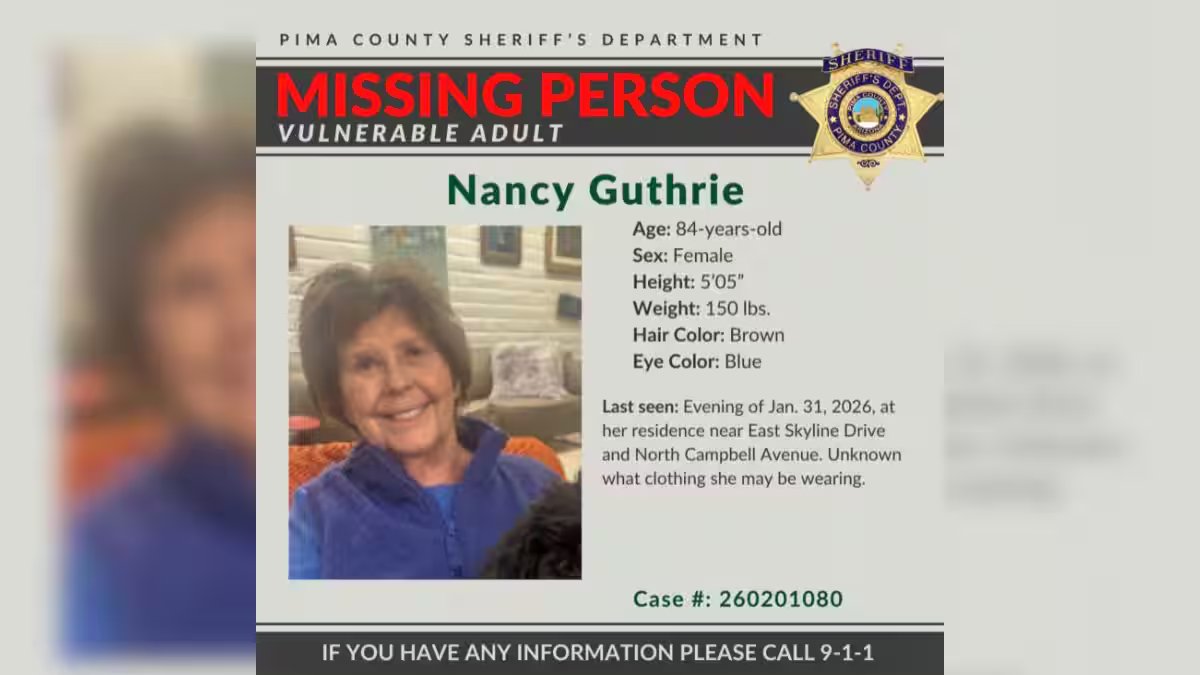
Nearly three weeks after 84-year-old Nancy Guthrie vanished from her residence in the Tucson area of Arizona, investigators say a seemingly small piece of physical evidence may hold major investigative value.
A glove recovered from a roadside field several kilometres from her home is now being examined for DNA, with federal authorities confirming that it resembles the gloves worn by a masked figure recorded on surveillance video outside Guthrie’s front door shortly before she went missing.
As law enforcement agencies increase forensic work and process thousands of public tips, the case has evolved into one of the most high-profile missing-person investigations in the region, drawing national attention because Guthrie is the mother of US television journalist Savannah Guthrie.
Officials from the FBI and the Pima County Sheriff’s Department have said the inquiry has entered its third week with no confirmed proof of life or death.
However, investigators continue to gather evidence from multiple locations, conduct court-authorised searches, analyse biological material, and review surveillance footage in an effort to reconstruct the sequence of events surrounding Guthrie’s disappearance.
Timeline of disappearance and early findings
Nancy Guthrie was last seen on January 31 after being dropped off at her Tucson-area home by family members following a family gathering at her daughter Annie’s residence.
The following day, members of her church noticed she did not attend services and alerted her family, prompting relatives to report her missing to authorities.
Law enforcement agencies responded by launching an immediate search operation, deploying helicopters, canine units trained in scent tracking, and large teams of officers to canvass nearby areas.
From the earliest stages of the investigation, officials expressed concern that Guthrie could not have left her home independently. Sheriff Chris Nanos said she had severely restricted physical mobility and required assistance, which led investigators to determine that she had likely been taken against her will.
Subsequent forensic work at her home reinforced the seriousness of the case. DNA testing confirmed that blood found on her front porch belonged to Guthrie. Authorities also disclosed that additional biological material was discovered at the property that did not match Guthrie or anyone known to be in close contact with her.
Those samples were sent for forensic examination, though investigators have not publicly disclosed any laboratory outcomes linked to that material so far.
As days passed with no sign of Guthrie’s return, purported ransom notes were delivered to news organisations. At least two such notes surfaced, with deadlines for payment that elapsed without any verified direct communication between those believed to be responsible and either Guthrie’s family or law enforcement agencies.
Despite the ransom messages, authorities have said there has been no confirmed contact from any suspected captors. Sheriff later stated that no proof of life had emerged, adding: “There’s not been any proof of death either.”
A critical development in the case came with
the release of surveillance footage captured by a doorbell camera at Guthrie’s home. The video shows a person outside her front door during the early morning hours before she was reported missing.
The individual is seen wearing a ski mask, gloves, long trousers, and a jacket, while carrying a backpack and wearing a handgun holster. Investigators also noted that the person appeared to attempt to interfere with the camera system.
Federal authorities described the individual as a man of average build, approximately 5 feet 9 inches tall. The backpack visible in the footage was identified as a 25-litre Ozark Trail Hiker Pack.
Nanos said he was confident that the individual shown in the recording was the primary suspect investigators were seeking in connection with the case. The FBI later described the masked person as a suspect and continued to ask for public assistance in identifying him.
The release of the footage prompted renewed efforts to gather tips from the public. Authorities made dedicated phone lines and a website available for people to submit information.
According to officials, the FBI has received more than 13,000 tips since early February, while the sheriff’s department has fielded at least 18,000 calls. Law enforcement agencies have not confirmed whether any of those tips have directly led to arrests or major breakthroughs, but officials have said each submission is being reviewed and logged as part of the ongoing inquiry.
The glove discovery and forensic process
The investigation took a new turn when law enforcement officers conducting searches near Guthrie’s home recovered several gloves in a roadside field approximately two miles away. In total, roughly 16 gloves were collected in recent days.
Officials later clarified that most of these items were discarded by people involved in search efforts and were not believed to be linked to the suspect. However, one glove was identified as potentially significant because it appeared to match the gloves worn by the masked individual in the surveillance footage.
The FBI confirmed that this particular glove was sent for DNA testing at a private crime laboratory in Florida. Preliminary findings were received on Saturday, with officials stating that the results were pending “quality control and official confirmation” before being submitted to national databases for comparison.
Once the quality assurance process is complete, the DNA profile is expected to be entered into the Combined DNA Index System (CODIS), the national database used to compare DNA from crime scenes with profiles from convicted offenders and unsolved cases.
Federal officials indicated that the process of running a sample through CODIS generally takes around 24 hours once the FBI receives the confirmed profile.
Investigators have said the DNA profile from the glove could potentially generate what forensic experts describe as a “hit,” which would link the specimen to an existing profile in the database.
Such a development could identify a suspect or connect the glove to another criminal investigation. However, authorities have emphasised that the forensic process involves multiple steps and verification procedures before any conclusions can be drawn.
Expanded searches and investigative activity
Alongside forensic analysis, law enforcement agencies have continued to carry out targeted searches and investigative actions. In recent days, officers sealed off a roadway near the field where the glove was found to allow forensic teams to examine the area.
A Range Rover SUV was also tagged and removed from a nearby restaurant parking area as part of the investigation, though authorities have not publicly disclosed the reason for its relevance.
Court-authorised searches were conducted at multiple properties. One search took place at a residence in an affluent neighbourhood less than two miles from Guthrie’s home. Another search occurred in Rio Rico, located south of Tucson.
These operations were carried out with warrants obtained in connection with the Guthrie case. Officials said that no arrests resulted from either search.
In addition, deputies conducted a traffic stop in the southern part of the Tucson area, during which an individual was questioned in connection with the investigation. Authorities later confirmed that the person was released without charges.
Law enforcement agencies have declined to provide details about what prompted the stop or the nature of the questioning, citing the ongoing nature of the investigation.
Health concerns and urgency of the search
From the outset, authorities and family members have stressed that Nancy Guthrie’s health makes the case particularly urgent. Law enforcement officials said she requires daily medication to survive and that she has a pacemaker.
Sheriff’s dispatcher audio indicated she has a history of high blood pressure and heart-related medical issues. Nanos later described her as being “not in good physical health,” while also noting that there were no reported cognitive impairments.
Investigators have repeatedly stated that the absence of her medication could place her in serious medical danger. These concerns have intensified public appeals for information and heightened the urgency surrounding the forensic work and search operations.
Officials have continued to remind the public that even seemingly minor details could assist investigators in locating Guthrie or identifying those responsible for her disappearance.
Family’s public appeals
Savannah Guthrie and her siblings, Camron Guthrie and Annie Guthrie, have used social media to directly address whoever may be holding their mother or may have knowledge of her whereabouts.
Their messages have evolved over time. Early videos focused on emotional pleas to the presumed captor and statements indicating a willingness to comply with ransom demands if it would lead to their mother’s safe return.
In one of the later messages posted two weeks after their mother was reported missing, Savannah Guthrie addressed “whoever has her or knows where she is” and said, “We believe in the essential goodness of every human being, and it’s never too late.”
In another video message released on Sunday night, she added, “It is never too late to do the right thing. And we are here. And we believe in the essential goodness of every human being, that it’s never too late.”
After the FBI announced progress on the glove DNA analysis, Savannah Guthrie also posted a message expressing continued hope and urging anyone with information to come forward.
The family has described Nancy Guthrie as a caring and supportive figure who played a central role in keeping them together after the death of their father from a heart attack in 1988.
Savannah Guthrie, who was 16 at the time of her father’s death, has spoken about her mother’s influence and strength in maintaining family unity during that period.
Officials confirmed that the FBI increased the reward for information related to her disappearance from $50,000 to $100,000.
The case has also attracted expressions of sympathy and support from national political figures, including President Donald Trump.
With inputs from agencies
End of Article