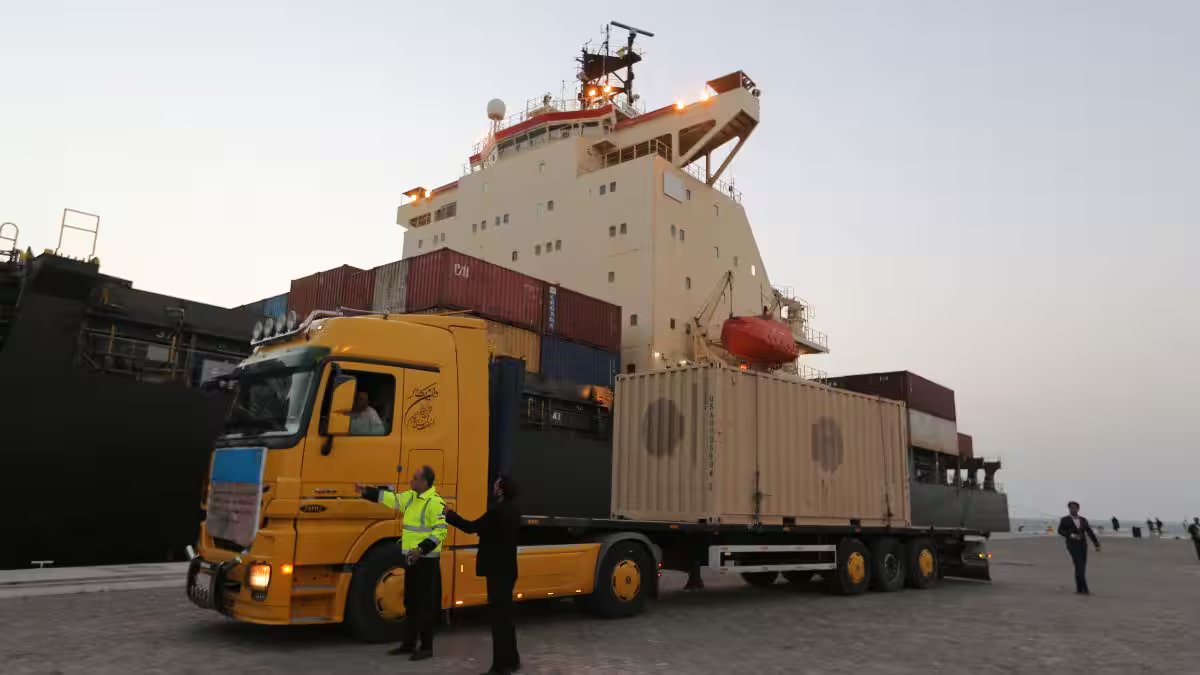
India allocated no budgetary support for Iran’s Chabahar port, triggering speculation about New Delhi’s future plans for the strategic dockyard. This, however, is ‘more of a pause than exit’, a prominent geopolitical expert tells Firstpost.
India’s zero allocation for Iran’s Chabahar port in the Budget represents a pause until the sanctions environment becomes more predictable rather than an exit that would amount to a strategic mistake, according to Anchita Borthakur, a scholar of geopolitics at the Chintan Research Foundation (CRF).
In sharp contrast to 2025–26, when the grant to the Chabahar port was increased fourfold,
the Budget for 2026–27 has reduced it to zero.
The reduction comes at a time when US President Donald Trump has doubled down on his ‘maximum pressure’ campaign, intensifying sanctions and military pressure on Ayatollah Ali Khamenei’s regime. As part of this push,
he restored sanctions on India’s Chabahar port projects in September 2025. A month later, he granted a six‑month waiver but has not committed to renewing it.
This marks a significant reversal from eight years of bipartisan American support for the Chabahar project when Trump in his first term and then President Joe Biden granted India waivers for the port’s development. This shift lies behind the zero allocation for the port.
Budgetary allocation to Iran’s Chabahar port development since 2024-25:
| Actuals 2024–2025 | Budget Estimates 2025–2026 | Revised Estimates 2025–2026 | Budget Estimates 2026–2027 |
|---|---|---|---|
| Grant | Loan | Total | Grant |
| — | — | — | — |
| 400.00 | — | 400.00 | 100.00 |
The decision to withhold fresh funding for Chabahar’s development does not necessarily indicate that the government is walking away from the port but, more plausibly, it suggests that it is delaying new expenditure until the sanctions environment becomes clearer and less prone to abrupt changes, according to Borthakur.
Borthakur said, “In May 2024, India and Iran signed a 10‑year agreement to develop the strategically significant Chabahar port. India has already disbursed its $120‑million commitment to develop Chabahar’s Shahid Beheshti terminal under the agreement. Since that money is already committed and being utilised, an additional budgetary provision may not have been required at this point.”
In any case, Chabahar is too important for India to abandon.
‘A complete exit from Chabahar would be a blunder’
India has envisioned the Chabahar port as a gateway to Afghanistan, Central Asia, and beyond.
Although discussions began in the early 2000s, India and Iran finalised the agreement on the port in 2015. Over more than a decade, India has spent around Rs 1,000 crore on the project and extended another Rs 2,000 crore as a line of credit.
Given its strategic value and India’s financial and political investment, “a complete walk‑away would be a strategic blunder for India, particularly given China’s expanding footprint and influence across the wider region”, Borthakur said.
“India’s connectivity push through Chabahar appears to be slowing and attracting less visible funding, but the trend points to a pragmatic pause driven by risk management rather than any fundamental decision to exit,” Borthakur told Firstpost.
Chabahar always plagued by funding hiccups and hard questions
Given the complexities of West Asia and Trump’s unpredictable foreign policy, India’s involvement in Chabahar has long been accompanied by questions over its long‑term viability.
Amid Trump’s maximum pressure strategy and worsening insecurity —marked by near‑daily threats of military action— analysts have questioned whether Chabahar can remain a dependable trade route for Afghanistan, Central Asia, and neighbouring regions.
Even though New Delhi has explored air‑freight corridors with Afghanistan to compensate for Chabahar’s limited access, these are not true alternatives. Air cargo—even with discounts—costs far more than shipping by sea. Except for select high‑value, low‑weight goods, air transport cannot replace maritime routes.
Such concerns as well as funding irregularities are not new. In fact, India’s engagement at Chabahar has always fluctuated and nothing illustrates this better than budgetary allocations.
In 2016–17, the government allocated Rs 150 crore to the port but this was later revised to just Rs 0.1 crore. In 2017–18 and 2018–19, Rs 150 crore was allocated each year, but no expenditure was recorded. The same happened in 2019–20 despite an initial allocation of Rs 45 crore.
Similarly, in 2020–21, no funds were spent despite an allocation of Rs 100 crore — although this coincided with the Covid‑19 pandemic.
It was only in 2021–22 that India began spending at Chabahar again, coinciding with Joe Biden’s assumption of the US presidency.
| Financial Year | Budget Estimates (BE) | Revised Estimates (RE) | Actual Spending |
|---|---|---|---|
| 2016–17 | — | — | 100 |
| 2017–18 | 150 | 0.1 | — |
| 2018–19 | 150 | — | — |
| 2019–20 | 45 | — | — |
| 2020–21 | 100 | — | — |
| 2021–22 | 100 | 100 | 100 |
| 2022–23 | 100 | 100 | 100 |
| 2023–24 | 100 | 100 | 100 |
| 2024–25 | 100 | 100 | 400 |
| 2025–26 | 100 | 400 | — |
| 2026–27 | — | — | — |
In both 2021–22 and 2022–23, India spent the entire allocated grant of Rs 100 crore.
In 2024, after signing a 10‑year agreement for the handling of a port terminal and committing $120 million (around Rs 1,000 crore), India allocated Rs 100 crore but ultimately spent Rs 400 crore. Similarly, in 2025–26, the government allocated Rs 100 crore and later revised this upward to Rs 400 crore.
End of Article


