
As India awaits the first advance estimates of GDP on January 7, economists caution that while real growth remains resilient, subdued nominal growth—unadjusted for inflation—could limit the government’s fiscal flexibility.
Morgan Stanley’s Chief India Economist Upasana Chachra said, “In this environment of low inflation that we have seen… the nominal growth will be an important key takeaway.”
Morgan Stanley expects India’s real GDP to expand by 7.6% in 2025-26 (FY26), marginally higher than a CNBC-TV18 poll estimate of 7.5%.
Sakshi Gupta, Vice President and Senior Economist at HDFC Bank, is slightly more conservative at 7.4%, though she said risks to the forecast are “clearly on the upside.”
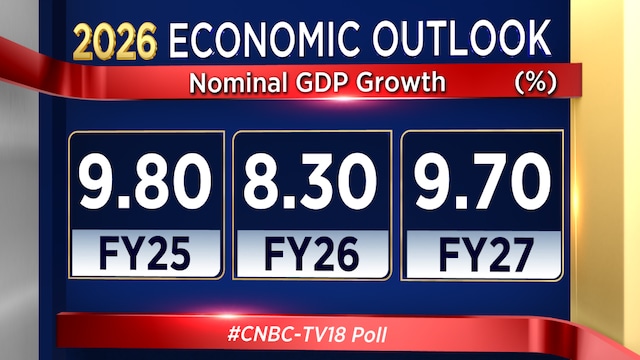
However, both economists flagged nominal GDP as the bigger concern, with Morgan Stanley projecting 8.4% and HDFC Bank 8.3% for FY26.
Gupta said the importance of the advance estimates—based on data extrapolated up to November—lies in how they feed into fiscal assumptions. “What will be interesting to watch out for… what is the government going to assume in terms of nominal growth for 2026-27 (FY27),” she said.
HDFC Bank expects the government to work with a 10.1% nominal GDP assumption for the next fiscal year, a figure that would directly influence tax collections and debt-to-GDP projections.
While high-frequency indicators offer a mixed picture, consumption trends remain supportive. Chachra pointed to strong automobile sales, which have risen over 20% in recent months, as evidence that demand is holding up after the festive season. At the same time, she acknowledged weak pockets such as power consumption, which has only recently begun to improve.
For the full year, Gupta expects consumption growth of 7.2% and investment growth of 7.5%, aided by front-loaded government spending and the impact of goods and services tax (GST) cuts in the first half.
Both economists also flagged a likely slowdown in the January-March quarter of 2026 (Q4FY26), driven by a high base and a pullback in government expenditure. “This year is not an easy year to meet the fiscal deficit target,” Chachra said, adding that spending restraint would be necessary to meet the FY26 deficit target of 4.4% of GDP.
Gupta echoed the concern, saying she is not “overtly optimistic about Q4 numbers” given the expected rationalisation of government spending.
Also Read | Union Budget 2026 should push R&D, tap demographic dividend: CareEdge’s Rajani Sinha
Both economists expect nominal GDP growth to rebound in FY27 to around 10%, supported by a low inflation base effect even if real growth moderates to between 6.5% and 7%.
Chachra said this recovery will be important for corporate revenues and earnings. “December quarter should mark the trough from a nominal growth perspective and the next four quarters should start showing a mild recovery,” she said.
The economists also briefly touched upon the upcoming revision of the GDP series scheduled for February 28, expressing cautious optimism that the updated data could present a more favourable picture of India’s economic trajectory.
For the entire discussion, watch the accompanying video