She sees FY27 as a transition year, with growth shifting from being consumption-led and informal-sector driven to one where the formal sector and investment play a larger role. This transition, in her view, should help stabilise growth around India’s potential rate.
As the Union Budget 2026 approaches in February 1, expectations are building around how the government will balance fiscal discipline with growth priorities in a relatively stable macro environment.
According to a CNBC-TV18 poll, economists are pencilling in a recovery in nominal GDP growth to about 10% in FY27, supported by better real growth and a moderate inflation deflator. Higher nominal growth is expected to translate into stronger tax collections, offering the government some room even as it continues on the path of fiscal consolidation.
From a fiscal strategy perspective, Sonal Varma, Chief Economist at Nomura, argues that while there is some fiscal elbowroom, the need for fresh stimulus is limited. With tax relief, GST cuts and front-loaded capital expenditure already supporting the economy, the focus of Budget 2026 is expected to shift towards medium-term priorities.
On the financing side, Upasna Bhardwaj, Chief Economist at Kotak Mahindra Bank, highlights the importance of non-tax revenues, particularly the Reserve Bank of India dividend, in supporting the government’s math.
Below are the edited excerpts of the interview.
Q: The fiscal deficit has to come down only marginally next year, compared to 40 basis points and 60 basis points in previous years, plus the expectation is of a higher nominal GDP. So would you say there is a little more elbowroom again, no tax cuts expected s little more elbowroom for the government to do something this year?
Varma: There is elbowroom but the bigger question is there a need in terms of counter cyclical growth support? In the last 12 months from the fiscal side, we have already seen counter cyclical measures in terms of the personal income tax cut, the GST cuts, the front loaded capital expenditure, and the latter two to counter the higher US tariffs. So, the economy is in a good place right now, having seen the impact of fiscal easing, plus, of course, the monetary policy easing. So, in terms of whether stimulus is needed, I don’t think there is a big need at this stage.
What is more important right now is to focus more on the medium term. The global backdrop in which India needs to grow, how do we make our supply chains more resilient? Do we expand the Make in India scheme? How do we boost domestic demand? These are the more medium term pillars that need a bigger focus in this budget?
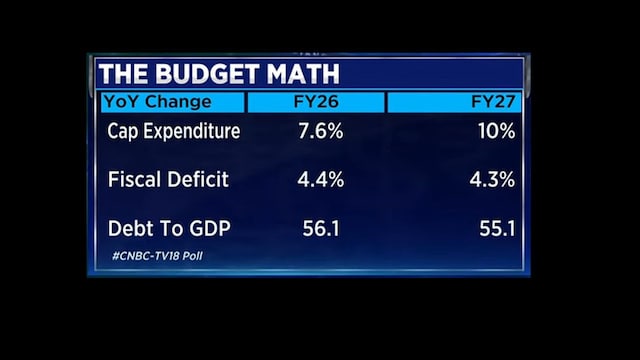
Q: Pranjul, how confident are you of this growth number? I got an average of 10.1% from all of you. Some of you are a little south of 10%, and some a little north of 10.1% but does it look like we will have a comfortable, real and deflator?
Bhandari: Having a 10% nominal GDP growth is quite possible in FY27 and you can also have slightly higher number. I would break down 10% in terms of 6.50% for real growth and 3.50% for the deflator. The state of the economy has been quite confounding, I can give you enough indicators which show things are looking good, like credit growth. It has picked up, or enough to show you that things are looking bad. For example, PMI, which has started to fall in the last couple of months. The truth is that the economy is in crossroads.
2025 was all about the informal sector coming back up and a consumption driven growth. 2026 is going to be the formal sector reappearing and moving a little more towards investment. We are in this crossroads, and that is why we are getting all of these confusing mix of data. However, the underlying growth is steady. 6.50%, which also is my estimate of India’s potential growth, is easily achievable at this point of time.
Q: Very quickly Pranjul, it’s the corporate earnings that have been disappointing. The GDP, number is only a number, you can’t buy the GDP, you buy shares, and there you have corporate earnings in single digits. Does that turn?
Bhandari: Yes, that is disappointing, but it’s not surprising, because if you look at the nominal GDP growth expectation for the December quarter, it’s probably the lowest. We are expecting about 7-7.50% so that also impacts corporate earnings, in terms of growth. My sense is this is something that will correct in the next fiscal year, and we will start seeing the corporate earnings go up a little bit. Although I want to say that generally, corporate earnings do better if the growth is formal sector led. last year was all about informal sector and that’s another reason why I think things will look a little look a little better going ahead.
Q: Sonal, to come back to you on cost of capital. The fiscal deficit is some of you placing that 4.2% and some of you at 4.3% but the borrowing number is about, ₹17 trillion gross borrowing. You take away ₹5.50 trillion, which is redemption, you still have a ₹11.50 borrowing plus states borrowing something like ₹13 trillion. So ₹17 plus ₹13 trillion, there is a ₹30 trillion borrowing already. The bond yields are at 6.67% thereabouts so is there going to be a pressure in terms of cost of capital. Never mind that the Reserve Bank has cut rates.
Varma: That is a challenge going forward. So on our estimates, the centre is gross borrowing we are estimating it closer to ₹17.50 trillion so about ₹12 trillion in terms of net borrowing, plus, including states, the gross borrowing numbers will be close to ₹30 trillion. So, the supply is quite large. From the demand side, I mean, we have seen demand from banks, pension insurance, foreign portfolio investors, all being lower than expected. It has really been the RBI’s OMO that has sort of filled in the delta gap. So, as we look ahead, I think some of these challenges will continue. We do think RBI will do some more OMO in FY27, there will be some SLR demand that will pick up. The FPI side there’s no index inclusion imminent, so that sort of remains a question mark.
So, you are right, the RBI can try to do more liquidity through OMO and keep spreads narrow. However, towards the end of the rate cutting cycle, and with, supply quite large, and the global backdrop, markets and investors are focusing a bit more on the fiscal and the term premium that, expecting a significant moderation in long end yields would be challenging.
Nevertheless, at the end of the day, whatever actions have been done cumulatively in the last 12 months, transmission is happening credit is picking up, and the economy is in the transition phase, so cost of capital may not fall much, but growth can hold up.
Q: Upasna, one of the things you have argued very strongly is about the RBI dividend. That was the clear magic this year. In spite of lower than expected tax, we got this massive ₹2.7 trillion from RBI. Does it get repeated?
Bhardwaj: If we see the dollar sales for this year have been significantly lower than what it was last year. So clearly, the kind of windfall that we got last year could not be necessarily the same, but it will not be very different. From what we see from all various expectations, we are looking at a range of ₹2.50-3 crores still. So more or less, we would be expecting a similar amount of dividend from RBI with a probable downside to an extent.
Q: Upasna, which sector should we bet on before the budget? The chorus seems to be defence?
Bhardwaj: Yes, absolutely, what has happened is that we have kind of hit a roadblock when it comes to incremental benefits coming from the railway. Railways, I still see benefit, but from the road segment. At this point in time when the geopolitical scenario is extremely volatile, this is the time to go ahead head on with increasing defence spending. We are looking at a reasonable growth on the defence spending side. It could be somewhere to the tune of 20-25% at least, and that should be something which we should definitely bet on.
For the entire discussion, watch the accompanying video