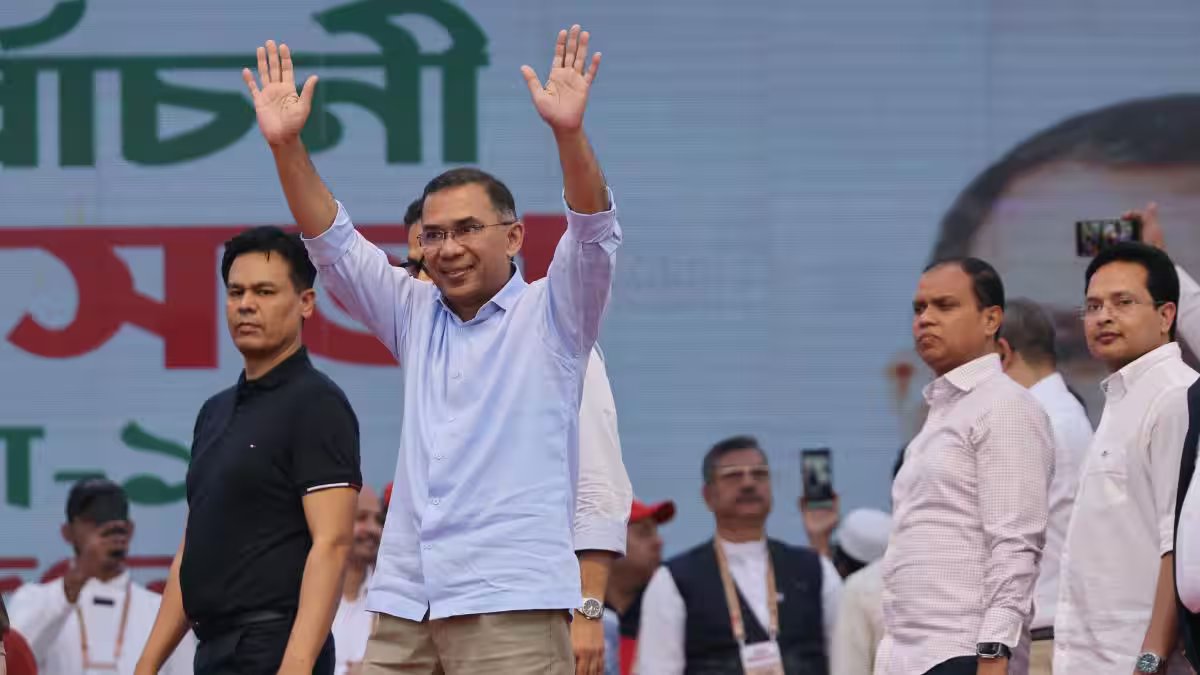
With Awami League absent from the ballots, Bangladesh has chosen the BNP to replace Muhammad Yunus’ unelected regime. Even as democracy has returned after 18 months, fundamental questions remain unanswered about the country.
With Awami League absent from the ballots, Bangladesh has chosen the BNP to replace Muhammad Yunus’ unelected regime.
The Bangladesh Nationalist Party (BNP)-led coalition has won 213 of 300 seats as against Jamaat-e-Islami’s 74, according to latest figures.
Even as Jamaat-led bloc has cast doubt on the integrity of the election and counting of votes, the BNP has declared itself as the winner and foreign leaders have begun congratulating BNP chief Tarique Rahman for the victory.
Follow our live coverage of Bangladesh election
here
But the return of democracy after 18 months would not be simple. Fundamental questions remain unaddressed bout the country. For one, the direction of the country is uncertain. Secondly, the deep insecurity —particularly among minorities like Hindus— amid cyclic majoritarian violence has not gone anywhere.
Since Sheikh Hasina’s ouster,
extremists like the Jamaat on the sidelines have not just become mainstream but become entrenched in the state. They have also waged a cyclic campaign of intimidation and violence, attacking minorities, media, and cultural centres that do not Islamist agenda.
Bangladesh General Election 2026
Seats Declared: 299 / 300 (Win + Leads) | Majority Mark: 151
| Alliance/Party | Seats | % of Declared Seats (299) |
|---|---|---|
| BNP+ | 213 | 71.2% |
| JIB+ | 74 | 24.7% |
| JPE+ | 0 | 0.0% |
| OTH | 12 | 4.0% |
| Total Declared | 299 | 100% |
BNP’s victory also marks a generational shift in Bangladesh as Tarique Rahman, the son of late Prime Minister Khaleda Zia, is expected to be the next premier.
Moreover, it would be the first time in nearly two decades that the country would have a premier other than Hasina. After the previous BNP-Jamaat government (2001-06), Hasina served three consecutive terms and was in her fourth term when she was ousted. There was an interim government between 2006 and 2009.
Bangladesh enters new era
With Raman’s victory, Bangladesh has entered a new era, but the success of the election would depend on the ability to repair the broken social contract, provide security to the masses, and fulfil the promises made to the people about a better economy and honest polity.
But there is little evidence that anything like that is on the cards.
Since Hasina’s ouster, Bangladesh has been in the grips of targeted majoritarian violence. Mobs have
waged a cyclic campaign where they have attacked minorities like Hindus, lynched Hindu men, and attacked minorities’ places of worship. They have also attacked political opponents and the media.
Yunus has so far not taken any step to contain the ongoing violence in the country. It remains to be seen if the BNP would be any different.
In addition to the rising Islamist violence and worsening security crisis, there are also concerns that Bangladesh’s fundamental character is under strain, according to Deep Halder, the author of ‘Being Hindu in Bangladesh: The Untold Story’ and ‘Inshallah Bangladesh: The Story of an Unfinished Revolution’.
“There were always two ideas of Bangladesh. One was the idea that led to the foundation of Bangladesh in 1971. It envisioned the nation as a sociocultural entity centred around language and culture. Under this idea, people would rise above religion. The second idea was that of East Pakistan that imagined the nation strictly in religious —Islamic— terms. This second idea now appears to be getting stronger by the day,” Halder previously told Firstpost.
End of Article