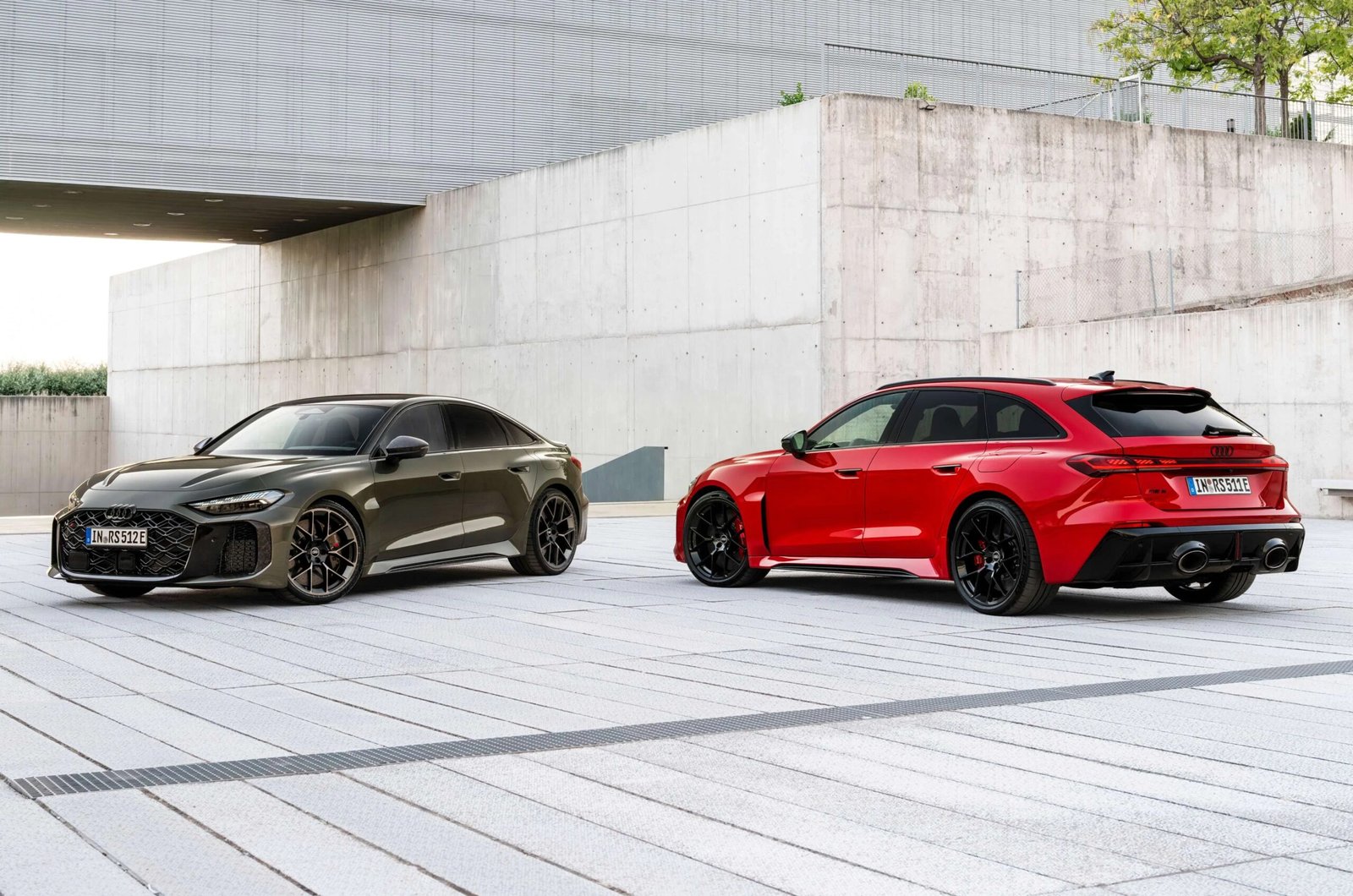
The 2026 Audi RS5 has just been revealed in both sedan and estate forms, and is the first of a new generation of plug-in hybrid (PHEV) performance cars from Ingolstadt’s performance wing, Audi Sport. Pairing the previous RS5’s 2.9-litre twin-turbo V6 with a gearbox-mounted electric motor and a battery pack, the new-gen model sends an astonishing 639hp and 825Nm to the road to a new version of Audi’s legendary Quattro AWD system. Thanks to Audi’s recent model range consolidation, this new model at once replaces both the RS4 Avant and the RS5 Sportback and coupe globally.
2026 Audi RS5 switches to PHEV
The new RS5 arrives at its headline power figures thanks to a number of factors. The high-performance 2,894cc, twin-turbocharged version of the EA839 V6, shared with Porsche, returns, albeit with its power cranked up to 510hp. Assistance from a 130kW electric motor mounted inside the 8-speed torque-converter automatic allows for a total power figure that is 189hp more than the outgoing RS5, and 272hp more than the new Audi S5, which uses a V6 mild-hybrid powertrain.
All this has brought the 0-100kph time down to 3.6sec, which is 0.3sec quicker than the outgoing RS4 Avant. If that seems disproportionate to the performance boost, which also includes 37 percent more torque, that’s because there’s also been a considerable weight gain of 550kg, with the new PHEV Avant tipping the scales at a portly 2,370kg (the sedan is about 15kg lighter).
The big contributor to this, of course, is the battery pack, whose capacity is rated at 25.9kWh (22kWh usable). While there is no official number yet, Audi says this allows the new RS5 to be driven more than 80km in electric only mode when fully charged, which in turn can be done via an AC charger at speeds of up to 11kW. The best part is Audi engineers say the powertrain “ensures the RS5 feels like an RS model when driving electrically too”.
Apart from the weight penalty, the battery pack, which sits above the new, high-tech rear-differential, also eats into boot space. In the more practical Avant wagon, it is a full 115 litres down on the non-hybrid A5 Avant, at just 361 litres, measured up to the seat backs. Still, it’s well shaped and looks like it could hold two large suitcases. The sedan, which is technically a liftback, as its tailgate is hinged at the roof, is only slightly less spacious at around 350 litres.
2026 Audi RS5 uses new-gen Quattro AWD
The 2026 RS5 introduces a new iteration of the brand’s venerable all-wheel drive system, that uses technology Audi says is an industry first. The 8-speed torque-converter gearbox is connected to a limited-slip centre differential, which can send as much as 85 percent of torque to the rear wheels or up to 70 percent to the front wheels. It also has a ‘pre load’ function which keeps it partially locked always, allowing for quicker reactions to throttle inputs and faster redistribution of power.
More impressive still is the new electro-mechanical rear differential, featuring what Audi calls Dynamic Torque Control. It essentially an electric actuator that can supply 8kW and 40Nm to split between the left and right rear wheels instantaneously, before the mechanical torque comes in; Audi says it reacts in just 15 milliseconds. This is of course governed by its own ECU that analyses every driver input as well as vehicle behaviour in real time, and also varies its performance based on the drive mode.
2026 Audi RS5 gets key functionality updates
The B10 Audi A5 and its platform siblings received some flak for their new-generation interiors which focused on large screens with large bezels, and did away with most physical controls – previously an Audi hallmark. Recently, the A5, S5, Q5, SQ5 and now indeed the RS5 have made some efforts to remedy this, switching from capacitive touch buttons on the steering wheel to hard buttons and click-wheels. Additionally, the screen graphics have been given an overhaul to be brighter and easier to read (and touch) with on the move, which is helpful as most controls – like the AC – remain in the touchscreen.
That aside, the interior remains a futuristic looking, high-quality affair, that’s taken on a decidedly sporty personality in the RS5. There’s greater use of Dinamica (suede) on the dashboard, doors and seats, while red accents – in upholstery, trim and lighting – intersect pretty much every surface. Heated, massaging, powered sports bucket seats are standard, though ventilation is part of an option pack. The rear seat offers reasonable space – though the view forward is hampered by the large front seats – and a sunroof is optional.