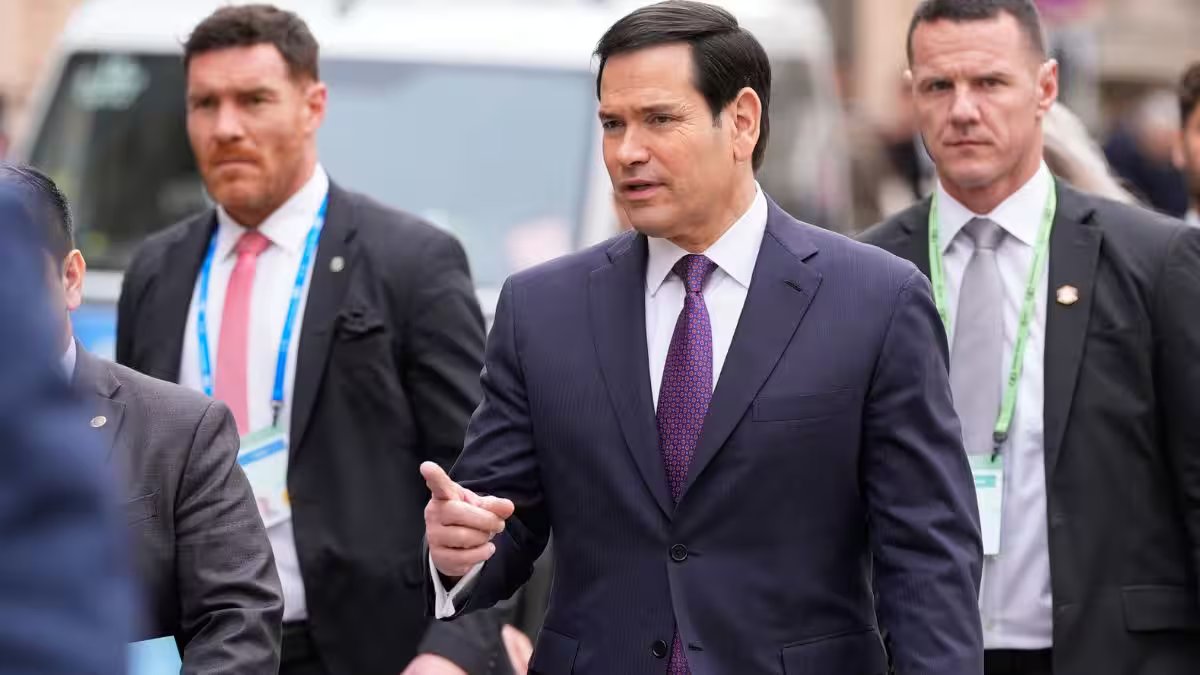
US Secretary of State Marco Rubio used the stage at the Munich Security Conference to deliver a calibrated message to European allies: the trans-Atlantic partnership remains vital but Washington’s priorities under President Donald Trump are unchanged.
His remarks struck a more measured tone than the rhetoric that has defined much of the past year, yet they firmly underscored the administration’s intent to reshape the alliance and press for policy “reciprocity” from Europe.
Addressing leaders and diplomats in Munich, Rubio emphasised that the United States is historically and strategically bound to Europe, even as it seeks structural changes in the relationship and in the post-World War II institutions that have anchored Western cooperation. The message was one of reassurance layered over resolve — continuity in alliance but adjustment in expectations.
The speech came against a backdrop of strain in trans-Atlantic ties. A year earlier, Vice President JD Vance had sharply criticised European political values at the same forum, setting off a series of tensions that included Trump’s brief threat to impose tariffs on several European countries amid his push for greater US influence over Greenland, a semiautonomous Danish territory and NATO ally.
On the eve of Rubio’s address, German Chancellor Friedrich Merz had called for Washington and Brussels to “repair and revive trans-Atlantic trust together,” warning that neither side is strong enough to navigate a shifting global order alone. European officials reiterated their commitment to principles such as free speech, climate action and open trade, making clear that renewed partnership would not mean retreat from core values.
Rubio’s intervention therefore sought to steady nerves without diluting the administration’s harder edge, a balance that framed the rest of his remarks.
Softer tone, firm policy line
While offering a calmer and more reassuring tone than the one often heard over the past year, Rubio made clear that the Trump administration is sticking to its guns on policy. He denounced “a climate cult” and “an unprecedented wave of mass migration that threatens the cohesion of our societies.”
Rubio argued that the “euphoria” of the Western victory in the Cold War led to a “dangerous delusion that we had entered ‘the end of history,’ that every nation would now be a liberal democracy, that the ties formed by trade and by commerce alone would now replace nationhood … and that we would now live in a world without borders where everyone became a citizen of the world.”
“We made these mistakes together and now together we owe it to our people to face those facts and to move forward to rebuild,” Rubio said.
“This is why we Americans may sometimes come off as a little direct and urgent in our counsel,” he said. “This is why President Trump demands seriousness and reciprocity from our friends here in Europe.”
Rubio said that an end of the trans-Atlantic era “is neither our goal nor our wish,” adding that “our home may be in the Western hemisphere, but we will always be a child of Europe.”
He acknowledged that “we have bled and died side-by-side on battlefields from Kapyong to Kandahar,” a contrast with disparaging remarks by Trump about NATO allies’ troops in Afghanistan that drew an outcry. “And I’m here today to make it clear that America is charting the path for a new century of prosperity. and that once again, we want to do it together with you, our cherished allies and our oldest friends.”
U.S. officials accompanying Rubio said his message was much the same as Vance’s last year but was intended to have a softer landing on the audience, which they acknowledged had recoiled at much of Trump’s rhetoric over the past year.
Europeans reassured but not complacent
The president of the European Union’s executive commission, Ursula von der Leyen, said Rubio’s speech was “very reassuring” but noted that “in the administration, some have a harsher tone on these topics.”
In her speech to the conference, she stressed that “Europe must become more independent,” including on defence. She insisted on Europe’s “digital sovereignty” — its approach to hate speech on social media.
British Prime Minister Keir Starmer said that “we shouldn’t get in the warm bath of complacency. He said the U.K. must re-forge closer ties with Europe to help the continent “stand on our own two feet” in its own defence, and said there needs to be investment that “moves us from overdependence to interdependence.”
Hanno Pevkur, the defence minister of EU and NATO member Estonia, said it was “quite a bold statement to say that America is ‘a child of Europe’.”
“It was a good speech, needed here today, but that doesn’t mean that we can rest on pillows now,” he told The Associated Press. “So still a lot of work has to be done.”
The conference pointed to tensions beyond those in the trans-Atlantic alliance.
Speaking after Rubio, Chinese Foreign Minister Wang Yi said Beijing felt “gratified” that Trump respects President Xi Jinping and China, but warned that some voices in the U.S. are leery of China’s rise.
“We see that some forces and some people are still trying their best to suppress and contain China, and are still attacking and slandering China by any means,” Wang said.
He cautioned that “law of the jungle and unilateralism have taken hold” and said some countries “even revive the Cold War mentality.”
With inputs from agencies
End of Article