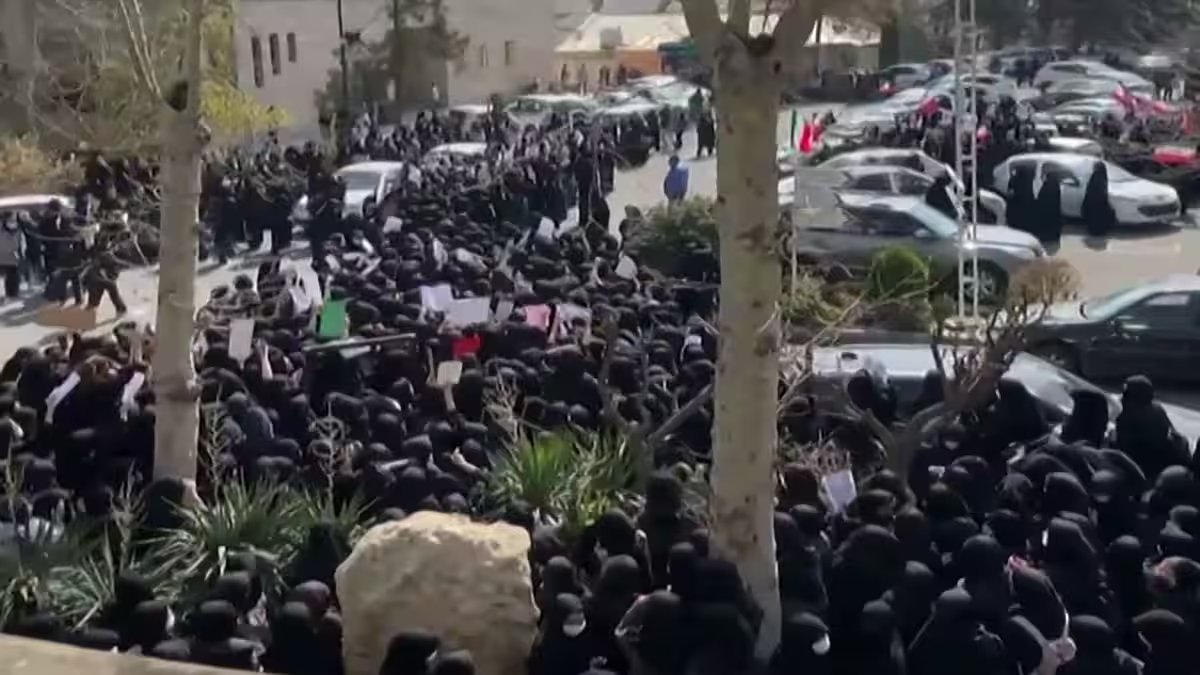
Clashes were reported on multiple campuses, including Tehran’s University of Science and Technology, where videos circulating on social media appeared to show scuffles between students and members of the Basij militia, a state-backed paramilitary force
Iranian authorities on Tuesday deployed plainclothes police and armed security personnel across several Iranian universities to quell a fourth consecutive day of student protests against Supreme Leader Ayatollah Ali Khamenei.
According to a Guardian report, clashes were reported on multiple campuses, including Tehran’s University of Science and Technology, where videos circulating on social media appeared to show scuffles between students and members of the Basij militia, a state-backed paramilitary force.
Images also showed pickup trucks mounted with machine guns stationed outside the University of Tehran. Demonstrations were reported in the northeastern city of Mashhad as well, added the report.
Elsewhere, students found themselves barred from entry if they had been identified as being involved in previous protests and university administrators also announced the closure of in-person classes.
Nearly 80% of Iran’s universities are currently operating online, a move critics say is aimed at preventing large gatherings and curbing dissent following a harsh crackdown on protests earlier this year.
Videos from Tehran’s University of Art captured students chanting slogans including “We fight, we die, we take back Iran” and “Political prisoners must be freed,” along with direct criticism of the country’s leadership, reported The Guardian.
The unrest marks one of the most significant waves of student-led demonstrations in recent months, underscoring continued tensions between the government and segments of Iran’s youth population.
Protests cast shadow over nuclear talks
The protests cast a tense shadow over a third round of talks on Iran’s nuclear programme scheduled for Thursday in Geneva between Iranian Foreign Minister Abbas Araghchi and US special envoy Steve Witkoff.
Iran’s attorney general, Mohammad Mohebi Azad, called for action against demonstrators.
“The responsible agencies must quickly identify the related elements and take decisive and legal action against them,” The Guardian quoted Azad as saying.
“Whenever the system has been on the path of negotiations, certain currents, under the guidance of the enemy, have tried to inflame the domestic atmosphere,” he added.
The Oman-mediated talks come as President Donald Trump completes a major buildup of US naval and air power in the region, heightening pressure on Tehran.
The negotiations hinge on whether Washington will allow Iran limited uranium enrichment inside the country, such as for medical purposes. If that compromise is rejected, Trump risks entering a conflict without clear objectives.
Trump has maintained that a war with Iran is winnable and has pushed back against reports that the US chairman of the joint chiefs of staff, Dan Caine, warned an attack would be inadvisable due to limited regional support and munitions.
In a social media post, Trump said that if Iran failed to reach a deal it would be “a very bad day for that country and unfortunately for its people” — a remark widely noted inside Iran.
Ali Hashem, associate research fellow at the Center for Islamic and West Asian Studies at Royal Holloway College, said Khamenei had shifted from “tactical restraint” to rhetoric framed as “confrontation through the lens of Karbala,” invoking the Shia narrative of Imam Hussein’s martyrdom.
“For foreign audiences, such references may have symbolic meaning,” The Guardian quoted Hashem as saying.
“However, for the Shiite political consciousness, Karbala is a moral and political code; a celebration of resistance to an existential threat, rather than compromise. The idea of ‘dying standing and not living in disgrace’ challenges the US logic of proportionate response and coercive diplomacy,” he added.
Meanwhile, Washington-based human rights group HRANA published what it called detailed identities of more than 7,000 people allegedly killed in the January protests. In its report, titled Red Winter, it listed 7,070 victims with personal details and locations of death.
Iran’s president’s office has released a list of 2,986 identified victims and said the total death toll stands at “3,117,” attributing a discrepancy of 131 to “the anonymity of some individuals and the discrepancy in the registration of the national IDs of some of the victims with the civil registration system.”
With inputs from agencies
End of Article