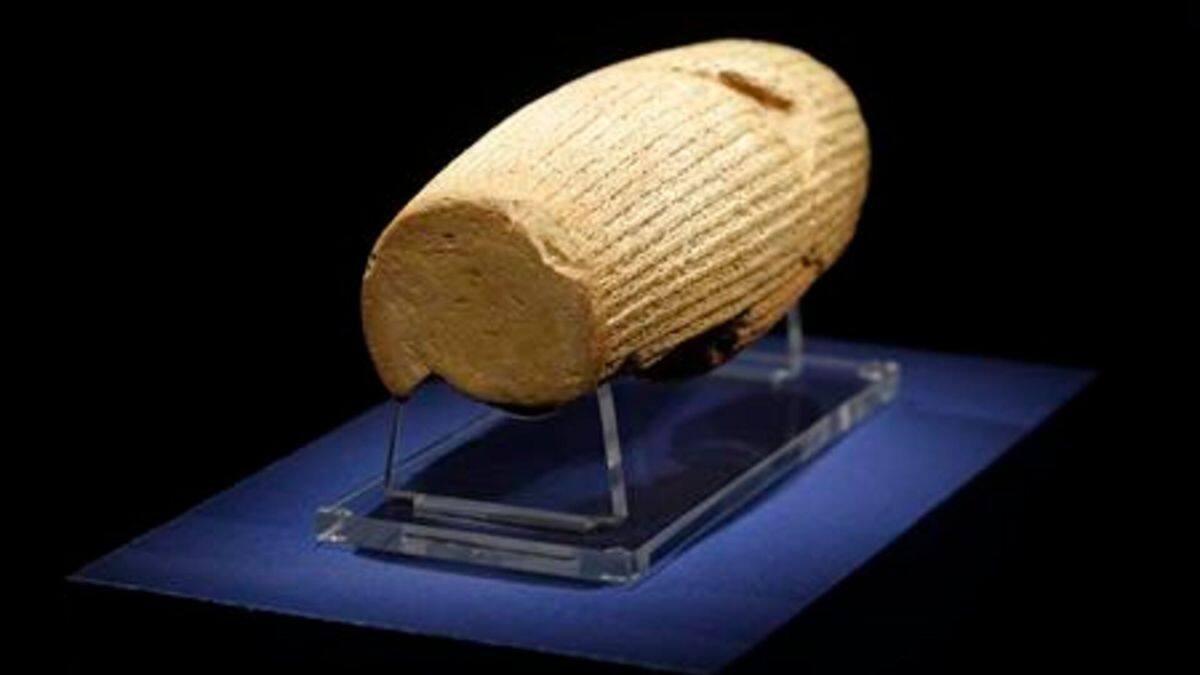
Ironically, Iran, which is today criticised for silencing critics and punishing protesters, gave the world its human rights charter. Cyrus the Great, the first king of ancient Persia, issued decrees that were codified into ‘Cyrus Cylinder’. These decrees accorded basic human rights to people.
In a cruel irony, the ancient Iran gave the world’s its first human rights charter. More than 2,000 years later, the modern Iran is criticised universally for silencing critics and punishing protesters.
In the weekslong protests that began last month, the Iranian regime has been accused of cracking down with unprecedented brutality. Estimates of deaths have ranged from hundreds to 2,000 to as high as 12,000. Just like China’s Tiananmen Square massacre, the real numbers are likely to never be known considering the fundamental opacity that the theocratic regime works under.
In sharp contrast, in 539 BC, Cyrus, the first king of ancient Persia, issued decrees that would go on to become the world’s first human rights charter. He issued these decrees after the conquest of Babylon.
These decrees were inscribed in the Akkadian language in cuneiform script on a baked-clay cylinder that came to be known as the ‘Cyrus Cylinder’. It is roughly of the size of a football.
From ancient Persia to American Independence
In his decrees, Cyrus freed the slaves, declared that all people had the right to choose their own religion, and established racial equality.
These decrees, along with his broader ideas written on the cylinder about governance, went on to inspire generations of statespersons and policymakers, such as Thomas Jefferson, one of the Founding Fathers of America.
Jefferson, who went on to be the third President of the United States, studied ancient Greek historian and philosopher Xenophon’s Cyropaedia, which documented the times of Cyrus, before he drafted the Declaration of Independence. He liked the book so much that he nudged his family to read the book as well.
In modern times, Cyrus’ decrees are nearly identical to first four Articles of the Universal Declaration of Human Rights. Understandably, the Cyrus Cylinder has been translated in all six official languages of the United Nations (UN).
From Babylon, Cyrus’ ideas are said to have spread to India, Greece, and Rome where these ideas formed the basis of what came to be known as ’natural law’.
End of Article