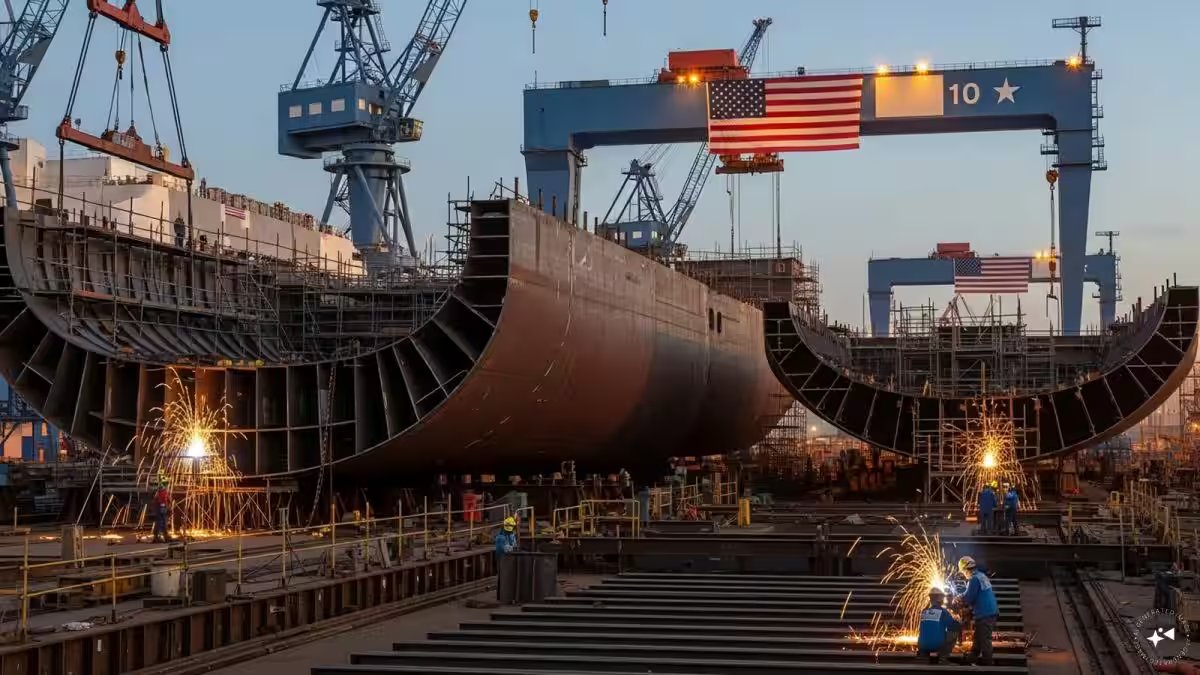
A new US maritime strategy seeks to revitalise shipyards, create Maritime Prosperity Zones and address strategic vulnerabilities, as China’s dominance in global shipbuilding intensifies industrial and security concerns.
The United States is preparing to return to its shipyards in a renewed industrial push that the administration has branded a “Maritime Golden Age”. The initiative, unveiled by Donald Trump, seeks to rebuild the country’s commercial shipbuilding capacity at a time when China dominates global production and Washington worries about strategic vulnerabilities.
At the core of the new Maritime Action Plan is the creation of so-called “Maritime Prosperity Zones”, designated waterfront industrial corridors designed to attract shipbuilders, manufacturers and maritime suppliers through regulatory relief and financial incentives. Regions such as the Great Lakes are being eyed as potential hubs for revival, echoing the industrial policies of earlier American manufacturing booms.
The plan aims to expand the number of US-built and US-flagged commercial vessels, reversing decades of decline that have left the country marginal in global ship construction. According to data cited by the Center for Strategic and International Studies (CSIS), China now accounts for more than half of global shipbuilding output, while the US share is effectively negligible.
The disparity underscores how far America’s maritime industrial base has withered since its mid-20th century peak. Once home to robust shipyards serving both commercial and military markets, the US industry has struggled with high labour costs, limited production scale and inconsistent federal investment.
Strategic anxiety behind industrial ambition
While pitched as an economic revitalisation effort, the strategy is deeply rooted in national security concerns. The administration argues that a weakened commercial fleet leaves the Pentagon dependent on foreign-built or foreign-crewed vessels to move troops and supplies during crises.
A stronger US Merchant Marine, officials say, would ensure that military logistics are not exposed to geopolitical pressure in the event of conflict, particularly amid rising tensions with China. The effort complements Defence Secretary Pete Hegseth’s “Arsenal of Freedom” campaign and the Navy’s “Golden Fleet” objective, both of which aim to restore maritime industrial strength after years of shrinking budgets and contracting shipyard capacity.
China’s shipyards benefit from substantial state support, integrated supply chains and economies of scale that allow rapid construction of both civilian and naval vessels. Analysts have warned that this production advantage gives Beijing leverage not only in trade but also in potential wartime mobilisation.
By contrast, the United States builds only a handful of large commercial vessels each year. Reviving the sector would require sustained investment, workforce training and policy continuity that stretches beyond political cycles.
Policy alignment and congressional backing
The Maritime Action Plan also aligns with legislative proposals such as the SHIPS for America Act, which seeks to create incentives and legal authorities to strengthen domestic shipbuilding, commercial shipping and the broader industrial supply chain supporting US maritime power.
Lawmakers backing the measure argue that industrial resilience has become as critical as technological superiority. In recent years, Washington has already moved to boost semiconductor and clean energy manufacturing domestically; the maritime sector is now emerging as another front in strategic competition.
However, questions remain about whether regulatory incentives and prosperity zones alone can overcome structural disadvantages. US shipyards face higher construction costs than their Asian counterparts, and building commercial vessels domestically often proves far more expensive for operators than sourcing ships abroad.
Supporters counter that the economic calculus must account for national security. By investing in shipbuilding, they argue, the US not only creates waterfront jobs and revitalises industrial communities but also reduces long-term strategic risk.
For now, the administration’s “Maritime Golden Age” framing signals a broader shift in American economic policy away from pure market efficiency and toward industrial self-sufficiency in sectors deemed vital to security.
If successful, the effort would mark a dramatic turning point for a country that once ruled the seas in industrial output as well as naval power. The question is whether America’s return to the shipyards can realistically narrow the gap with China or whether Beijing’s dominance has already set the global course.
End of Article