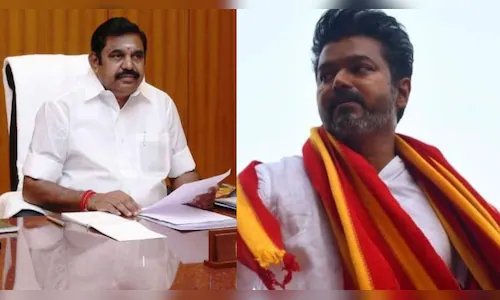
Party general secretary Edappadi K Palaniswami (EPS) announced the measures as part of the AIADMK’s second list of poll assurances. The education loan waiver—earlier announced in previous campaigns and now reintroduced—has been positioned as a key plank aimed at students and middle-income households. The party has not yet disclosed the estimated fiscal cost of the waiver or the mechanism through which it would be implemented.
Other proposals include interest-free loans for women from Muslim, Christian and other minority communities to start self-employment ventures, three free LPG cylinders annually for ration card holders, and free bus travel for men, expanding a scheme currently available only to women under the DMK government.
The announcements have renewed focus on Tamil Nadu’s fiscal position and the extent of headroom available for additional welfare spending.
Tamil Nadu’s fiscal position
According to the state’s 2025-26 budget estimates, Tamil Nadu’s outstanding public debt is projected to rise to about ₹9.29 lakh crore by March 2026, equivalent to roughly 26% of Gross State Domestic Product (GSDP). This places the state below the debt-to-GSDP ceiling recommended for states by the 15th Finance Commission.
The fiscal deficit for 2025-26 has been pegged at around 3% of GSDP, in line with the limit prescribed under the Fiscal Responsibility and Budget Management (FRBM) framework. However, the state continues to run a revenue deficit, meaning its routine expenditure exceeds revenue receipts.
Budget documents show that a significant share of revenue expenditure is committed to salaries, pensions, subsidies and interest payments, limiting flexibility for new recurring schemes unless matched by higher revenues or expenditure reprioritisation.
Growth and revenue context
Tamil Nadu remains one of India’s larger and more industrialised state economies, with manufacturing and services forming the backbone of growth. Higher nominal GSDP growth in recent years has helped keep the debt-to-GSDP ratio broadly stable despite rising borrowings in absolute terms.
At the same time, the state’s revenue receipts continue to face pressure from structural factors such as GST-related compensation changes and high committed expenditure, according to budget statements and official disclosures.
Welfare spending and fiscal rules
National fiscal institutions, including the Finance Commission and recent Economic Survey assessments, have consistently urged states to adhere to FRBM limits, prioritise capital expenditure, and ensure that borrowing does not disproportionately fund recurring revenue expenditure.
Tamil Nadu has so far maintained compliance with deficit thresholds while sustaining capital outlay. However, education loan waivers, credit subsidies and transport concessions typically involve either direct budgetary outgo or compensation to public sector entities, adding to revenue expenditure.
Political backdrop
The AIADMK’s renewed welfare push comes as it seeks to regain ground after losing the last three major elections following the death of former chief minister J Jayalalithaa. The party has revived its alliance with the BJP while simultaneously attempting to broaden its appeal among minorities and urban voters through targeted schemes.
The ruling DMK-led alliance, which has retained power through successive elections, has defended its fiscal approach by pointing to stable debt ratios and economic growth.
With actor Vijay’s Tamilaga Vettri Kazhagam (TVK) and Seeman’s Naam Tamilar Katchi (NTK) contesting independently, Tamil Nadu is headed for a multi-cornered election in which welfare commitments, fiscal discipline and economic management are expected to feature prominently in campaign debates.