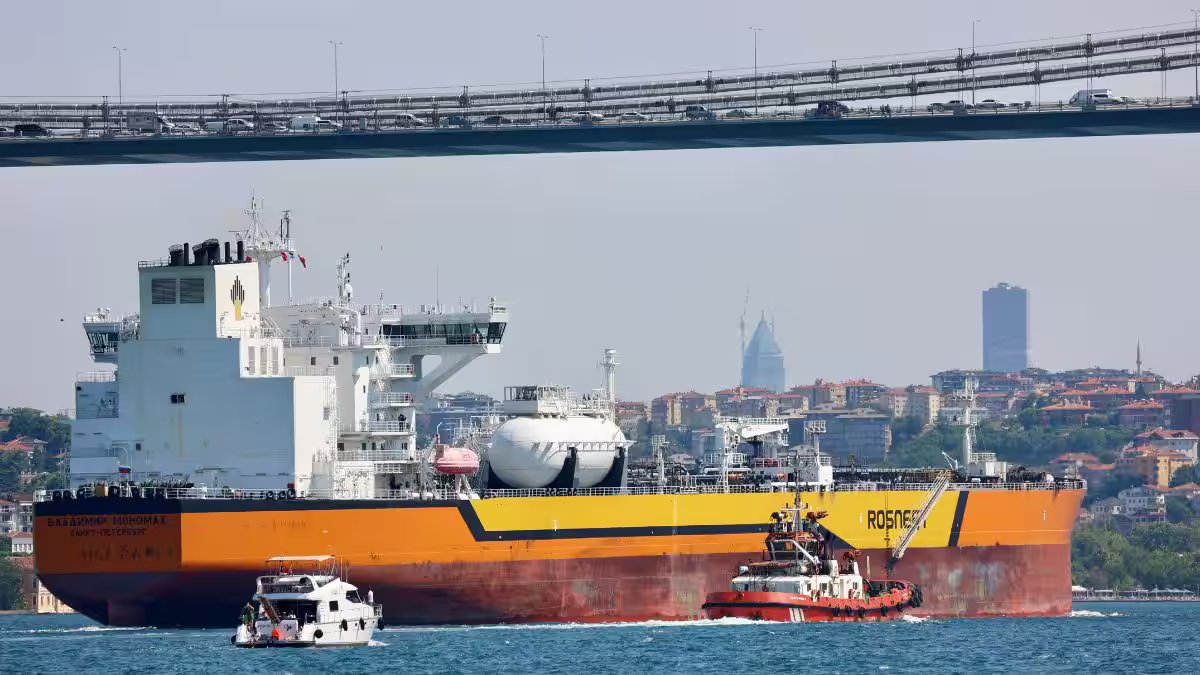
Russia and Iran have deepened oil discounts to China as displaced cargoes pile up in Asian waters, while the US escalates regional signalling by moving the USS Gerald R. Ford closer to Israel amid stalled nuclear talks with Tehran
Russian and Iranian oil producers have widened discounts to Chinese buyers as diverted cargoes overwhelm demand in Asia — even as Washington ramps up military signalling in the Middle East by moving a frontline aircraft carrier closer to Israel.
The twin developments, a deepening oil price war and a fresh US naval deployment, highlight how energy markets are once again being shaped by fast-moving geopolitical tensions.
Discounts deepen as India retreats
Moscow and Tehran are offering sharper price cuts as they compete for a limited pool of Chinese refiners after India scaled back Russian purchases.
Russia’s flagship Urals crude is trading at around $12 per barrel below the global benchmark Brent crude, according to a Bloomberg News report— wider than the roughly $10 discount seen last month. Iranian Light is being offered at as much as $11 below Brent, compared with discounts of $8–$9 in December, the report said.
Consultancy Rystad Energy estimates India’s imports of Russian oil could drop by as much as 40 per cent from January levels to around 600,000 barrels per day under one scenario. Much of the displaced supply is now being redirected to China, intensifying direct competition with Iranian barrels long favoured by Beijing’s independent refiners.
Chinese refiners stretched, oil piles up
China’s so-called “teapot” refiners — private processors that account for roughly a quarter of national capacity — have historically absorbed sanctioned crude. But analysts say their import quotas and operational limits are now constraining additional intake.
“Chinese private refiners cannot take in much more as their capacity is likely maxed out,” analysts at Energy Aspects noted, pointing to a build-up of sanctioned crude in onshore tanks and offshore floating storage.
State-run majors such as China Petroleum & Chemical Corp. have traditionally avoided Iranian crude and have limited direct exposure to Russian cargoes, leaving the independents to shoulder most of the trade.
ALSO READ:
Amid Iran tension, US moves aircraft carrier Gerald R Ford from Greece to Israel
vessel-tracking data compiled by Bloomberg show Russian crude arrivals at Chinese ports averaged about 2.09 million barrels per day in the first 18 days of February, up roughly 20 per cent from January. In contrast, Iranian exports to China have slipped to about 1.2 million barrels per day so far this year, down around 12 per cent from a year earlier.
Nearly 48 million barrels of Iranian oil are estimated to be floating in Asian waters, alongside roughly 9.5 million barrels of Russian crude — underscoring the growing supply overhang.
US repositions USS Gerald R. Ford
Adding to the geopolitical backdrop, the United States has repositioned its most advanced aircraft carrier, the USS Gerald R. Ford, from waters near Greece toward the eastern Mediterranean, closer to Israel, as tensions with Iran mount.
US defence officials have described the redeployment as a routine force posture adjustment. However, the timing coincides with stalled indirect nuclear negotiations between Washington and Tehran in Geneva and rising regional security concerns.
The carrier strike group — equipped with guided missile destroyers and advanced air capabilities — is designed for rapid power projection. Its presence near Israel signals both reassurance to a key US ally and deterrence to Iran and allied militant groups.
Security advisories issued to US diplomatic personnel in Israel further underscore concerns over potential regional escalation.
Diplomacy under strain
Efforts to revive understandings over Iran’s nuclear programme have made limited headway in recent weeks. While both sides publicly express willingness to continue talks, mistrust remains high.
US President Donald Trump has warned that failure to reach a diplomatic agreement would be “very bad” for Tehran, even as Washington insists it does not seek a broader regional war.
Ukrainian President Volodymyr Zelenskiy has also indicated renewed diplomatic engagement over Ukraine, a factor some Chinese buyers see as lowering relative political risk for Russian crude compared with Iranian supply.
Analysts note that deploying a Gerald R. Ford-class carrier — equipped with advanced radar and electromagnetic aircraft launch systems — carries significant symbolic and strategic weight. Such vessels represent the cutting edge of US naval capability and are closely watched by both allies and adversaries.
End of Article