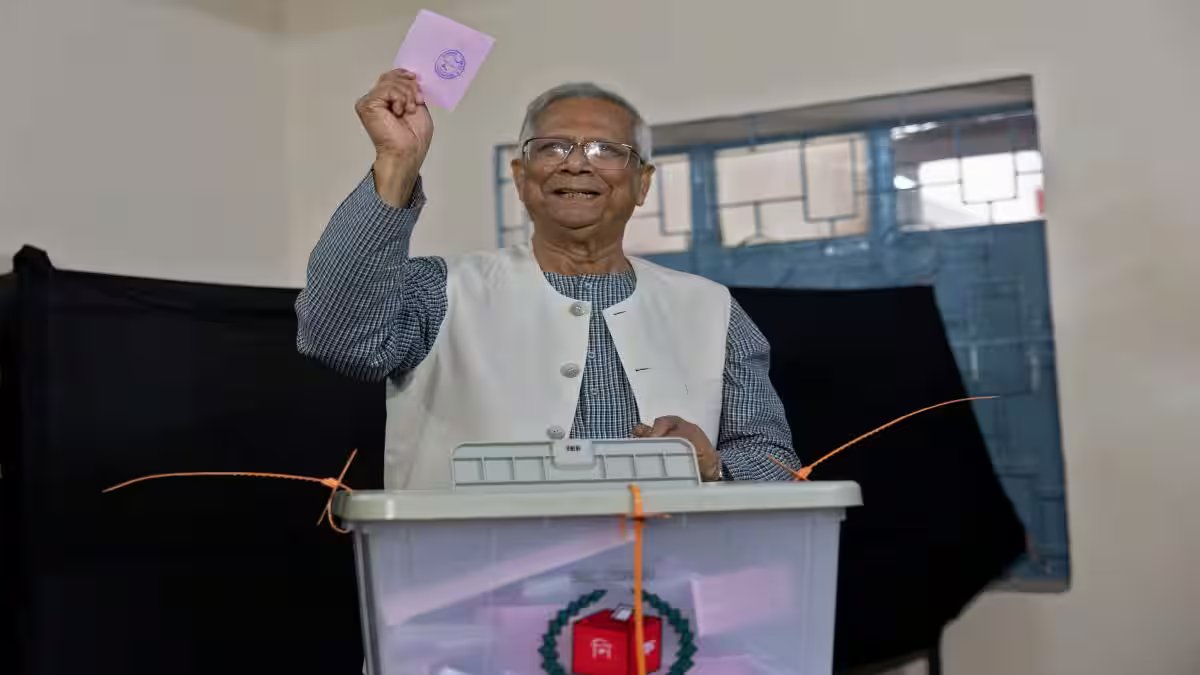
On August 8, 2024, 85-year-old Muhammad Yunus returned to Bangladesh from France, where he had been attending the 2024 Olympic Games, and was sworn in as the head of Bangladesh’s interim government. This development came as a result of a Gen-Z uprising that overthrew Sheikh Hasina’s 15-year term and forced her to flee the country, seeking solace in neighbouring India.
Now, two years later, on February 13, the
Tarique Rahman-led Bangladesh Nationalist Party has claimed a victory in the elections, defeating the 11-party alliance led by Jamaat-e-Islami and the student-led National Citizen Party (NCP).
While many are celebrating Rahman and BNP’s win, others are wondering what will happen to Muhammad Yunus. Also, how will history remember his tenure?
Rise of the professor
Born in Chittagong, southeast Bengal, at the height of the Second World War,
Yunus taught economics at Chittagong University. Known as a pioneer of microfinancing, he won the
2006 Nobel Peace Prize.
Following the Gen-Z revolt in 2024, which resulted in the ouster of Sheikh Hasina, Yunus was brought in to head the interim administration as the consensus candidate. At first, Yunus was reportedly hesitant about the job, insisting he was “not a political person”. But as protests escalated and deaths mounted, he stepped in, in “a moment of obligation”.
The
task before him was to stabilise a fractured country, restore a credible electoral process, and build consensus around reforms aimed at preventing a return to authoritarian rule by balancing power among different state institutions.
A post-election future for Yunus
Notably, Muhammad Yunus wasn’t on the ballot this election. Before the polls, he asserted that he was only a caretaker of Bangladesh, positioning himself as a neutral steward of the electoral process. He stated that his immediate responsibility after the polls was a smooth and peaceful transfer of power.
In a televised address, hours after the political campaign ended on Tuesday (February 10), the Nobel Laureate stated, “The task of the interim government will end with the election of a new government. We will return to our respective professions after handing over power with joy and pride to the newly elected government.”
Some report that Yunus intends to return to his work at the Yunus Centre and the Grameen Bank, focusing on social business and poverty alleviation. But others speculate that the president’s post awaits the Nobel laureate to help to provide stability during the new government’s tenure.
However, Yunus has denied these claims.
Yunus leaves behind a mixed legacy
But even as the country looks forward to the return of the BNP, many still wonder how Yunus’s 18 months in power shall be remembered.
Perhaps, his biggest legacy will be the referendum on the
July National Charter-2025. A resounding 65.5 per cent of the population voted in favour of the charter, which proposes creating a bicameral legislature, imposing prime ministerial term limits of two terms or 10 years, and granting constitutional recognition to the 2024 uprising.
But for many, the 94-year-old’s time in power has also been marked by revenge politics. As a report in The Print notes, it was one thing to go after Sheikh Hasina for her ‘crimes’, quite another to ban the students’ wing of her party,
Bangladesh Chhatra League, and then ban her party, Awami League, from all political activities under the Anti-Terrorism Act.
Under the leadership of Yunus, there were also multiple inquiries set up to investigate the various abuses carried out under Hasina’s administration, including arrests of critics, extrajudicial killings, and enforced disappearances. This resulted in
Sheikh Hasina being sentenced to death in absentia for crimes against humanity and convicted in other cases.
Yunus also formed the Commission of Inquiry on Enforced Disappearances, which documented 1,913 complaints and 287 victims, with most of those cases tied to security agencies, including the police and the Rapid Action Battalion. Mubashar Hasan, an adjunct fellow at Western Sydney University, who was himself abducted in Dhaka in November 2017, called the commission Yunus’s “most consequential intervention”.
However, when it came to law and order, Yunus fell short of expectations. In a report titled ‘Gotham but No Batman’, Al Jazeera reported how muggings, assaults, and rapes spiked in the Bangladesh capital under the interim government.
There’s also the matter of rising
crimes against minorities in Bangladesh. A January report by the Human Rights Congress for Bangladesh Minorities revealed that at least 116 members of minority communities were killed in Bangladesh in just seven months, pointing to a “relentless” and nationwide surge in violence following the formation of the interim government led by Muhammad Yunus.
The rights group says the scale and spread of the attacks, between June 6, 2025, and January 5, 2026, mark one of the most severe phases of violence against minorities in recent years.
But Yunus fended off these charges, claiming they were “exaggerated propaganda”, insisting that the attacks were political and not communal in nature.
Economically, too, Yunus didn’t bring about the reforms as many had hoped for. Economists note that while macro indicators stabilised during his tenure, household-level distress persisted with unemployment, stagnant wages and sluggish investment keeping private sector confidence low and limiting the government’s capacity to generate growth and jobs.
However, it was under Yunus’ administration that Bangladesh secured a
2026 trade pact with the United States and $2.1 billion in Chinese infrastructure funding.
But many note that Yunus’ time in power was noteworthy. The BNP and the Jamaat-e-Islami note that holding elections itself was a “major achievement”. As Jamaat leader Abdul Halim told Al Jazeera, “He started the reform process and made significant progress.”
It will take some more time to determine if Yunus’ time in power helped Bangladesh. But as Hasan told Al Jazeera, “He provided leadership at a moment when Bangladesh could have fallen apart.”
With inputs from agencies
End of Article