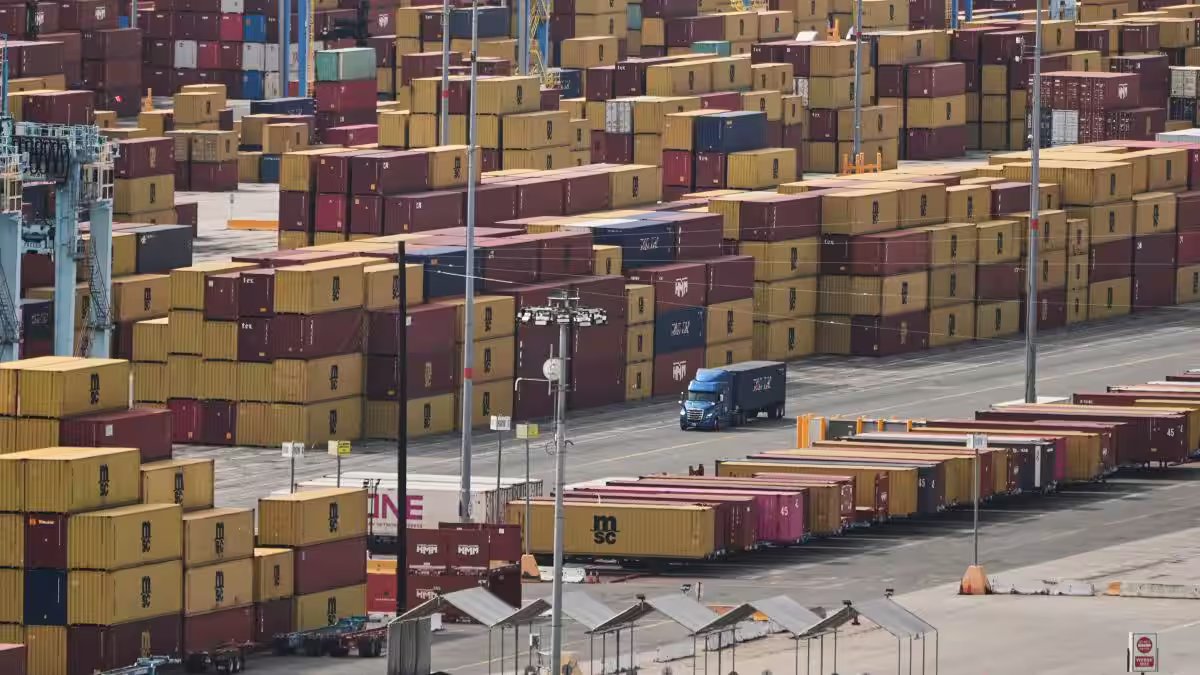
US container imports fell 6.5 per cent in February to 2.09 million TEUs, though volumes remained the fourth-highest on record as geopolitical tensions, tariffs and supply chain disruptions reshape global trade
Containerised imports into the United States fell in February from a year earlier, reflecting the typical slowdown after the winter holiday shopping season, though volumes remained historically strong, according to new data from Descartes Systems Group.
US seaports handled 2,093,422 twenty-foot equivalent units (TEUs) in February, down 6.5 per cent year-on-year, the supply-chain technology firm said in its monthly trade report released on Tuesday.
Despite the decline, the figure marks the fourth-highest February import volume on record, underscoring the resilience of U.S. consumer demand even amid rising geopolitical tensions and policy uncertainty.
“This performance underscores the relative resilience of US import demand even amid ongoing policy and economic uncertainty,” Descartes said in the report.
China shipments decline sharply
Imports from China totalled 728,562 TEUs in February, representing a 16.5 per cent drop from a year earlier.
However, China’s share of total US container imports inched up slightly to 34.8 per cent, as shipments from several other Asian exporters declined even more sharply.
According to Descartes, imports from India, Thailand, and South Korea also fell during the month.
The company noted that February 2025 volumes were likely boosted by importer “frontloading”, as companies rushed to bring goods into the United States ahead of new tariffs proposed by Donald Trump.
Tariffs and court ruling add policy uncertainty
Trade flows have also been affected by shifting US tariff policies.
Last month, the Supreme Court of the United States ruled 6–3 that the Trump administration exceeded its authority by invoking emergency powers to impose sweeping tariffs.
Following the ruling, the administration announced a new global tariff of 10 per cent on imports, with plans to increase it to 15 per cent for up to 150 days.
Descartes said such policy changes are adding to uncertainty in global trade.
“Trade conditions are increasingly being shaped by geopolitical escalation and policy shifts,” the company said.
West Asia conflict disrupts shipping routes
Global supply chains are also facing fresh risks from escalating conflict in West Asia.
Military strikes by the United States and Israel on Iran have slowed oil shipments through the critical Strait of Hormuz, sending energy prices sharply higher.
Major container carriers including Mediterranean Shipping Company have introduced emergency fuel surcharges and temporarily halted cargo operations to several Gulf ports.
The disruption has created port backlogs and raised fears of cascading delays across global supply chains.
At the same time, shipping companies are monitoring the risk of renewed attacks in the Red Sea by Iran-backed Houthi movement, which previously targeted commercial vessels passing through the region.
With inputs from agencies.
End of Article