In a notification issued on March 9, the Ministry of Petroleum and Natural Gas said supplies of natural gas — including regasified liquefied natural gas (RLNG) — would be redirected towards priority sectors after shipments through the Strait of Hormuz faced disruptions due to the ongoing regional conflict.
The order said the decision followed supply interruptions after gas suppliers invoked “force majeure” clauses.
“The central government has determined that the ongoing conflict in the West Asia has resulted in disruptions to liquefied natural gas shipments through the Strait of Hormuz and suppliers have invoked the force majeure clause,” the notification said, adding that available gas supplies would be diverted to priority sectors.
Priority sectors identified
Under the revised framework, natural gas supply has been divided into multiple priority tiers based on sectoral importance.
Priority Sector I — which includes domestic piped natural gas supply, compressed natural gas (CNG) for transport, LPG production and essential pipeline operations — will receive up to 100% of their past six-month average gas consumption, subject to operational availability.
Fertiliser plants fall under Priority Sector II, which will receive about 70% of their average gas consumption over the past six months, provided the supply is used exclusively for fertiliser production.
Industrial consumers connected to the national gas grid — including sectors such as tea manufacturing — fall under Priority Sector III, where supplies will be maintained at around 80% of past consumption levels. City gas distribution networks supplying industrial and commercial consumers will also maintain supplies at around 80% of their past six-month consumption, subject to availability.
Redistribution across sectors
To meet these allocations, the government has directed gas marketing entities to reallocate supplies by curtailing deliveries to certain sectors.
The order specifies that gas supplies to petrochemical facilities — including plants operated by ONGC Petro Additions Ltd and GAIL’s Pata petrochemical complex — may be curtailed first, followed by reductions to some power plants if required.
Oil refining companies have also been asked to absorb part of the disruption by reducing gas allocation to refineries to roughly 65% of their past six-month consumption, subject to operational feasibility.
The notification directs natural gas producers, importers, marketers and pipeline operators — including entities such as ONGC, Reliance Industries, Oil India, Vedanta and GAIL — to revise supply schedules and implement sector-wise allocations as directed by the government.
It also states that the provisions of the order will have effect notwithstanding existing Gas Sale Agreements or other commercial arrangements, if necessary to implement the prioritisation.
Commercial users begin to feel the impact
Industry groups say the changes have already begun affecting commercial supply chains.
The Federation of LPG Distributors of India has sought clarification from the government on the availability of commercial LPG cylinders following the order.
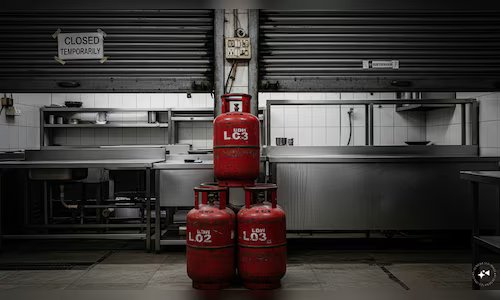
Distributors say an abrupt halt in commercial LPG supplies to several industries since March 8 has created uncertainty in the market, prompting concerns among restaurants and other commercial users that depend on regular cylinder deliveries.
Restaurant associations in several cities have reported temporary shutdowns or reduced operations as commercial LPG deliveries slow.
In parts of Maharashtra, including Pune, some mortuary facilities and auto-rickshaw associations that rely on gas supplies have also reported disruptions.
Legal basis for the order
The directions were issued under powers granted by the Essential Commodities Act, 1955, which allows the government to regulate the supply and distribution of petroleum products in order to maintain availability and ensure equitable distribution.
The notification also cited the Supreme Court’s ruling in Association of Natural Gas vs Union of India (2001), which held that natural gas and liquefied natural gas fall within the definition of petroleum and petroleum products under the Act.
The government’s move comes as energy markets closely track the impact of the escalating conflict involving Iran and Israel.
The Strait of Hormuz is a key maritime route for global energy trade, with a significant share of the world’s oil and liquefied natural gas shipments passing through the narrow waterway.
Any disruption in shipments through the route can affect supply chains across Asia, including India, which relies heavily on imported energy.