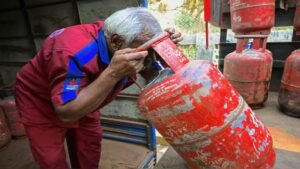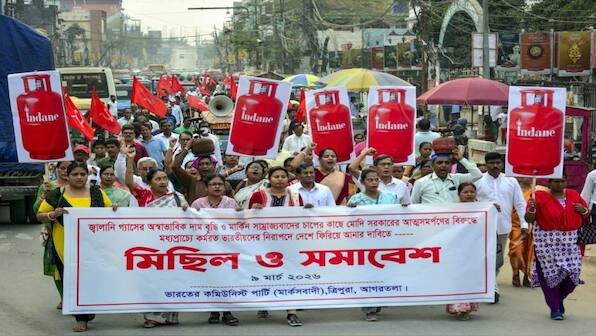
On the tenth day of the Iran war (on March 9), as prices of oil skyrocketed to over $100 a barrel, far away in India, a sense of dread was being felt by many as they stood in queue outside LPG, or cooking gas, agencies. Videos emerged on social media, depicting Indians standing in serpentine queues outside cooking gas agencies, hoping to get their hands on one cylinder.
Amid this situation of panic buying, the government of India stepped in on Monday (March 9), taking measures to ensure uninterrupted supplies to households. The government has increased the minimum waiting period for booking a cylinder to 25 days from 15, as well as directed all domestic or SEZ oil refining companies to maximise their propane and butane production for LPG.
The question is: Is India really experiencing a LPG gas shortage amid the war?
A LPG ‘shortage’ sparks panic
As the war entered its tenth day on Monday, social media was abuzz with videos of people showing up outside LPG agencies in several towns and cities across India. Long queues of consumers clutching empty LPG cylinders were seen on Monday outside a Bharat Gas agency in Noida’s Sector 22. A viral video from Birdpur village in Uttar Pradesh’s Sitapur district showed at least hundreds of people sitting on their empty LPG cylinders lined up outside a gas agency.
Impact off iran US war,
People are queueing up for. LPG gas agencies
Government should do a press conference and ask people not to worry about petrol Diesel & LPG pic.twitter.com/V8Iygr5f0e— 💝🌹💖🇮🇳jaggirmRanbir🇮🇳💖🌹💝 (@jaggirm) March 7, 2026
Moreover, as the war continues to escalate, the price of gas cylinders has also increased. Last Saturday, the cost of a domestic LPG cylinder rose by Rs 60, while the price of a commercial LPG cylinder was also increased by Rs 115.
With this hike, the price of a 14.2 kg domestic LPG cylinder in Delhi is now at Rs 913, up from Rs 853. In Mumbai, the new rate of a domestic LPG cylinder now stands at Rs 912.50, up from Rs 852.50 earlier. Notably, the last time the prices of LPG in India was changed was last April.
This has resulted in many queuing up outside gas cylinder agencies across the country. One such individual told India Today, “There is a war going on in Iran. I had booked my LPG refill five days ago, but it had still not been delivered at home.” He added that he had come to the agency to find out what had happened to the booking.
Besides the panic buying of LPG, there are other indicators too of a potential cylinder shortage. On Monday, the Pune Municipal Corporation temporarily closed the city’s gas crematoriums until further notice. An official, however, added that electric crematoriums and wood-fired facilities equipped with air pollution control systems would continue to function.
Restaurants in Maharashtra and Karnataka have also complained that the war has led to disruptions in the supply of cooking gas and that if it continued, they would be forced to shut down. Vijay Shetty, president of the India Hotels and Restaurant Association, said the shortage is spreading rapidly and could soon paralyse the sector.
“Restaurants in Mumbai will shut down in the next two days if the shortage continues, said Shetty, adding that the associated had written to Petroleum Minister Hardeep Singh Puri. He further warned that if the situation persisted that in two days’ time, all restaurants would be forced to shut down.
Restaurant owners say commercial LPG supplies have largely stopped since Sunday.
In Karnataka too, hoteliers are facing a similar problem, with the Bangalore Hotels Association writing to the Centre, “Hotel owners are not ready to close down under any circumstances. Closing down is not in our nature… We will function till the last drop to serve people, but the government and MPs must discuss this matter and help hotel owners. With shortage issues, the business and livelihoods will be affected.”
Government speaks on LPG ‘shortage’
The Centre, however, maintains that there is no shortage of LPG gas cylinders. Last Friday, Petroleum Minister Hardeep Singh Puri said there is no shortage of energy.
In a post on X, he wrote, “Our priority is to ensure availability of affordable and sustainable fuel for our citizens, and we are doing it comfortably. There is no shortage of energy in India and there is no cause of worry for our energy consumers.”
Sources within the government also added that India is in a “very comfortable position” regarding crude oil, petroleum products and LPG supplies despite concerns over disruptions through the
Strait of Hormuz.
On March 3 too, government sources were quoted as telling The Hindu that India had enough LPG stocks and strategic reserves to cover 25 to 30 days of demand, with refineries increasing production to offset any temporary import disruptions.
Moreover, India is securing LPG supplies from the international portfolios of global companies, including UAE’s Adnoc (Abu Dhabi National Oil Company), Sonatrach, Algeria’s state-run oil and gas company, and others as the war continues, a top government source told Moneycontrol. The official further revealed that deliveries of LPG from Australia, Algeria, Canada and the US are in progress.
Centre’s new restrictions on LPG
However, the government has taken up
certain measures in order to maintain LPG supplies. On March 6, the Centre invoked the Essential Commodities Act to direct all oil refining companies and public sector oil marketing companies (OMCs) to prioritise the production and uninterrupted supply of LPG for domestic consumers.
The order mandates that refiners must utilise all propane and butane streams produced, recovered or fractionated at their facilities for LPG production. Refiners have also been barred from diverting these streams for petrochemical manufacturing or other downstream derivatives.
“All oil refining companies shall not divert, utilise, process, crack, convert or otherwise employ propane or butane streams for manufacture of petrochemical products or other such downstream derivatives,” the order read.
Also, on Monday (March 9), the government also introduced a 25 day inter-booking period to avoid hoarding/black marketing. Authorities said that looking at the consumption of LPG by households, they need a cooking gas cylinder every six weeks or so, and hence, the 25-day booking limit is comfortable.
The government has said that these are pre-emptive measures to help maintain India’s supply of LPG. “If push comes to a shove, we will take other measures,” a government source told CNBCTV-18, indicating that further steps could be considered to safeguard domestic LPG availability.
With inputs from agencies
End of Article