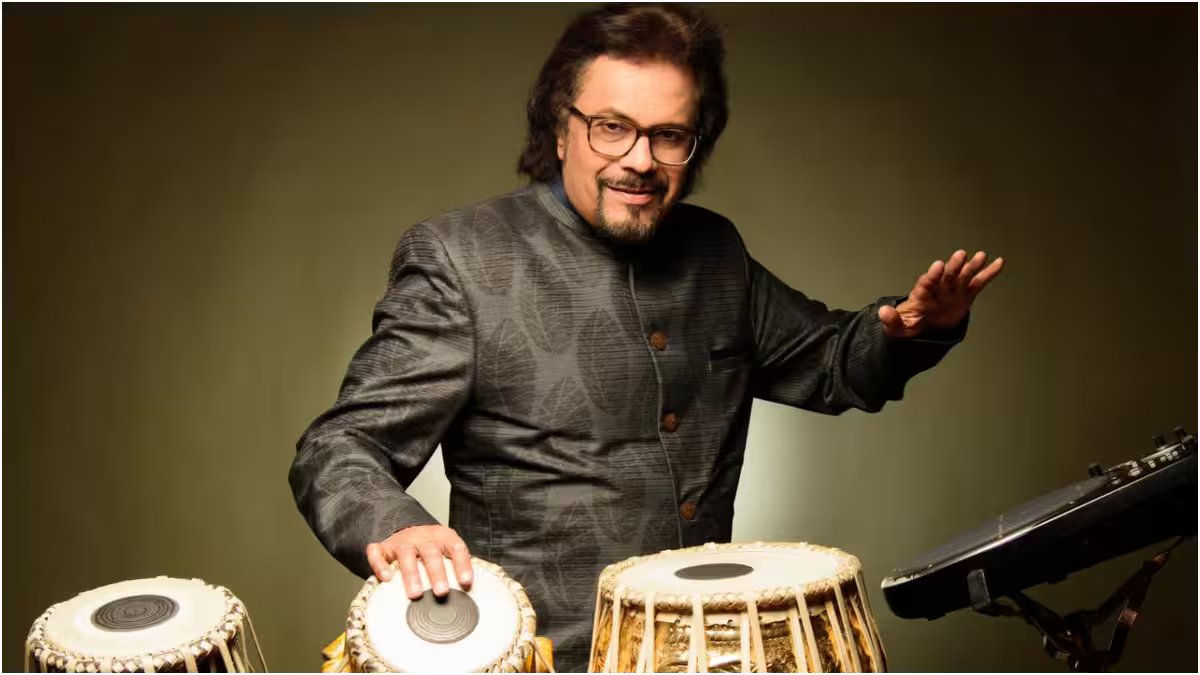
Few musicians have shaped the contemporary language of Indian percussion as dynamically as Bickram Ghosh. A virtuoso tabla player, composer and musical innovator, Ghosh has spent decades expanding the possibilities of rhythm, seamlessly moving between classical traditions, film music and large-scale global collaborations.
The son of legendary tabla maestro Shankar Ghosh, Bickram Ghosh inherited a formidable musical lineage. Yet he has carved out a distinct identity of his own by bringing together diverse sonic traditions, often bridging the worlds of classical discipline and folk rawness.
At
Mahindra Percussion Festival, Ghosh presented the Drums of the East, an ambitious ensemble performance that celebrates the rich percussion traditions of eastern India. The project brought together instruments such as the dhaak, srikhol and Bangla dhol, alongside classical tabla and melodic accompaniment, to showcase the region’s vibrant rhythmic heritage.
The ensemble features acclaimed artists including sitarist Abhishek Mallick, srikhol maestro Gopal Burman, Padma Shri awardee dhaaki Gokul Dhaki and Bangla dhol player Ranjan De, among others.
In an exclusive interview with Firstpost’s Zinia Bandyopadhyay, Bickram Ghosh reflects on the cultural significance of the East, the philosophy behind Drums of the East, and why folk percussion traditions deserve to be heard on larger stages.
The many rhythms of the East
For Ghosh, the idea of the “East” is not simply geographic. It represents a vast musical ecosystem shaped by both classical excellence and deeply rooted folk traditions.
“The eastern part of India is percussively very vibrant,” he explains. “We have a huge array of folk drums, and of course the tabla occupies a very important place in this region. Kolkata especially has been the seat of tabla for many decades.”
The region has also produced some of the most influential musical minds in Indian history. From composers like Sachin Dev Burman and Rahul Dev Burman to legends like Ravi Shankar and Ali Akbar Khan, eastern India has long shaped the melodic and rhythmic vocabulary of Indian music.
“There is a strong heritage in the East,” Ghosh says. “When your predecessors are such enormous musical entities, there is also a standard that you feel responsible to uphold.”
Beyond the classical world, the East is home to powerful folk percussion traditions. Instruments such as the dhaak, srikhol and Bangla dhol carry not just musical significance but also cultural identity.
“There are full-blown traditions around these instruments,” he adds. “The East represents a plethora of sound, melody and emotion.”
The idea behind Drums of the East
The concept for the ensemble emerged from Ghosh’s desire to bring these diverse traditions together on a single stage.
“The reason behind creating this ensemble was to showcase the eastern part of India and its fantastic drumming traditions,” he says.
While percussion takes centre stage, the presence of melody remains essential to the structure of the performance.
“We also have a wonderful sitar player with us, Abhishek Mallick. Melody is very important because it gives perspective to the drums. If you play a dhaak with a certain kind of melodic structure, the instrument truly flowers.”
Each musician in the ensemble represents a different rhythmic tradition.
“Srikhol is played by Gopal Burman, one of the finest in the world. The dhaak will be played by Gokul Dhaki and his team. He is a Padma Shri awardee. Bangla dhol will be played by Ranjan De, who has also innovated with the instrument by using sticks in his playing.”
The result, Ghosh says, is a sonic conversation rather than a display of virtuosity.
Folk traditions on the concert stage
Bringing folk percussionists into a curated concert setting presents its own creative challenges. But Ghosh believes the musicians he has chosen embody both tradition and adaptability.
“The interesting part about these artists is that while they are practitioners of folk instruments, they are also well versed in classical traditions,” he explains.
For instance, srikhol maestro Gopal Burman trained under Pandit Shankar Ghosh and has expanded the instrument’s possibilities within a classical framework.
“He has evolved the sounds of the srikhol and given it the ambit of a classical instrument,” Ghosh notes. “At the same time, we retain the raw sonic character of these instruments because that charm is very important to the concept.”
Reimagining the dhaak
For many Bengalis, the sound of the dhaak is inseparable from the spirit of Durga Puja. Its thunderous rhythms evoke devotion, celebration and collective emotion.
Ghosh acknowledges that cultural memory but also believes the instrument can evolve for contemporary audiences.
“The dhaak has evolved with time,” he says. “Today there are women dhaakis as well, which is a big change.”
Some of these women percussionists, trained under Gokul Dhaki, will also be part of the performance.
At the same time, the presentation itself will incorporate rhythmic structures drawn from other percussion traditions.
“We are going to experiment with rhythmic patterns that are more common in the southern drumming tradition, such as Khanda and Mishra structures, but interpreted in the dhaki language. That makes the presentation both contemporary and classical.”
Rediscovering identity through rhythm
Even after decades of performing, Ghosh says each new project becomes an opportunity for self-discovery.
“I have been rediscovering my own musical identity for a long time now because experimentation has become second nature to me,” he says.
Working closely with folk percussionists has opened new creative avenues.
“The challenge is to bring newness through the overlap in musical content between these instruments. Each instrument has its own cultural and sonic positioning, but when you introduce new ideas, you expand the horizons of the instrument and of yourself as a musician.”
Visibility for folk percussion
While classical instruments often receive wider recognition, folk percussion traditions have historically remained rooted within their local cultural contexts.
For Ghosh, projects like Drums of the East are partly about creating visibility.
“Folk traditions are not really meant to be mainstream. They are ethnic cultural identities,” he says.
However, when contemporary musicians incorporate these traditions into larger concerts, films or global collaborations, the instruments reach new audiences.
“People like myself and other percussionists are bringing these traditions into larger spaces. That gives folk drummers visibility.”
He also points out that such efforts are not new. Past masters such as Pandit Jnan Prakash Ghosh and Pandit Shankar Ghosh had similarly worked to bring folk drums onto the concert stage.
What he hopes audiences will take home
For Ghosh, the goal of Drums of the East goes beyond entertainment. He hopes the performance reshapes how audiences perceive percussion.
“Many people think of percussion simply as something to dance to or enjoy as beats,” he says. “But there is a deep cultural world around these instruments.”
The performance also incorporated konnakol, the vocalisation of rhythmic syllables, to highlight the linguistic and compositional depth of percussion traditions.
“I hope audiences leave with a sense of the vast world of percussion and the traditions behind these instruments,” he says. “Of course, there will be excitement and virtuosity on stage. But I also hope they go back with a deeper understanding of cultural identity and rhythm.”
For an evening that promised both explosive energy and musical storytelling, Drums of the East was one of the most compelling highlights of the Mahindra Percussion Festival.
End of Article