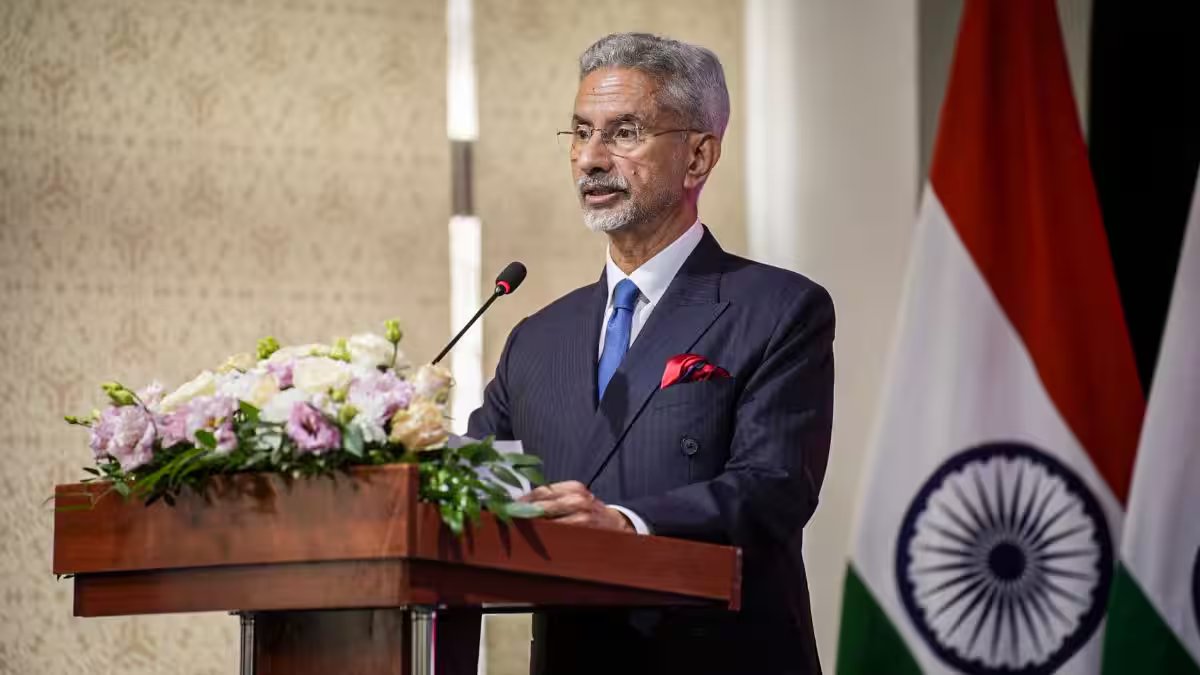
In an address in the parliament on the government’s approach to the West Asia conflict, External Affairs Minister S Jaishankar said India calls for de-escalation and considers national interests, including energy security and trade, as paramount.
In an address in the parliament on the government’s approach to the West Asia conflict, External Affairs Minister S Jaishankar on Monday said that India has called for de-escalation and restraint and considers national interests, including energy security and trade, as paramount.
Jaishankar also confirmed that two Indian sailors have been killed in the conflict in the region and a third remains missing.
The American and Israeli war on Iran has spiralled into a wider conflict that has engulfed the entire West Asia. Several oil refineries in Gulf countries and oil tankers in the region’s waterways have been struck. Shipping has almost come to a halt in the Strait of Hormuz, raising anxiety across the world as around 20-25 per cent of seaborne oil and 20 per cent of gas passes through the strait.
Jaishankar said that India is in favour of peace and urges a return to dialogue and diplomacy.
“We advocate de-escalation, restraint, and ensuring the safety of civilians. The wellbeing and security of the Indian community in the region is our priority. And our national interests, including energy security and trade, will always remain paramount,” said Jaishankar.
Much of the address took place amid sloganeering from the Opposition over the demand of a discussion on the situation in West Asia, not just a statement.
My statement in Rajya Sabha today on ‘The Situation in West Asia’ https://t.co/LhetCLKmP8
— Dr. S. Jaishankar (@DrSJaishankar) March 9, 2026
Highlighting the government’s actions, Jaishankar said the Cabinet Committee on Security chaired by Prime Minister Narendra Modi met on March 1 to review the situation, including implications for regional security, economic activity, and the safety of the large Indian community in the Gulf.
Jaishankar noted that around Rs 1 crore Indians live in the Gulf and the government is in touch with the governments about their safety.
Jaishankar outlines India’s three-step approach
Jaishankar outlined three guiding factors to the approach to the situation in West Asia: firstly, India favours peace and urges a return to dialogue and diplomacy; secondly, India remains focussed on the security of the Indian community in the region and continues to work with the governments in the region for this priority; thirdly, India’s national interest, including energy, security, and trade will always be paramount.
Amid the spiralling conflict in West Asia, Jaishankar said the government has facilitated the return of around 67,000 Indians.
Jaishankar said that India has used land crossings to transfer Indians wanting to return from the UAE to Oman from Qatar and Bahrain to Saudi Arabia. For their return to India, he said the government approved and undertook commercial flights, including non-scheduled flights, to enable the return of Indian passengers.
“Our diplomats have also worked hard to assist stranded transit passengers in hubs like Dubai, Doha and Abu Dhabi. They have facilitated international border crossings for Indian nationals including from UAE to Oman and from Qatar, Kuwait and Bahrain to Saudi Arabia. Wherever there has been a partial opening of airspace, we have approved and undertaken commercial flights, including non-scheduled flights, to enable the return of Indian passengers,” said Jaishankar.
End of Article