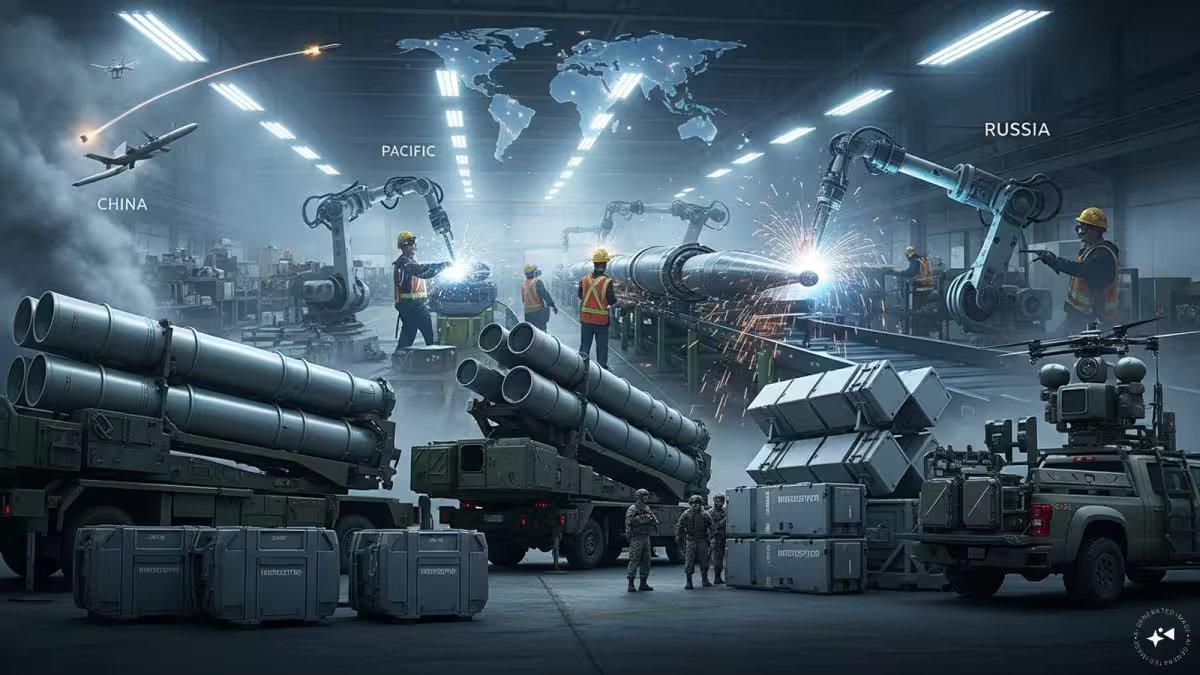
The ongoing US and Israeli military campaign against Iran has intensified concerns among lawmakers and defence analysts about the strain on American weapons stockpiles, highlighting longstanding production challenges that could pose difficulties if another major conflict erupts.
The administration of US President Donald Trump has insisted that American forces currently possess sufficient weapons to sustain the war effort, which has entered its second week. Trump said on social media that several defence companies had agreed to rapidly expand production of key munitions, claiming some contractors would increase output fourfold, though he did not specify which weapons systems were involved.
Despite those assurances, questions about the availability of advanced weaponry have grown as the campaign against Iran intensifies. Several Democratic lawmakers argue the president has initiated what they describe as a “war of choice,” while experts point out that certain missile defence systems are already under heavy pressure.
Among the most in-demand systems are the Patriot missile system and the Terminal High Altitude Area Defense (THAAD) system. These interceptors are widely used by the United States and its allies, including Ukraine and Israel, to counter missile threats.
“I’m not particularly worried about us actually running out during this conflict,” said Ryan Brobst, a scholar focused on US defence strategy at the Foundation for Defence of Democracies. “It’s about deterring China and Russia the day after this conflict is over.”
The US is using both systems to take down Iranian missiles fired in retaliation for the American and Israeli attacks, but U.S. officials have said they are struggling to stop waves of drones launched by the Islamic Republic and that they are bringing in an American anti-drone system proven to work against Russian drones in Ukraine. The system known as Merops also is cheaper than firing a missile that costs hundreds of thousands of dollars at a drone that costs less than $50,000.
Sean Parnell, the Pentagon’s chief spokesman, said in a statement that the US military “has everything it needs to execute any mission at the time and place of the President’s choosing and on any timeline.”
Defense contractor Lockheed Martin posted on X late Friday that it had agreed to “quadruple critical munitions production” and “began this work months ago.” Trump and Lockheed did not offer a timetable of when the production increases would reach their target.
Some Democratic lawmakers, meanwhile, have questioned the long-term impact to the U.S. and its allies.
“We’ve been told again and again and again one reason that we can’t provide interceptors for the Patriot system or other munitions for Ukraine is that they’re in short supply,” Sen. Richard Blumenthal, D-Conn., told CNN on Thursday.
Sen. Mark Warner, D-Va., told reporters that American supplies are dwindling after the military fought the Houthi rebels in Yemen and engaged in more recent conflicts under the Republican administration. The top Democrat on the Senate Intelligence Committee did not specify what type of munitions he was referring to.
“Our munitions are low. That’s public knowledge,” Warner said. “It will require additional funding, funding where we have other domestic needs as well.”
Supplies of defence interceptors are the most taxed, said Brobst, who is deputy director of the Center on Military and Political Power at the Foundation for Defence of Democracies, a hawkish Washington think tank.
The THAAD system is designed for defeating medium-range ballistic missiles, while the Patriot system is for taking down short-range ballistic missiles and crewed aircraft. About 25% of the entire THAAD stockpile was estimated to be used defending Israel from Iran’s ballistic missiles in the 12-day war with Iran last summer, Brobst said.
“These were already in very high demand and we had not procured enough before the conflict,” Brobst said. ”And now we’ve probably used, between the two of them, probably several hundred more.”
The exact number of US THAAD and Patriot systems is classified, with administration officials and Democratic lawmakers declining to offer details.
Demand for interceptors is likely falling as the US and its allies take out Iran’s weapons’ capabilities, Brobst said. Gen. Dan Caine, chairman of the Joint Chiefs of Staff, told reporters this week that the number of ballistic missiles fired by Iran was down by 86% from the war’s first day.
Other munitions in demand include cruise missiles and precision-guided missiles, known as “standoff” weapons, Brobst said. Their stockpiles are likely healthier, and their use probably peaked at the beginning of the war as U.S. forces hit Iran’s early-warning systems, air defences and other targets.
Defence Secretary Pete Hegseth said as much — that American forces used more ”standoff munitions at the start, but no longer need to.” He told reporters Wednesday that they would be using “500-pound, 1,000-pound and 2,000-pound GPS- and laser-guided, precision gravity bombs.”
The US has a healthy supply of those types of weapons, which are cheaper but require aircraft to fly closer to their targets, Brobst said.
But the US military is moving to bolster its anti-drone capabilities in the region with the Merops system that flies drones against drones. It is small enough to fit in the back of a midsize pickup truck, can identify drones and close in on them, using artificial intelligence to navigate when satellite and electronic communications are jammed.
Brobst said the problem of not having enough advanced munitions, particularly interceptors, was around well before the war in Iran, though “this has definitely not made it get any better by using up these munitions.”
“Successive administrations over multiple decades did not procure sufficient quantities of these interceptors, and when that happens, companies don’t have an incentive to expand their production capacity,” Brobst said, adding that it takes “significant time” to ramp up production.
The administration in recent months has promised to boost defence spending and to speed up production, while calling on the Pentagon to call out defence contractors that underperform and insufficiently invest in building manufacturing.
Katherine Thompson, a former deputy senior adviser at the Pentagon during this Trump administration, said then-President Joe Biden had diminished some of the stockpile of interceptors by sending them to Ukraine.
“It was a short-term win for the Biden administration but a long-term strategic problem for the United States as a whole,” said Thompson, who left her Pentagon position in October and is now a senior fellow in defence and foreign policy studies at the libertarian Cato Institute. “I would hope that the Trump administration doesn’t make that same mistake here.”
Riki Ellison, chairman of the Missile Defence Advocacy Alliance, said the US military could shift interceptors from one part of the world to another or get them from allies if needed. He also noted the Pentagon effort to get defence contractors to boost production.
“We’re moving in that direction,” Ellison said. “That’s not going to be ready next week or anything, but it’s moving.”
With inputs from agencies
End of Article