In recent years, Europe has faced a range of challenges that have jeopardised its security. From the prolongation of the Russia-Ukraine war to US President Donald Trump’s frequent warnings about annexing Greenland, Europeans must consider their own strategic autonomy.
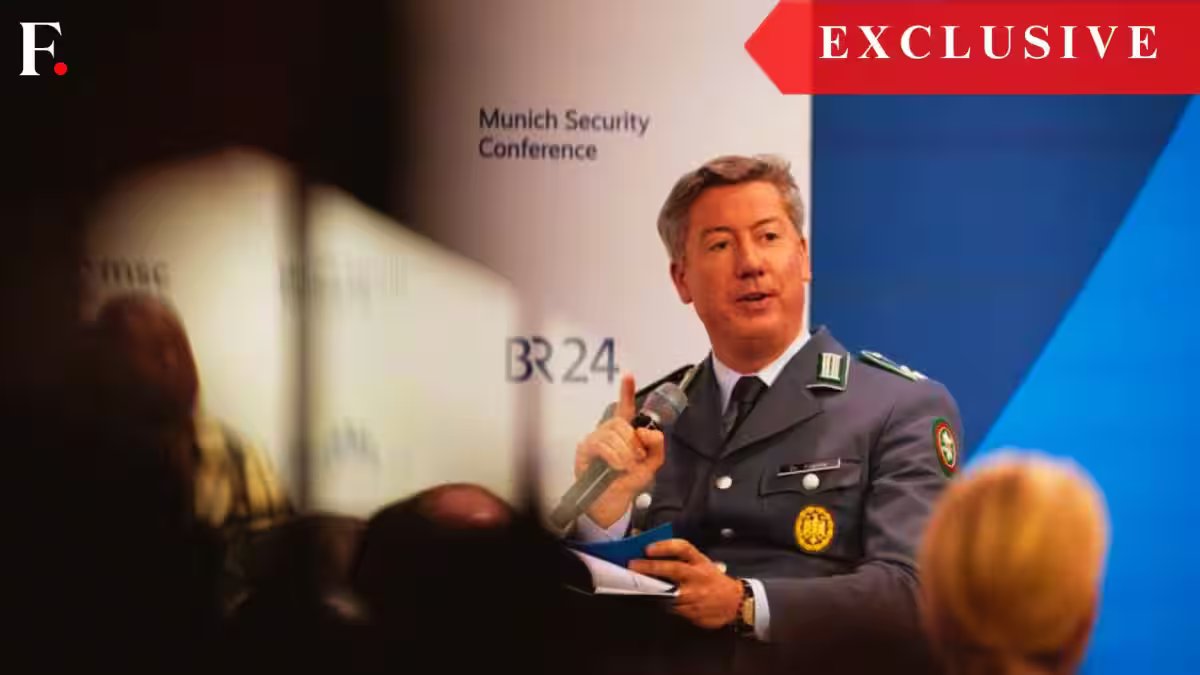
In an exclusive conversation with Firstpost’s Bhagyasree Sengupta, Benedikt Franke, Vice-Chairman and Chief Executive Officer of the Munich Security Conference, Germany, laid out the security challenges Ukraine is currently facing and insisted that the one person who can end the ongoing Russia-Ukraine war is Russian President Vladimir Putin.
While he admitted that transatlantic ties have taken a hit this year, he made it clear that they are “not dead”. Franke also maintained that Europe’s exclusion from the Ukraine peace deal discussion by US President Donald Trump’s administration is not America’s fault, but Europe’s.
How the Munich Security Conference was different this time
While speaking to Firstpost, Franke said this year’s Munich Security Conference was different from last year’s, where US Vice President JD Vance’s provocative speech against Europe dominated the event. “So last year, everything was about one speech, about the speech by JD Vance. This year, there wasn’t one speech that dominated everything. It was a much broader debate about the state of the global order and about potential remedies,” he said.
“What was striking this year was that no one agreed on anything. We’ve seen some who said the ‘global order is dead’. We saw some, particularly from the Global South, who said the ‘global order isn’t yet dead enough’. It’s still unfair to us. It’s tilted. And then there were those, mostly from our American friends, who said the global order is getting better by the day thanks to Donald J. Trump. So we had these three schools of thought that were very diverse and hence very different from us,” he continued.
‘Only one person can end the Ukraine war’
When asked about the prospects of a peace deal between Russia and Ukraine, Franke noted that German Chancellor Friedrich Merz had just flown to Washington. He emphasised that the key points of talks between Merz and Trump would include the fact that “Ukraine cannot cede any more territory than it has already lost.”
“The demands by Russia are so unreasonable that it is relatively clear that they are an excuse for continuing the war, that they are not really interested in ending the war,” he said. “I just want to repeat the point that there is one person in this world who could end the war against Ukraine, and that is President Putin. I hope that Trump is slowly but surely coming around to that point of view, too,” Franke told Firstpost.
On transatlantic ties
Transatlantic ties took a major hit with the return of Trump to the White House. There have been instances when Europe felt ambushed, for instance, not being included in the Alaska Summit. When asked about his take on the matter, Franke noted three things. “First, yes, it is true that the transatlantic relationship has taken a bit of a beating lately. But it’s certainly not dead. This alliance is not falling apart. Point number two is that you have to distinguish between Europeans not being at the table and the Americans doing things that Europeans don’t like,” he said.
“So, us not being at the table is not the Americans’ fault. It is our fault. We haven’t made clear why we should be at the table. We are not yet offering enough, or at least we’re not good enough at communicating to the Americans our value added. But things like Greenland, those are things that Europeans are massively concerned about and that, in a way, have freaked us into a cohesion that we haven’t had for a long time,” he added.
Trump has reignited his ambition to take over Greenland ever since he returned to the White House. The American administration has often threatened to “annex” the Arctic island, which is a self-governing, autonomous territory of Denmark. However, Trump’s plan garnered backlash from both Denmark and Greenland, with former Danish Prime Minister Anders Fogh Rasmussen stating at the Raisina Dialogue that annexation of Greenland would “end Nato”.
Franke agreed with the sentiment and maintained that the Europeans have drawn a red line over the matter. “I hope the president has understood that Europeans have drawn a red line. This is not American territory, and it will not be American territory. But everyone in the alliance is open to addressing American concerns on Arctic security and military access to the high north. Everyone is open to the Americans building more bases on Greenland,” he told Firstpost.
“Everyone is open to the Americans, you know, playing a stronger, for that purpose, more profitable role in the exploitation of natural resources in Greenland. But I don’t think anyone is open to the Americans owning Greenland,” he explained.
How Europe is looking at the conflict in Iran
The US and Israel’s conflict with Iran has spilt over into Nato, with member-state Turkey being targeted by Tehran last week. When asked how Europe and Nato are looking at the ongoing tension, the Munich Security Conference CEO maintained that “Nato isn’t responding beyond the operational military support within the command structures. I don’t see Europe doing much in this conflict.”
He emphasised that with the Joint Comprehensive Plan of Action (JCPOA) out of the window, there is no alternative. It is pertinent to note that the deal in question was signed in 2015 between Iran and the P5+1 (USA, UK, France, Russia, China, plus Germany). It lifted economic sanctions on the West Asian nation in exchange for limitations on Iran’s nuclear programme.
“We are naked on the diplomatic front. If you look at the Iran conflict, there are some who I think credibly say this is yet another example of there not being a Europe in foreign policy,” Franke told Firstpost.
“We’ve seen very different responses. The German Chancellor is flying to Washington, you know, on a positive note. The Spanish Prime Minister said Americans can’t use the bases. The British Prime Minister is sort of changing his mind occasionally. There wasn’t a European response to Iran. And I’m afraid, I don’t think there will be one for a while.”
However, Franke expressed hope that once the tensions simmer down, “Europe will be a constructive player and will actually offer diplomatic facilitation services, financial support and a recovery plan. Because that is something we’re good at,” he averred.
- ‘Iran is trying to find a way out’
The European political scientist and diplomat admitted that many people are “wondering what the hell is Iran doing?”, pointing out how Tehran attacked almost all its neighbours and even potential allies. “I think the Iranian regime is trying to find a way out of this conundrum. They have really ruined their standing in their own region. By blaming, you know, some rogue commanders, I think that is one way of dealing with that,” Franke said. “I’m flabbergasted at how unstrategic the Iranians have dealt with this situation,” he remarked.
‘Russia is testing Europe every day’
Since last year, Russia has conducted numerous incursions in several European nations. Be it frequent sabotage operations by the Russian shadow fleets or Russian drones infiltrating the airspace of Eastern European nations, Moscow’s conduct amid the Ukraine war has compelled Nato and Europe to solidify their military infrastructure.
Sharing his take on the matter, Franke admitted that “Russia is testing Europe every day”, insisting that “Europe is getting better at responding.” However, he acknowledged that the continent has been “far too slow” in dealing with the issue.
“Europe is getting better at responding, but far too slow. Sometimes I wish we were better at catching Russia off guard once. They keep catching us off guard, and we need to get better at catching them off guard,” he said.
The EU and Nato often face challenges from the outliers in the group. Ever since the start of the Russia-Ukraine war, countries like Hungary and Slovakia have opposed blocking energy supplies from Russia, to the point of going against the bloc to hold talks with Russian President Vladimir Putin.
When asked how Nato maintains solidarity in such a situation, Franke maintained an optimistic stance. “See, unity doesn’t mean that everyone needs to think and say the same thing at all times. I know that it is very attractive for journalists to look at Hungary and the Czech Republic, but Europe is alive and well. And yes, we can deal with Viktor Orban having a different opinion ever so often,” he said.
“This diversity of views is making us stronger. Yes, it is making the whole process slower and more cumbersome and sometimes more frustrating than it needs to be. But it’s not making it worse,” Franke concluded.
The 11th edition of the Raisina Dialogue was held from 5 March 2026 to 7 March 2026 in New Delhi. Firstpost has partnered with the Raisina Dialogue to bring exclusive conversations with global leaders to you.
The Raisina Dialogue is India’s flagship conference on geopolitics and geo-economics, hosted by the Observer Research Foundation in collaboration with India’s Ministry of External Affairs.
End of Article