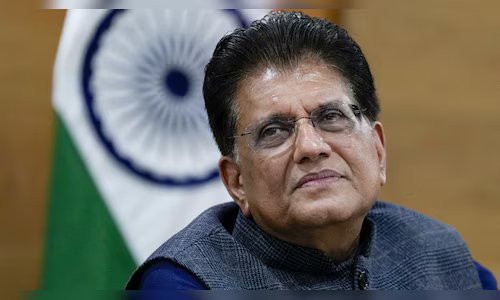
Commerce and Industry Minister Piyush Goyal said India aims to attract high-paying students from developed countries and urged educational institutions to ensure their curriculum is attractive enough for students from the United States, European Union (EU), Japan, Korea, Australia and New Zealand.
Addressing the Vice-Chancellor’s Conclave organised by the Indian Institute of Foreign Trade in New Delhi, Goyal called for the right “ambience”, hostel, and classroom facilities to reverse the trend of net outward migration from India for studies.
He expressed hope that in the coming years the present ratio of 28 Indian students going abroad for every international student coming to India would be reversed, hoping that “India would attract around 1.3 million foreign students to study in its institutions while only a small number of Indian students go abroad.”
Goyal also called for activating the alumni ecosystem in India’s universities instead of relying mainly on government funding. Citing the example of several Ivy League colleges, he said many global universities are funded through endowments. He added that the IIFT is exploring the potential that education as a service holds for boosting India’s export earnings and expanding the global reach of Indian education.
Highlighting the importance of internationalisation of India’s trade, manufacturing and services sectors, along with engagement with modern technologies such as artificial intelligence, quantum computing and machine learning, he stressed the need for educational institutions to reassess their curriculum and teaching styles.
Also read: Piyush Goyal: India will meet all commitments for goods and services, working to support exporters
This includes adding subjects like international trade and India’s Free Trade Agreements to help students understand opportunities in the global economy.
He also lauded the National Education Policy 2020 for allowing international universities to set up campuses in India and collaborate with Indian institutions to offer dual degrees.
Goyal suggested models like three-year programmes where students could spend one year in India and two years in their original institution, or split their time equally between both institutions.