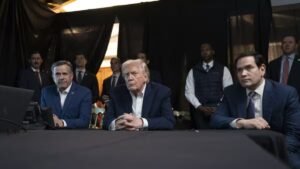
As the war in West Asia intensifies, statements from the administration of Trump have repeatedly shifted — from regime change to nuclear threats and the role of Israel, revealing several contradictions.
As the ongoing war in West Asia intensifies following strikes by Israel and the United States on Iran, messaging from the administration of US President Donald Trump has repeatedly shifted.
From regime change to nuclear threats and the role of Israel, the explanations behind the war have seen several reversals.
Here are five key contradictions in the administration’s narrative.
Regime change
Trump told Iranians to “take over your government” in his war announcement, signalling support for regime change in Iran. However, US Defence Secretary Pete Hegseth later said it was “not a so-called regime change war”.
Trump then appeared to contradict his own defence chief by saying the US should be “involved in choosing” Iran’s next leader. He also expressed support for Kurdish militias fighting the Iranian regime.
Original justification for the war
The reasoning behind the conflict also shifted. Trump initially threatened military action over Tehran’s crackdown on anti-government protests.
Later, the justification moved to concerns about Iran’s nuclear programme.
The nuclear threat
Trump claimed that Iran was just two weeks away from building a nuclear weapon. However, he had earlier repeatedly asserted that US strikes had already obliterated Iran’s nuclear programme last June — weakening the argument for urgent action now.
Meanwhile, Rafael Grossi, head of the International Atomic Energy Agency, said there was “no evidence” that Iran was building a nuclear bomb.
Iran’s navy
Trump and Defence Secretary Pete Hegseth claimed Iran’s naval forces had been destroyed, with Trump declaring: “They have no navy.”
However, on the same day, Dan Caine, Chairman of the Joint Chiefs of Staff, said the US military would continue striking Iranian naval capability over the next 24–48 hours, contradicting the claim that it had already been eliminated.
Why the US launched the strike
The explanation behind the US strike shifted several times. Trump first threatened military action if Iran did not abandon its nuclear ambitions, then over Tehran’s refusal to accept his demands during nuclear talks.
Later, the White House said the strike came after intelligence suggested Israel was preparing to launch its own attack. Israeli officials, however, said they acted because they anticipated an Iranian strike.
War spreads across the region
It has been a week since Israeli and US forces pounded targets across Iran, prompting Iranian retaliatory strikes around the Gulf. The conflict has spread to Lebanon, rattled global markets and pushed oil prices sharply higher.
Four days into the war, US President Donald Trump told reporters that the US military had struck numerous Iranian naval and air targets, saying that “just about everything has been knocked out”.
In Lebanon, Iran-backed Hezbollah fired rockets at Israel, prompting Israeli air strikes and reinforcement of ground positions in the south. Thick black smoke blanketed Beirut as explosions echoed across the city. Authorities said dozens were killed.
Iran said the death toll from the attacks had reached 787. That included 165 girls killed on the war’s first day when their school was bombed — the highest toll among several civilian targets reported to have been hit.
State media showed hundreds gathering in the southern city of Minab, where the girls’ small coffins draped in Iranian flags were passed from a truck and carried by mourners across a sea of raised hands towards the burial site.
The United Nations Human Rights Office demanded an investigation into the strike, which a spokesperson described as “absolutely horrific”.
Some Iranians have openly celebrated the death of Ali Khamenei, 86, who had ruled Iran for 37 years and whose security forces had killed thousands of anti-government protesters only weeks earlier.
End of Article