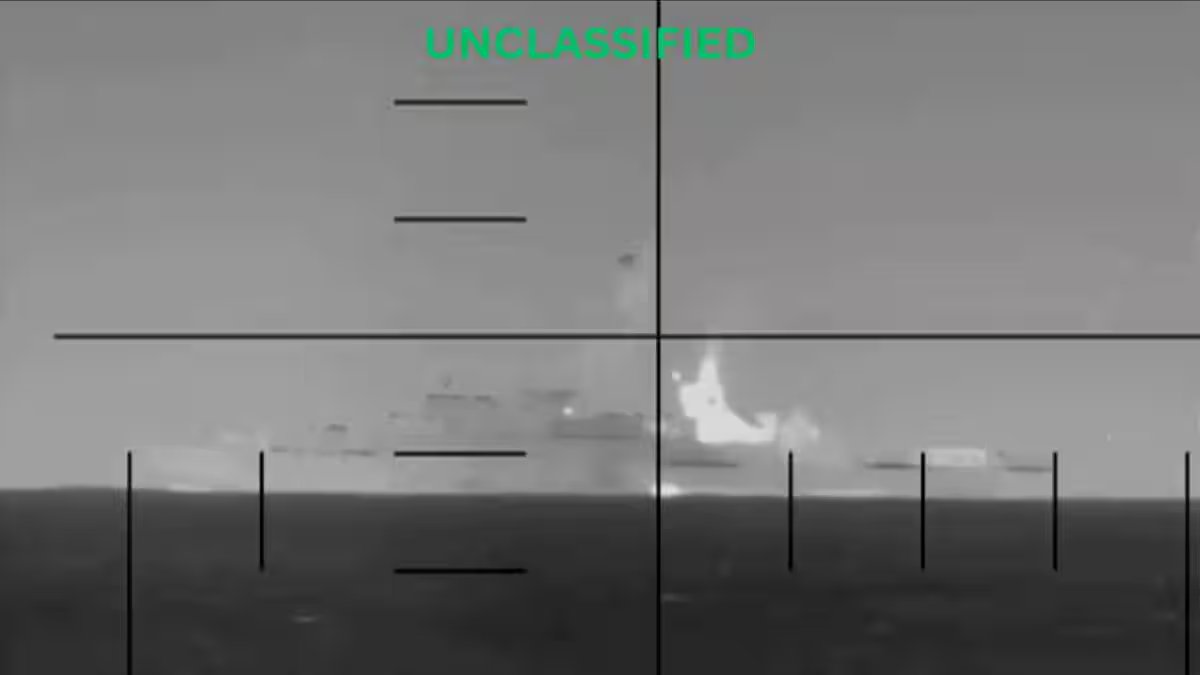
The Iran war, now in its sixth day, continues to escalate. On Wednesday (March 4), the war reached India’s backyard when a United States submarine torpedoed and sank an Iranian warship.
At least 87 Iranian soldiers were killed in the attack on Iris Dena, the Iranian ship, off the southern coast of Sri Lanka in the early hours of Wednesday, with US Defence Secretary Pete Hegseth saying that the vessel died a “quiet death”.
What do we know of this strike on Iris Dena? Why was it in international waters in the Indian Ocean? What could be the implications of this strike for India?
What we know about the US attack on Iris Dena
Early Wednesday morning, news emerged that a torpedo fired by a US submarine sank
Iris Dena, an Iranian warship, off the south coast of Sri Lanka. The incident came on the fifth day of Israel and the US trading fire with Iran, with Washington officials warning that strikes would soon hit targets “deeper” in Iran.
Pete Hegseth, the US Defence Secretary, confirmed that the US sank the Iris Dena as it sailed close to the Sri Lankan coast. The Pentagon released black-and-white footage of a Mark 48 heavyweight torpedo striking the frigate, sending a geyser of seawater into the air.
https://t.co/PiqQpVIrMu pic.twitter.com/Wc1e0B0um7
— Department of War 🇺🇸 (@DeptofWar) March 4, 2026
“An American submarine sank an Iranian warship that thought it was safe in international waters,” Hegseth said. He said the attack was carried out late on Tuesday night.
“It was sunk by a torpedo, a quiet death – the first sinking of an enemy ship by a torpedo since World War II,” added Hegseth. “Like in that war, back when we were still the war department, we are fighting to win.”
Notably, while this is the first time that an American submarine has sunk an enemy ship since 1945, the United Kingdom and Pakistan have both sunk vessels using torpedoes since then.
According to Sri Lanka’s Foreign Affairs Minister, Vijitha Herath, coastguards received a distress call from the Iris Dena at 5.08 am on Wednesday. Crew members described the incident as an explosion.
“By 6 am, we dispatched a naval vessel and by 7 am the second naval vessel,” Herath added. He said Sri Lanka had an obligation to respond to the call for help because it was a signatory to the International Convention on Maritime Search and Rescue.
Weighing in on the same, Sri Lankan navy spokesman Budhika Sampath noted that rescuers didn’t spot any vessel in the region. Though the ship’s location “was beyond our waters,” Sampath said, “it was within our search and rescue region. So we were obliged to respond as per international obligations.”
The Iris Dena was reportedly ferrying 180 crew members at the time of the strike. While 87 bodies have been retrieved from the waters, another 32 have been rescued and moved to a hospital in the southern port of Galle, where they are receiving treatment for their “serious injuries”.
What we know about Iris Dena
Iran’s Iris Dena was first launched in 2015 and was attached to Iran’s Southern Fleet, which is tasked with deployments in the
Strait of Hormuz and the Gulf of Oman.
It was the newest frigate in the Iranian navy and equipped with surface-to-air missiles, anti-ship missiles, cannon, machine guns, and torpedo launchers. The vessel, named after Mount Dena in southwestern Iran, also included a helicopter landing pad and radar systems capable of tracking multiple targets.
The ship had been sanctioned by the US Treasury Department in February 2023, along with eight executives of an Iranian drone manufacturer that supplied weapons to Russia for use against civilian targets in Ukraine.
Why the ship was in the Indian Ocean
Shortly after the sinking of the Iris Dena, many wondered what the frigate was doing in the Indian Ocean, as naval deployments in this region have been rare.
Interestingly, the ship had been participating in diplomatic naval activities in the weeks leading up to the incident. Iris Dena had participated in the International Fleet Review (IFR) and multilateral exercise, Milan-2026, organised by the Indian Navy in February.
For those who are unaware, the IFR is a grand sea parade where warships, submarines, aircraft, and sailors from different navies participate. Meanwhile, Milan-2026 is a biennial multilateral naval exercise hosted by the Indian Navy, aimed at fostering mutual understanding, trust, and professional interaction among maritime partners.
More than 85 ships from 74 countries participated in the exercise, including those from the US and Iran. The Iranian warship had participated in the events in India and following the Fleet Review on February 18, had docked at the Indian port city of Vizag on February 20.
Many residents in India’s Visakhapatnam told The Hindu of their encounters with the personnel of the now sunken ship. “They clicked numerous selfies and photographs with locals at the park, especially on the glass skywalk bridge,” said one resident. The personnel had also visited shopping malls, purchasing souvenirs and artefacts to take back home. “Little did they know that they might meet a watery grave miles away from their homeland,” he told the Indian daily.
Why the US downing of the Iranian ship matters for India
The US’s decision to strike the Iris Dena in the Indian Ocean has raised questions about how it impacts India.
Former Navy Chief Admiral Arun Prakash wrote on X: “Sinking of Iranian warship, off southern tip of Sri Lanka, with heavy loss of life is a senseless & inflammatory act. Initiating another dimension of violence in this open-ended conflict will spread alarm across the high seas and disrupt global seaborne commerce. Condemnable!”
He was also quoted as telling India Today, “The sinking of the Iranian warship shows the Iran-US-Israel war has come to our doorstep.”
International relations analyst Zorawar Daulet Singh also noted that the warship being sunk near India was significant. “Iranian missiles have pushed the US navy close to Indian waters. This is precisely one of the scenarios for which the US signed the LEMOA (logistics agreement) with India. But the repercussions for India to be even an inadvertent war party in an aggressive & unprovoked intervention by the US would be dangerous. This is the time for the Indian government to act independently and intelligently to safeguard Indian interests,” he wrote on X
However, as columnist and satirist Kamlesh Singh pointed out, the Indian Ocean doesn’t mean India’s Ocean. “While this is bad news and a reaction is imperative, must remember that the Indian Ocean not equal to Indian territory. The ship was on a visit to an Indian port but that was before the war began. Sooner or later, It was bound to be targeted by the enemy like any warship would be,” he pointed out on X.
The incident has, however, raised eyebrows within India’s defence and security establishment. We shall have to wait and watch how New Delhi navigates this matter.
With inputs from agencies
End of Article