TVS Motor Company has overtaken Yamaha Motor in global two-wheeler sales to become the world’s third-largest manufacturer by annual volume, marking a rare reshuffle in the global motorcycle industry. Our sister publication Autocar Professional had earlier reported that TVS Motor was expected to surpass Yamaha’s global volume last year.
- TVS is successful in the mass-market with its diverse product portfolio
- Most of Yamaha’s sales are in the lower volume premium segments
- TVS is also focusing on other markets, aside from India
How TVS overtook Yamaha for global number three
TVS has a diverse portfolio to cater to different customer segments
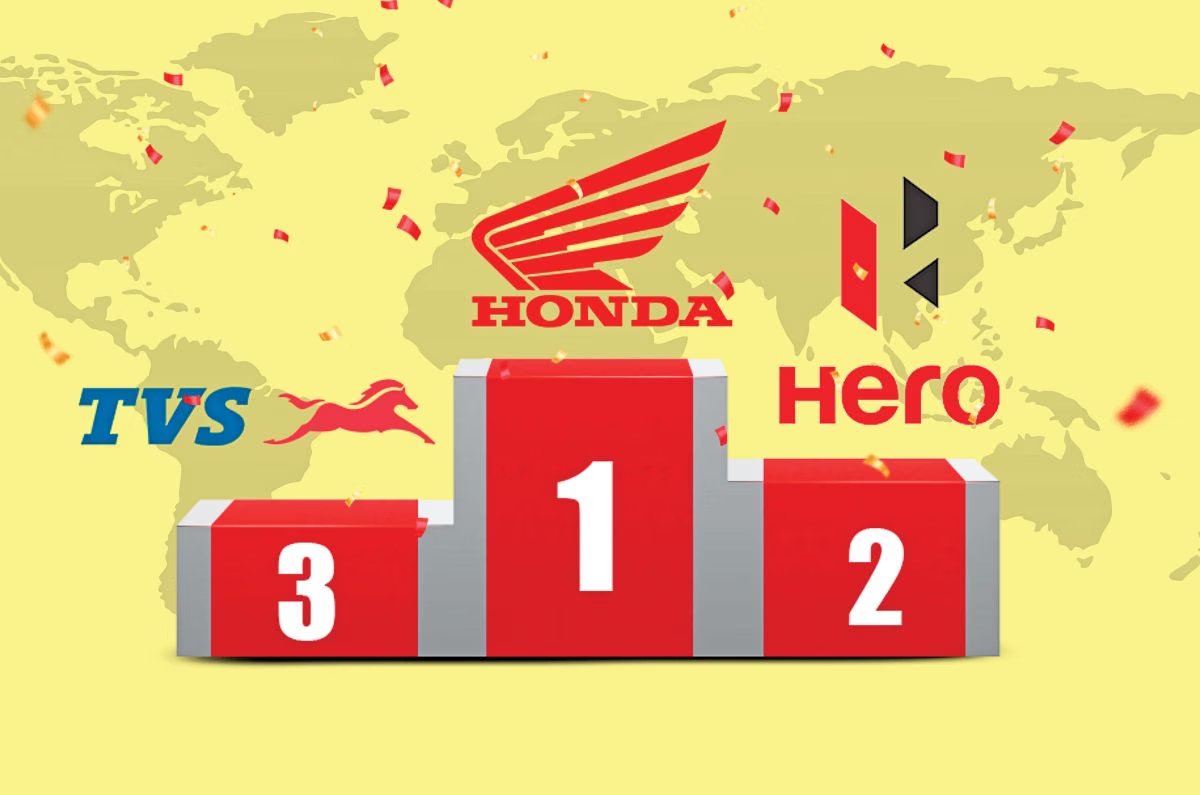
TVS sold 5.46 million units in 2025, up 20.7 percent from 4.52 million units in 2024, according to industry data. The sharp increase enabled the Chennai-based manufacturer to surpass Yamaha, which recorded approximately 5 million units in 2025, a modest 0.8 percent rise from 4.96 million units a year earlier.
The shift underscores the rising influence of Indian manufacturers in the global motorcycle market. Honda retained the top spot with 16.44 million units in 2025, up 6 percent from 15.51 million units in 2024, while Hero MotoCorp remained second with 6.25 million units, a 5.2 percent increase from 5.94 million units in the previous year.
TVS’ entry into the global top three makes it the second Indian manufacturer after Hero. The development also reflects intensifying competition in India’s two-wheeler market, where the battle has expanded beyond the traditional contest between the top two players into newer areas such as electric mobility, premium motorcycles and export business.
TVS is currently the third-largest two-wheeler manufacturer in India, behind Hero MotoCorp and Honda, with an estimated 19-20 percent domestic market share. A key growth driver for TVS has been the ongoing premiumisation trend in India’s motorcycle market. Demand growth has increasingly shifted toward the 150cc+ segments where TVS has expanded its presence and benefited from stronger consumer demand for higher-displacement models.
TVS’ volume growth in India is supported by strong presence in the mass-market segment, backed by a broad product portfolio. The company also benefits from a significant export footprint across developing markets, particularly in Africa, which adds meaningful scale to its global volumes.
Yamaha, in contrast, has been increasingly focused on more niche segments within the mass market and has exited several high-volume categories over the years. In addition, a sizable share of Yamaha’s volumes comes from developed markets, where demand growth tends to be slower compared with emerging markets.
TVS has also emerged as a major player in India’s electric two-wheeler market, where it consistently tops monthly sales charts to secure its leadership position. Rising EV demand has prompted TVS to review further expansion of its electric two-wheeler manufacturing capacity as production approaches an annual output of around 5 lakh units.
At the same time, TVS is strengthening its leadership. The company, which elevated Sudarshan Venu as its chairman, is set to bring Nick Rogers, the former engineering head of Jaguar Land Rover, into its senior leadership team as part of a broader push to strengthen engineering capabilities and accelerate development for its global brands, including the Norton motorcycle business.
Premiumisation, electric vehicles and global expansion are the major pillars on which TVS Motor is banking for future growth. The company is also charting its course to capitalise on growing two-wheeler markets including Europe, Africa, Latin America, Southeast Asia and the Middle East by increasing its presence.
Yamaha, meanwhile, said its motorcycle performance in 2025 was mixed across markets. While sales rose in Japan, overall volumes were slightly lower in developed markets due to weaker demand in Europe and the United States. In emerging markets, production and shipments were temporarily halted in Vietnam, though sales increased in Indonesia, the Philippines and Thailand.
As a result, the company said total motorcycle unit sales and revenue were largely in line with the previous fiscal year, though operating income declined due to higher procurement costs, increased R&D spending, rising labour costs and the impact of new tariffs in the United States.
Honda continues to dominate the global motorcycle market, with the Asian region accounting for about 85 percent of its global sales, reinforcing the importance of emerging markets to the industry’s growth trajectory.
With inputs from KIRAN MURALI