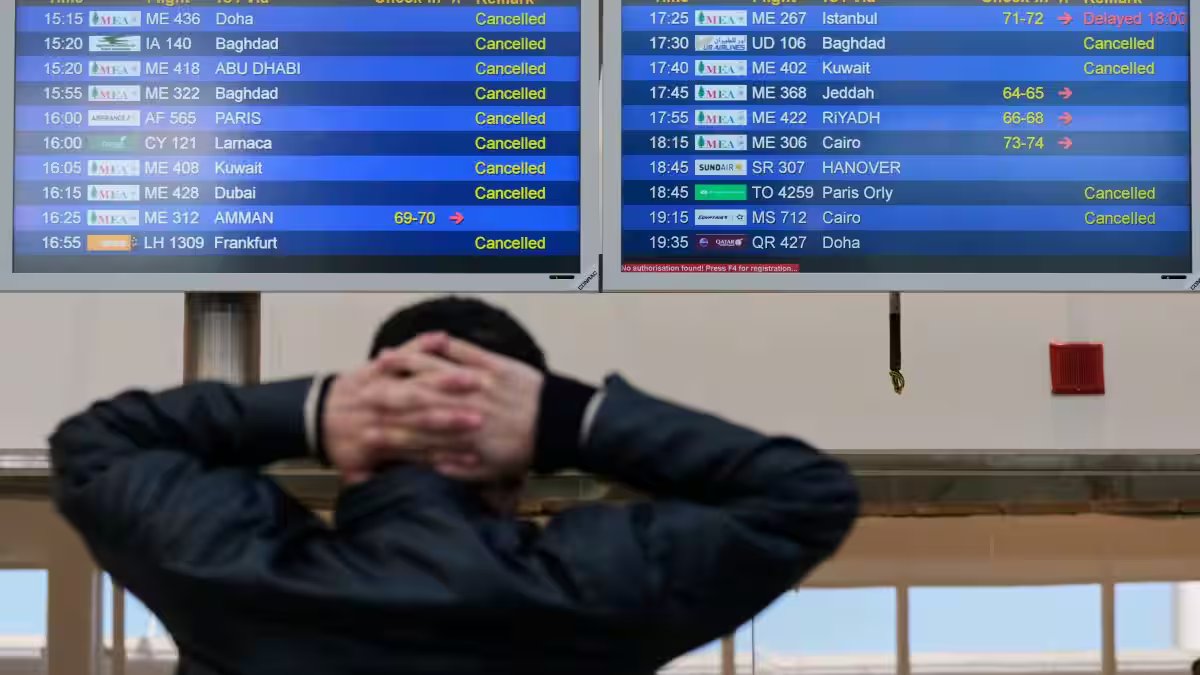
The Iran-US and Israel conflict has led to thousands of flights being cancelled and many more thousands of passengers stuck in transit, at point of origin or in a third country. Below is a guide for passengers caught unawares by the war.
The Iran-US and Israel conflict that escalated to subsume neighbouring countries such as Saudi Arabia, Oman, UAE, Qatar, Bahrain and Kuwait has had a ripple effect on aviation. The attacks on non-military targets, including civilian airports, led to an immediate closure of traffic from the major Middle Eastern gateways like Dubai, Abu Dhabi and Doha. All these airports are hubs for the 3 big Gulf carriers—Emirates, Etihad, and Qatar Airways, respectively.
The conflict has led to thousands of flights being cancelled and many more thousands of passengers stuck in transit, at point of origin or in a third country. As of now, Etihad and Emirates are operating limited rescue flights for passengers stuck at their hubs while Qatar Airways remains grounded until further notice. Most carriers are updating information daily with cancellations lasting for 24 hours before the next notice is out. The three Gulf carriers offer over 1 lakh seats per week out of India, with Emirates leading the pack with close to 60000 seats on offer, along with Flydubai, which is impacting passengers travelling to and from India across the world.
What should the passengers do?
Passengers stuck in transit are the most exposed to war and the possibility of another attack on the civilian infrastructure, including airports. Airlines are managing the situation by starting evacuation flights in the window that is available for safe operations. Both Emirates and Etihad have operated such flights based on the safety assessment, the destination of passengers who are stuck and the passenger mix. There isn’t anything that passengers can do if stuck in transit.
If one is booked for immediate travel via one of the carriers where flights are suspended, airlines are offering full waiver of cancellation charges, full refund or ability to rebook without additional cost over the next few days. How long the attacks would last is anybody’s guess and thus rebooking for a later date does not assure travel on those dates. The risk assessment on travel via Middle East is being done by corporates and individuals.
Lastly, multiple passengers hold tickets for a future date which is over a week from now and have transits planned in the Middle East. Will the region remain volatile during this period remains unknown and is dependent on how long the conflict lasts? If it becomes a longer conflict with Iran continuing to engage against its immediate neighbours, the situation may turn grim for the hub carriers in the region and impact thousands of passengers. The airlines would already be under strain with limited forward bookings as passengers wait it out to see if they want to fly via the Middle East or not.
Why passengers must be in touch with airlines
Passengers have little choice but to wait and see how the conflict evolves if they are already booked with these airlines. Passengers must have their details updated with the airline because the flight schedules could change a lot after the restart of operations as airlines try to clear the backlog of passengers, readjust to a new reality with possibly lower passenger numbers and tinker with the frequencies to adjust capacity with demand.
The impact is not only on the Gulf carriers, but also their Indian counterparts flying to the Middle East. Indian carriers boast of a sizeable network that is focussed on the region as well on Europe and North America. Remember, many of the air routes in the Middle East are closed, leading to increased flight times and technical stops.
Tail Note
The Middle East region has seen multiple conflicts over the last four decades. However, aviation and travel were not central themes, even during the Gulf War in the early 1990s. The subsequent wars in Iraq had little impact on the region, while the Israel-Iran skirmishes in the last few years were restricted to the two countries. It is only now that the whole region is being pulled into the conflict. How does this impact the carriers in the longer run will depend on what happens to Iran and how soon peace returns to the region.
Ameya Joshi is the founder of Network Thoughts, an aviation analysis website.
End of Article