It’s been three days since the Iran war began — it started on Saturday (February 28) when the US and Israel, in a joint operation, launched airstrikes at various cities in the Islamic Republic, including Tehran. The following day, US President Donald Trump announced the death of “one of the most evil persons in history, Ayatollah Ali Khamenei”.
In retaliation, Iran has launched counterattacks against Israel and various Arab countries, particularly targeting the airports as part of a strategy to build pressure to end the war.
This has resulted in travel chaos across West Asia and beyond, sending airline stocks sharply lower on Monday, as carriers across the Persian Gulf extended blanket flight suspensions, causing major disruptions at some of the world’s busiest airports.
Airports across Gulf countries hit by Iran
The Iranian regime is taking aim at the crucial nerve centres of Gulf countries — airports. The Islamic Republic has struck airports in
Dubai and Abu Dhabi, the hubs for the Emirates and Etihad airlines in the United Arab Emirates.
On Sunday, videos went viral online showing plumes of smoke from Dubai’s International Airport, which last year ranked as the world’s busiest for international passengers. All flights were suspended until further notice, the airport said on its website. There’s also been damage reported to the concourse that has injured four staff members.
As Dubai continues to hear explosions, the airport authorities have advised passengers not to travel to the airport and instead contact their respective airlines directly for the latest updates regarding their flights. “We appreciate the cooperation of our guests. Further updates will be provided as we continue to monitor the situation,” it added.
Iran also took aim at the airport in the UAE’s capital, Abu Dhabi. According to a report by state-run Wam news agency, one person was killed by falling debris after air defences intercepted a drone targeting the airport there.
Iran’s drone strikes also targeted international airports in Kuwait and Bahrain. As per a report by Anadolu Agency, a drone hit Kuwait International Airport, causing minor injuries to several workers and limited material damage at Terminal 1.
In a statement posted online, the General Directorate of Civil Aviation’s spokesperson Abdullah Al-Rajhi said the drone strike resulted in slight injuries to a number of employees and “limited material damage” to the T1 passenger terminal building.
A similar drone attack in Bahrain caused damage to its international airport. Fortunately, the strike caused no fatalities and resulted in limited material damage. A senior official said that rapid response protocols have been activated. Emergency plans have been put in place, including the precautionary evacuation of the passenger terminal to ensure the safety of travellers as well as staff.
Travel chaos ensues; airline stocks fall
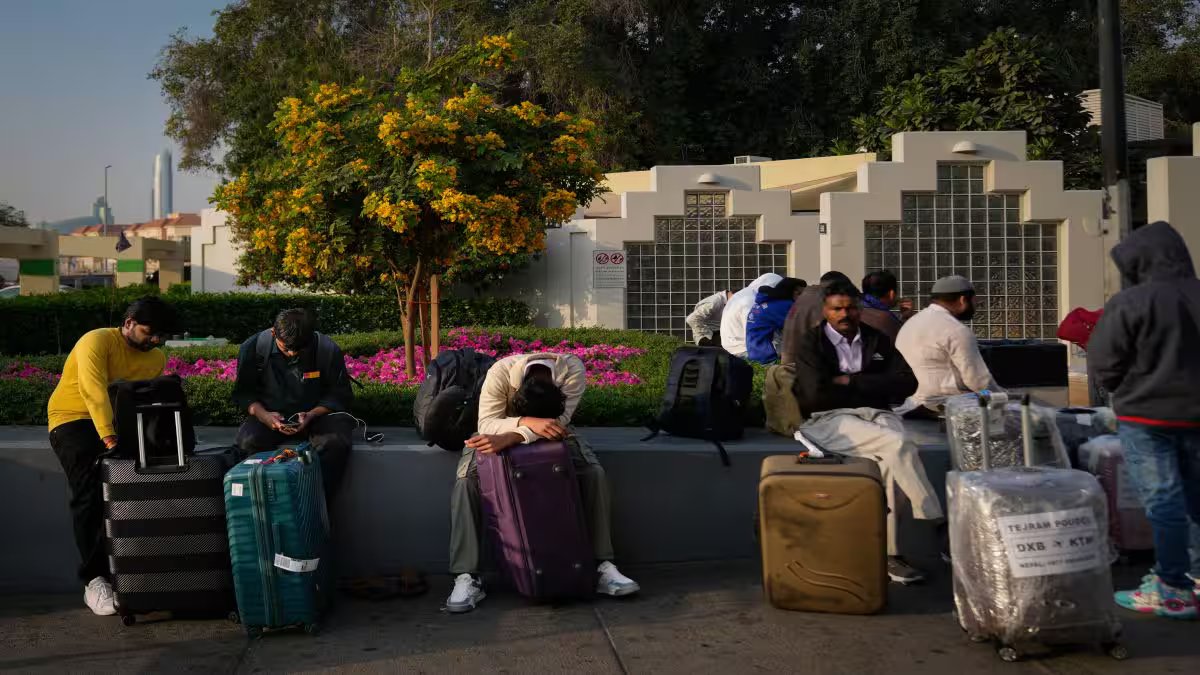
As a result of Iran’s strikes on airports across the Gulf countries, travel turmoil has erupted, leaving passengers stranded. According to the tracking platform FlightAware, a total of 2,800
flights were cancelled on Saturday and 3,156 were cancelled on Sunday. And early on Monday, 1,239 flights had already been cancelled.
Travellers in Dubai, who are stuck as a result of flights being grounded, spoke of the chaos they encountered. “It’s been quite chaotic since the planes have been grounded,” said George Koshy, a passenger caught in the disruption.
“A lot of people who were to take flights here, especially understand the fact that Dubai is one of the key hubs, key international hubs, where planes actually take off to different regions across the world, especially to Europe as well as the US,” he was quoted as telling NDTV.
Manish Gupta, a 35-year-old engineering manager for a fintech firm in India, was hoping to return to New Delhi just hours after the strikes were launched. However, his taxi was stopped by security personnel as they neared the terminal and told to turn around, he told the Wall Street Journal.
“Now we’re just waiting,” he said, “We have no idea how long.”
As these airports closed operations, it has led to a domino effect, affecting passengers across the world. For instance, thousands of flyers were stuck at airports across India after airlines cancelled international flights due to airspace restrictions across West Asia.
The strikes have also led to airline stocks falling drastically. Cathay Pacific Airways fell as much as seven per cent at the open in Hong Kong, while Singapore Airlines Ltd dropped as much as 7.5 per cent. Qantas Airways Ltd lost as much as 10 per cent.
Iran’s attacks on airports by design
Experts, who are witnessing the conflict unfold, note that Iran’s attacks on airports across Gulf countries mark the region’s most widespread business disruption since the Covid-19 pandemic.
Aviation analyst Shukor Yusof told the BBC, “Iran has adopted a scorched earth policy. It has attacked airports in the Gulf and will likely continue to do so.”
There’s also the fact that these airports are an economic cornerstone for the Gulf countries, bringing in food, their mostly expatriate workforce, and facilitating global trade. Moreover, the Islamic Republic is aiming to use this economic pain to put pressure on the US and Israel to curb their strikes.
“Iran is using the strikes to inflict a sense of isolation on those countries, to make their residents feel they are on their own and create a panic inside them,” said Yasmine Farouk, the Gulf and Arabian Peninsula project director at International Crisis Group, to The Wall Street Journal. “The Iranian strategy is to not only regionalise the conflict, but to internationalise this through the Gulf countries from day one.”
Bader Al-Saif, a professor at Kuwait University and fellow at Chatham House, agrees with this assessment. “They want to incur costs on everyone involved. It’s like a scorched-earth strategy. They’re trying their best to show that if we’re going down, you’re going down with us.”
With inputs from agencies
End of Article