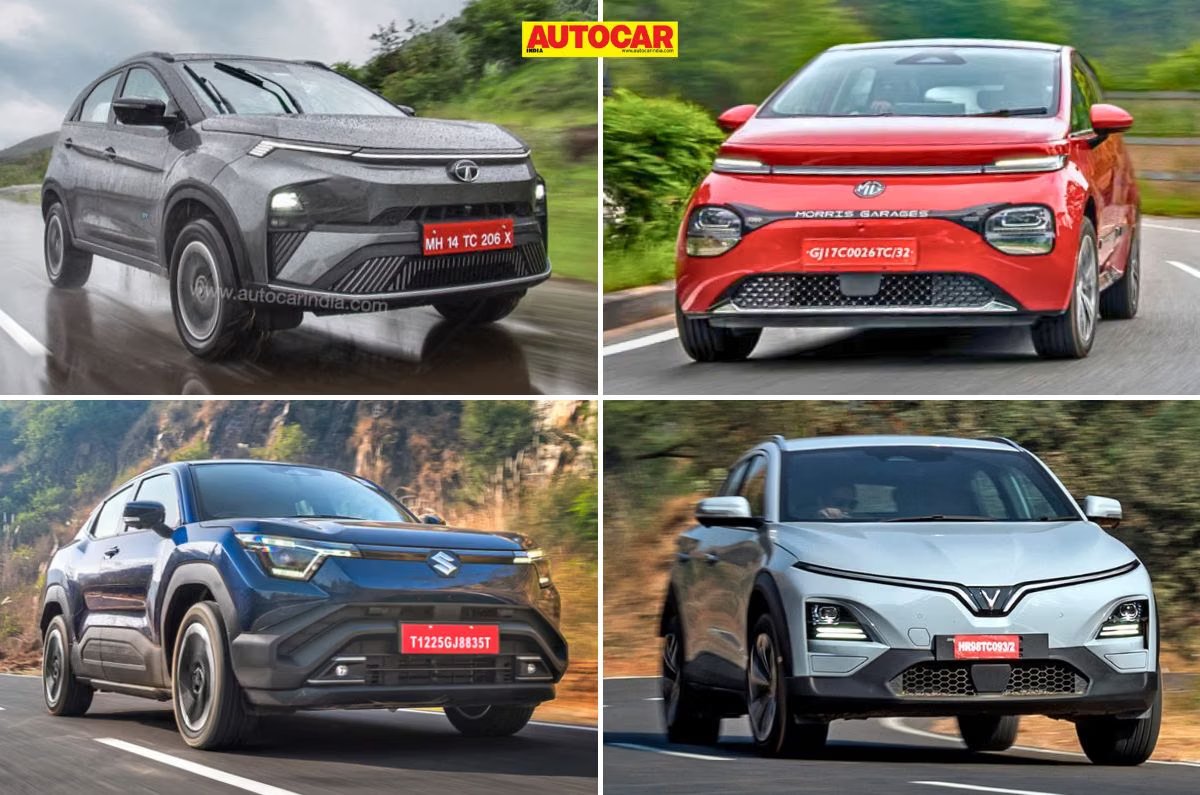
Retail sales of electric passenger vehicles slowed in February, with 13,669 units sold during the month. While this marks a strong 44 percent year-on-year growth over February 2025’s 9,479 units, volumes fell sharply by 28 percent compared to January 2026’s 18,993 units. In fact, February 2026’s tally is the lowest monthly total EV sales recorded since June 2025.
Mass-market EV segment
Tata
Tata Motors retained its lead in EV sales in February, delivering 5,558 EVs, up 39 percent year-on-year (YoY) from 4,002 units in February 2025. This translated to a 41 percent increase in market share, down from 43 percent in January 2026, while its FY2026 tally for the first 11 months stands at 69,765 units. While the Harrier EV, Nexon EV and Tiago EV maintain steady demand, the Curvv EV has yet to gain sustained traction. The Punch EV, one of the brand’s bestsellers, received a facelift recently, which is expected to further accelerate sales.
MG
JSW MG Motor India clinched the second spot in February 2026 with a 24 percent market share, retailing 3,310 EVs during the month. This marks a 5 percent year-on-year decline compared to 3,489 units sold in February 2025. Despite the slight dip, the Windsor continues to be its key growth driver. Notably, the manufacturer’s 11-month FY2026 total stands at 47,567 units, marking a strong 81 percent year-on-year increase over the same period last year.
Mahindra
Mahindra & Mahindra, with 2,913 e-SUVs retailed in February, took the third spot on the podium, marking a 473 percent year-on-year rise from 508 units in February 2025. This gave it a 21 percent market share and pushed its 11-month total to 36,673 units. The BE 6 and XEV 9e continue to anchor volumes, with the recently launched three-row XEV 9S expected to further contribute to the demand.
VinFast
VinFast, one of the most recent entrants to the Indian automotive market, retailed 384 units of its two e-SUVs in February 2026. In just its fifth month of sales, this was enough to secure a 3 percent market share and fourth place among 17 players. Between October 2025 and February 2026, it has sold 1,660 locally assembled VF6 and VF7 EVs, with its highest-ever monthly tally coming in January 2026 at 440 units.
BYD
BYD registered 306 EV sales last month, up 10 percent year-on-year from 278 units and an 82-unit month-on-month (MoM) increase over January’s 224 units. This 31 percent MoM growth helped it move ahead of Hyundai and Kia in February’s EV sales rankings.
Hyundai
Hyundai Motor India sold 304 EVs in February 2026, down a sharp 61 percent year-on-year from 775 units, amid weak demand for the Creta Electric and Ioniq 5. Its cumulative sales for the first 11 months stand at 5,371 units.
Kia
Kia India sold 295 electric utility vehicles in February, a sharp rise from just 22 units in the same month last year. Sales have improved following the launch of the mass-market Carens Clavis e-MPV, which expanded the brand’s EV line-up alongside the premium EV6 and EV9 imports. However, February’s tally is the brand’s lowest in the past seven months, with higher volumes recorded each month from August through January.
Maruti
Maruti Suzuki also marked its entry into the mass-market EV segment with the e Vitara, sales of which began in mid-February. The company retailed 214 units last month, giving it a 1.56 percent share of total EV sales in February 2026.
Luxury EV segment
372 luxury EVs were sold in February, marking an 8 percent YoY increase
Luxury EV makers retailed 372 units in February, up 8 percent YoY from 345 units, but down 23 percent compared to January’s 482 units, reflecting softer MoM demand. BMW led the segment with 245 units and a dominant 66 percent share. Mercedes-Benz followed with 65 units, down 10 percent year-on-year, giving it a 17 percent share of the luxury EV market.
Tesla sold 29 units of the Model Y, taking an 8 percent share and pushing its six-month total since entering the market in September 2025 to 293 units. Volvo retailed 25 EVs, one more than a year ago, while Rolls-Royce sold three units of the all-electric Spectre, taking the total count to 14 Spectres in FY26’s first 11 months.
With inputs from Dipan Sur


